
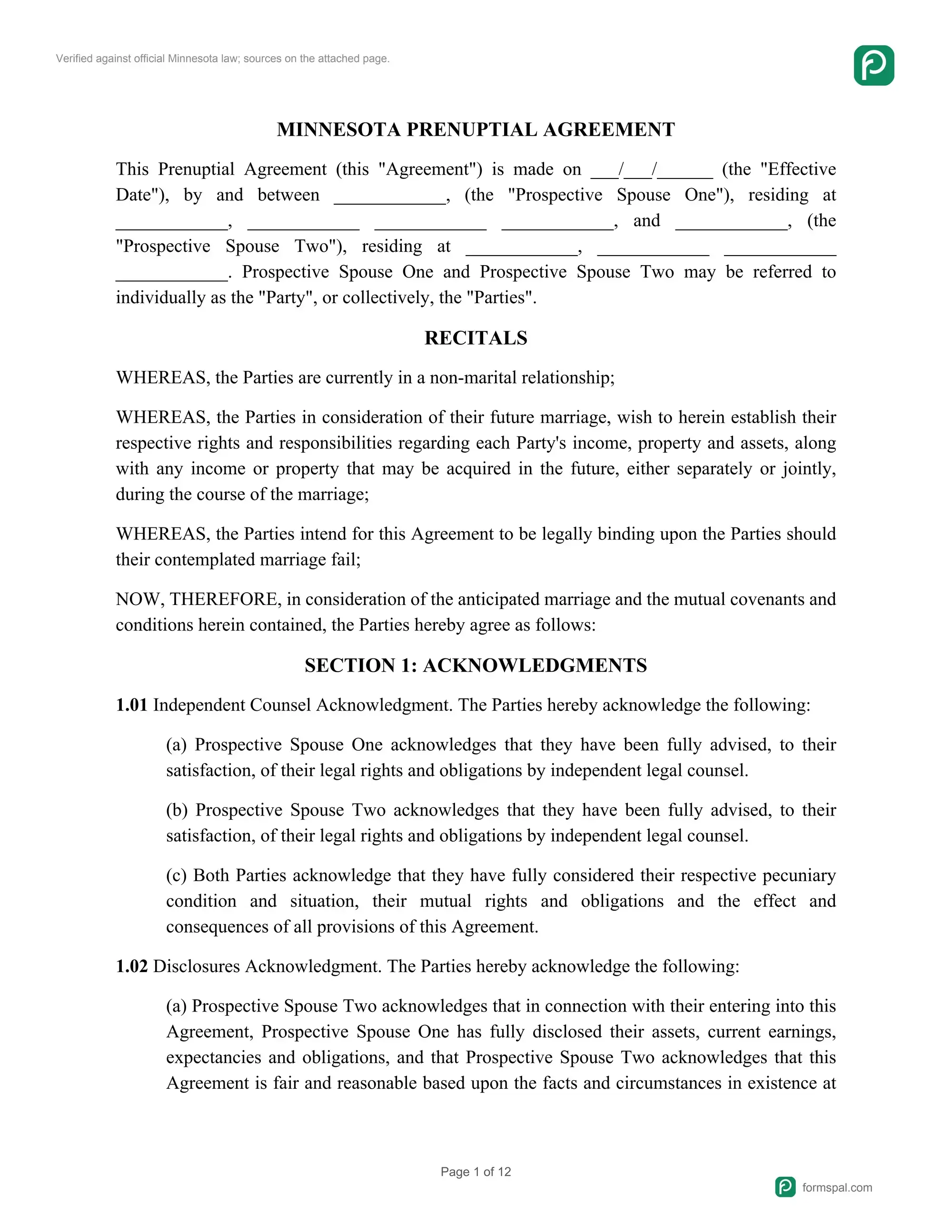
A Minnesota prenuptial agreement is a written contract two people sign before they marry. It decides what rights each spouse has in marital and nonmarital property, in spousal maintenance, and in the other's estate.[1] Section 519.11 of the Minn. Stat. sets the rules it has to meet.
The agreement binds the couple once they marry, and the marriage itself counts as the consideration for it.[1] It must be in writing, signed in front of two witnesses, and acknowledged before a person authorized to administer an oath.[1] It cannot reduce a child's right to support.
Build Your Document
Answer a few simple questions to make your document in minutes
Save and Print
Save progress and finish on any device, download and print anytime
Sign and Use
Your valid, lawyer-approved document is ready
It is a contract between two people who plan to marry, and Minnesota's statutes call it an antenuptial agreement. In it the couple decides what rights each of them will have in marital and nonmarital property. The same contract can settle spousal maintenance and what each may claim from the other's estate.[1] Section 519.11 of the Minn. Stat. holds the rules.
It can also bar each spouse from estate rights the document does not expressly secure for them.[1] Without one, the same questions are answered by a divorce court, or by the rights that chapter 524 of the Minn. Stat. otherwise confers on a surviving spouse.[1] Minnesota courts read antenuptial agreements against that statutory backdrop.
You and your partner sign it before the wedding, and neither of you has to pay the other anything for it. The marriage itself is adequate consideration for an agreement made in conformity with Section 519.11.[1] What the timing changes is who has to prove the agreement is good if it is ever challenged.
The seven-day mark decides where that burden falls:
Seven days is a floor, not a target. Signing weeks ahead of the wedding keeps the presumption and leaves room for the disclosure the statute requires.
Popular Local Prenuptial Agreement Forms
Section 519.11 of the Minn. Stat. governs every stage of Minnesota antenuptial agreements. It fixes the formalities the couple has to observe at signing. It sets the disclosure and counsel conditions that make an agreement procedurally fair. It also decides how close to the wedding you can leave the signature, and what it takes to change the document afterwards.[1]
Three formalities have to be met together, and missing any one of them leaves the agreement procedurally unfair.[1]
Sign the document yourself. A power of attorney does not satisfy that requirement.[1]
An antenuptial agreement is procedurally fair only if both people knew what they were signing away. Section 519.11 asks for full and fair disclosure of the current income and property of each party.[1] Neither of you can waive that disclosure requirement.[1]
Each party must also have had a meaningful opportunity to consult with independent legal counsel of that party's choosing.[1] The statute asks for the opportunity, not for a signed retainer. On top of that, the agreement has to be entered into voluntarily and free of duress.[1]
You cannot waive the disclosure. Some agreements try to say that each side gives up any right to see the other's finances. In Minnesota that clause does not work. A party must not waive the full and fair disclosure requirement.[1]
Section 519.11 of the Minn. Stat. lets a couple settle three things in advance, and together they cover most of what a divorce court or a probate court would otherwise decide for them. The statute names each one.[1]
The estate terms do real work. Spouses may bar each other of all rights in the respective estates not secured to them by their agreement.[1] Couples in a second marriage often use that to keep an inheritance pointed at children from the first.
Child support and child custody stay out of the document. Minnesota decides both on the best interests of the child, whatever the parents agreed before the wedding. The agreement also cannot cut away the disclosure the statute requires, because a party must not waive full and fair disclosure of the other's current income and property.[1]
Keep all of these out:
Yes. Minnesota courts enforce prenuptial agreements that meet the test in Section 519.11 of the Minn. Stat., and one that does is presumed enforceable. It has to be in writing, witnessed and acknowledged, backed by full and fair disclosure, signed voluntarily, and executed at least seven days before the marriage.[1]
An agreement that clears that bar is also easier to prove years later. One duly acknowledged and attested is prima facie proof of the matters acknowledged in it.[1] That is what the notary step buys you.
Enforceable is not the same as untouchable. A Minnesota court can still refuse an agreement whose terms are substantively unfair as to be unconscionable.[1]
Two tests can sink one. Minnesota courts look first at how the deal was made, and second at what is in it. Procedural fairness covers disclosure, counsel, voluntariness and timing.[1] Substantive fairness asks whether the terms are unconscionable, and the court weighs that separately.[1]
These are the grounds a Minnesota court can act on:
On that last ground the statute tells the court what to weigh:
the court shall consider whether all or part of the agreement is substantively unfair as to be unconscionable to a party either by the agreement's terms or as the result of drastically changed circumstances originally not foreseen when the agreement was created, such that enforcement would no longer comport with the reasonable expectations of the parties at the time that the parties executed the agreement.
Two limits sit on that review. A deviation from statutory standards does not in itself make an agreement unconscionable.[1] And where an antenuptial agreement unambiguously permits severability, the court may sever any unenforceable provision and enforce the remaining provisions.[1]
Not a prenup, but Minnesota does allow a postnuptial agreement, and the bar is higher. A postnuptial agreement is valid and enforceable only if at the time of its execution each spouse is represented by separate legal counsel.[1] Before the wedding the statute asks only for the chance to see a lawyer. After it, two attorneys are mandatory.
Timing matters even more once you are married. A postnuptial agreement is presumed to be unenforceable if either party starts an action for legal separation or dissolution within two years of the date the agreement was executed.[1] The spouse who wants to enforce it can still do so by establishing that it is fair and equitable.[1]
What a Minnesota postnuptial agreement needs:
A postnuptial agreement is also the only way to change an antenuptial one. An antenuptial agreement may be amended or revoked after the marriage only by a valid postnuptial agreement.[1]
Start early and work through the statute's conditions in order. Minnesota wants disclosure, a real chance to see a lawyer, a voluntary signature, two witnesses, an acknowledgment, and at least seven days between the signing and the wedding.[1]
If the agreement deals with real estate, you can record it with the county recorder in the county where the property is located.
Not for an antenuptial agreement. Section 519.11 asks that each party have a meaningful opportunity to consult independent legal counsel of their own choosing.[1] That is a chance to get advice, not an obligation to hire anyone. A postnuptial agreement is different, because there each spouse must be represented by separate legal counsel.[1]
Taking the opportunity is still the safer route. Disclosure and the chance to see a lawyer are two of the four procedural fairness conditions in the statute, and both of them get argued over later.[1] Many couples hand the drafting to family law attorneys for that reason, and Minnesota law leaves the choice to you.
Last Updated: September 2026. This guide is reviewed and updated regularly to reflect current Minnesota law. If you notice an error or outdated information, please contact us.

Other Prenuptial Agreement Forms by State