
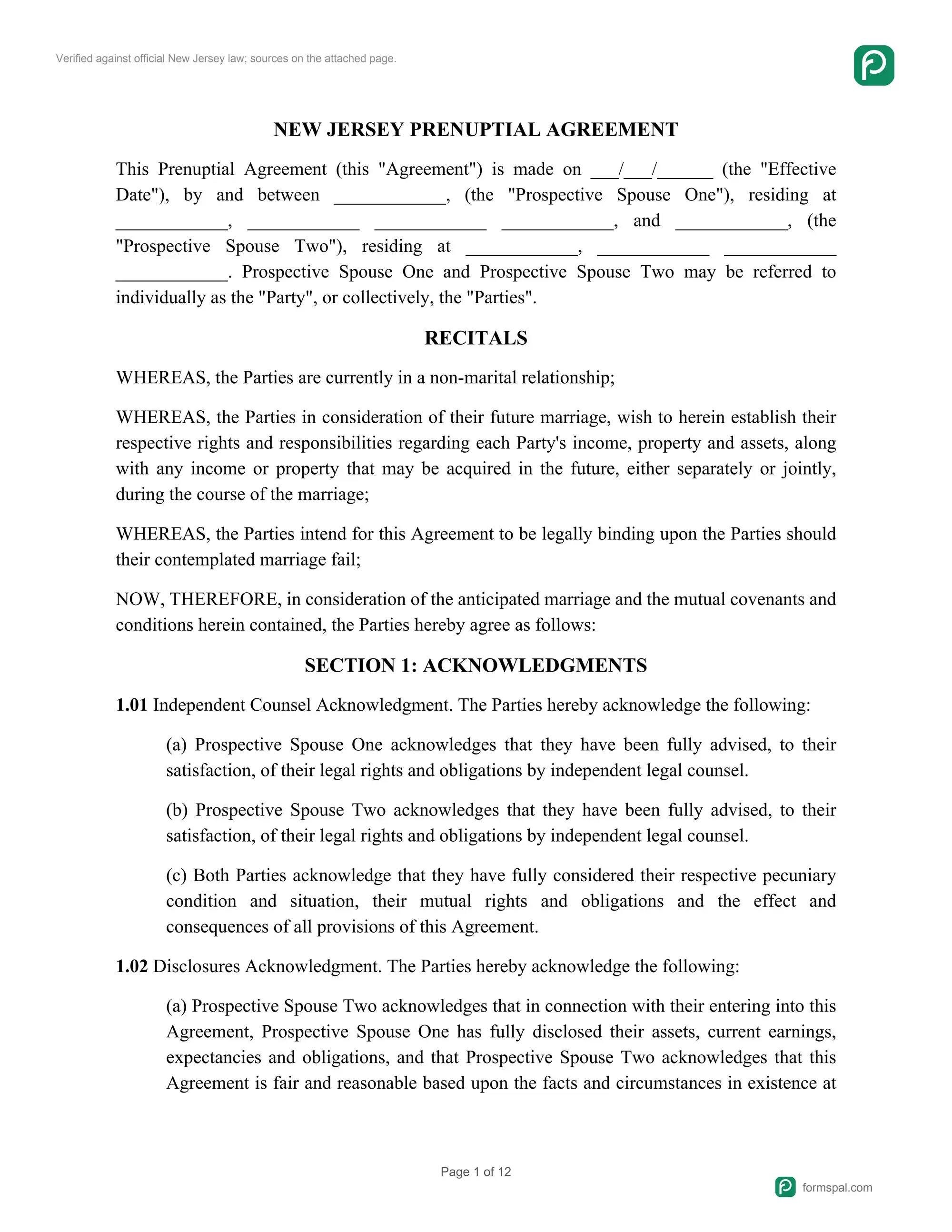
A New Jersey prenuptial agreement is a written contract that two people sign before they marry or enter a civil union.[3] It sets out how their property, debts and spousal support will be handled if the relationship ends.[4] State law calls it a premarital or pre-civil union agreement, and the same rules cover both.[2]
The statute sets three formal requirements. The agreement must be in writing, it must have a statement of assets attached, and both parties must sign it.[3] It takes effect only when the marriage or civil union begins.[6] It cannot cut down a child's right to support.[5]
Build Your Document
Answer a few simple questions to make your document in minutes
Save and Print
Save progress and finish on any device, download and print anytime
Sign and Use
Your valid, lawyer-approved document is ready
It is a contract between prospective spouses or civil union partners, made in contemplation of marriage and effective once that marriage or union begins. The statute treats a marriage and a civil union the same way, so the agreement covers either one on identical terms.[2] It fixes property and support terms in advance, so neither person has to argue them later. New Jersey enforces it without consideration, which means neither side has to pay or promise anything extra to make it binding.[3]
The agreement is not only about divorce. It can also say what happens to property when one spouse dies, when the couple separates, or when any other event the two of them name occurs.[4] A signed prenuptial agreement is legally binding on both spouses once the marriage begins.[6]
Prenuptial agreements here are governed by Title 37, Chapter 2 of the New Jersey Statutes Annotated. The article of that chapter is cited as the Uniform Premarital and Pre-Civil Union Agreement Act.[1] Eight sections set out the definitions, the required form, the permitted contents, the effective date, and the grounds for refusing to enforce the contract.
The act was written to cover couples entering a civil union as well as couples marrying, so every rule below applies to both.[2]
Section 37:2-33 sets the whole test, and it is short. The agreement must be in writing, it must have a statement of assets annexed to it, and it must be signed by both parties. Nothing else is required, because that same section binds the contract without consideration, so neither party needs to give the other anything of value in exchange.[3]
The statute does not call for witnesses and it does not require a notary.[3] An oral promise between an engaged couple does not meet the test, and neither does a signed document with no asset statement attached to it.
A premarital or pre-civil union agreement shall be in writing, with a statement of assets annexed thereto, signed by both parties, and it is enforceable without consideration.
Section 37:2-34 lists the permitted contents, and the list is broad. It reaches each party's rights in any property, wherever and whenever that property was acquired. It also reaches the right to manage or sell that property, what happens to it if the couple separates, divorces or one of them dies, and the choice of law that governs how the agreement is read.[4]
The full list of permitted subjects:[4]
Property is defined broadly for this purpose. It means an interest, present or future, legal or equitable, vested or contingent, in real or personal property, including income and earnings.[2] That wording reaches income not yet earned and interests that have not yet vested.
Popular Local Prenuptial Agreement Forms
Two limits apply to the contents. A premarital agreement cannot adversely affect the right of a child to support, so a clause that waives or caps child support fails to that extent. The catch-all in Section 37:2-34 permits any other matter only where it does not violate public policy, and that is the line a court applies to unusual clauses.[5]
Keep child-related terms out of the document. The right to support belongs to the child rather than to the parents, so the couple cannot trade it away between themselves. Custody, parenting time and guardianship are decided by the family court as well, not by the agreement. A clause covering any of them is wasted drafting at best. Keep the prenuptial agreement to financial matters between the two spouses.
A prenup cannot adversely affect a child's right to support.[5] Anything the couple writes about child support is measured against that rule, and the part that conflicts with it does not hold.
A premarital or pre-civil union agreement becomes effective upon the marriage of the parties, or upon the parties establishing a civil union. Signing the document does not by itself make it operative. If the couple never marries and never enters a civil union, the agreement never takes effect at all.[6]
Timing matters for a second reason. The statute covers agreements made in contemplation of marriage or a civil union, so a contract the couple signs after the wedding is a different instrument.[2] Couples in that position use a postnuptial agreement instead.
After marriage, the agreement may be amended or revoked only by a written agreement signed by both parties. A verbal understanding does not change it, and neither does the way the couple behaves. The amendment or revocation is itself enforceable without consideration, so neither party has to give anything up to make the change stick.[7]
Yes. New Jersey enforces these agreements, and the burden of proof to set one aside rests on the party alleging that it is unenforceable. Section 37:2-38 allows a court to set an agreement aside on two grounds only, and the challenging party has to prove one of them by clear and convincing evidence.[8]
The two grounds are that the party executed the agreement involuntarily, or that the agreement was unconscionable when it was executed.[8]
Unconscionability is narrow here. An agreement is not unconscionable unless one of the disclosure circumstances in subsection c. applies.[8] The court decides that question as a matter of law.[8]
A court may refuse to enforce the contract where the challenging party proves one of the following:[8]
You can. No lawyer is required to draft or sign a premarital agreement in New Jersey. The statute asks only for writing, a statement of assets annexed to the document, and the signatures of both parties.[3] Going without counsel carries one specific risk. A party who did not consult independent legal counsel, and did not waive that opportunity in writing, keeps a ground to challenge the agreement later.[8]
A prenuptial agreement template gives you the structure, and the steps below cover the content that goes into it. Each of you gives the other full and fair disclosure of earnings, property and financial obligations.[8]
The process has six steps. You each list what you own and owe, attach that statement to the agreement, write the property terms, settle the spousal support terms, take independent legal advice or waive it in writing, and sign before the wedding. Work through them in order, because each step depends on the one before it.
Last Updated: September 2026. This guide is reviewed and updated regularly to reflect current New Jersey law. If you notice an error or outdated information, please contact us.

Other Prenuptial Agreement Forms by State
Unless noted otherwise, the sources below are from the New Jersey Statutes Annotated.