
A Delaware quitclaim deed is a written form of deed that transfers the owner's interest in real estate to a new owner. Under the Delaware Code, a deed passes the interest the grantor could lawfully convey.[2.1] A quitclaim deed makes no promise that the title is clear. People often use quitclaim deeds to transfer property between relatives or spouses, or when both sides already trust the title.
Last Updated: October 2026. This guide is reviewed and updated regularly to reflect current Delaware law. If you notice an error or outdated information, please contact us.
Build Your Document
Answer a few simple questions to make your document in minutes
Save and Print
Save progress and finish on any device, download and print anytime
Sign and Use
Your valid, lawyer-approved document is ready
Deeds in Delaware fall under Title 25 of the Delaware Code, Chapter 1. Those sections cover how a deed transfers ownership of property, how it is acknowledged, where it is recorded and what address it must carry.
Section 121 of the 25 Del. C. sets out a statutory form of deed. A deed in that form, signed and acknowledged, passes the interest the grantor could lawfully convey, unless it is restricted or limited.[2.1]
A deed in the form prescribed in subsection (a) of this section, duly executed and acknowledged, unless otherwise restricted or limited, or unless contrary intention appears therein, shall be construed to pass and convey to the grantee therein and to the grantee's heirs and assigns the fee simple title or other whole estate or interest which the grantor could lawfully convey in and to the property therein described together with the tenements, hereditaments, franchises and appurtenances thereunto belonging, and the reversions and remainders, rents, issues and profits thereof.
In plain words, the grantor is the owner who signs and the grantee is the person who receives ownership. The statutory form:
Section 121 also gives the words "grant and convey" a set meaning in any Delaware deed.[2.1]
The words "grant and convey" in any deed shall, unless specifically restricted or limited operate as a special warranty against the grantor and the grantor's heirs and all persons claiming under the grantor or them.
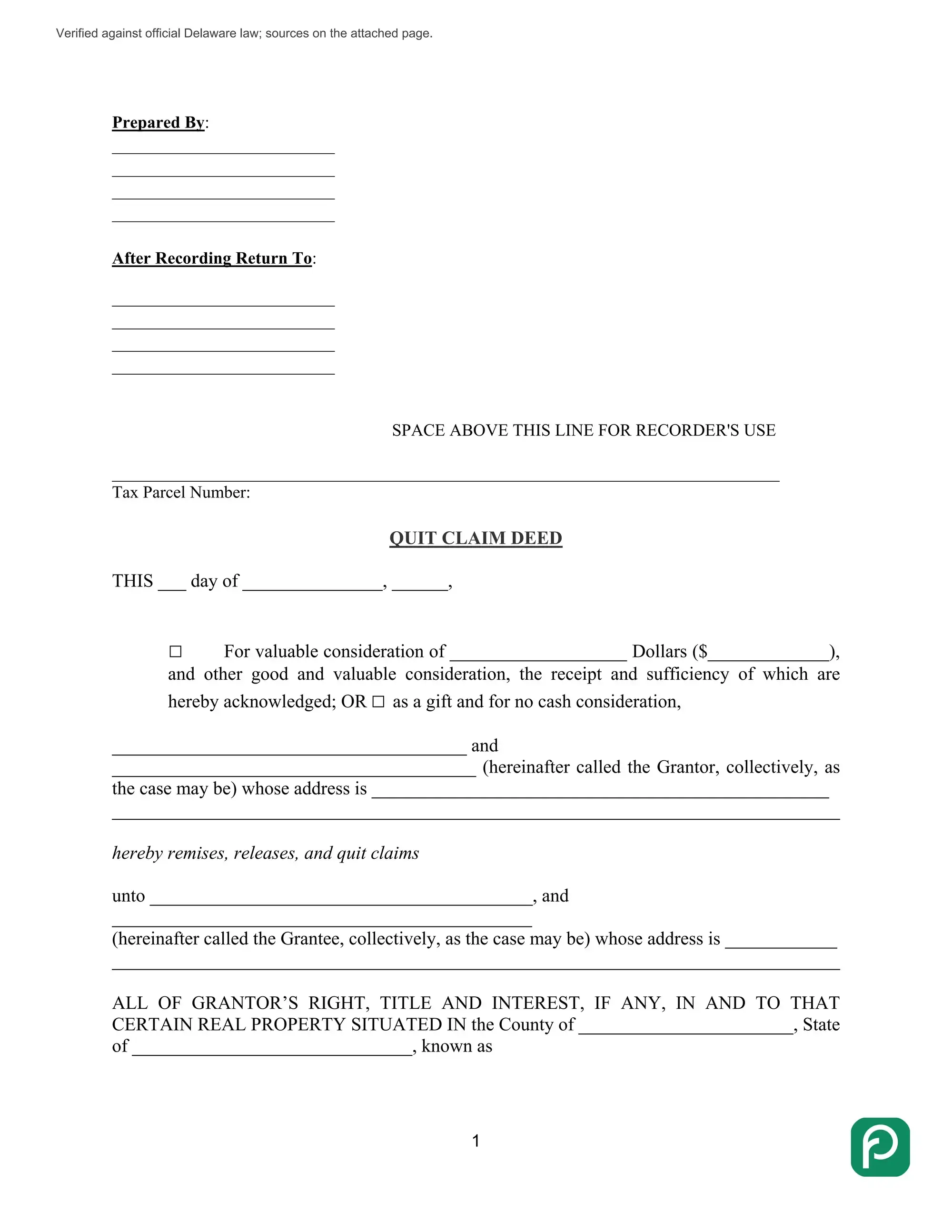
In plain words, those words carry a promise from the owner who signs unless the deed says otherwise. The FormsPal form uses the words "remises, releases, and quit claims". Its paragraph on page 2 states that the property is quit claimed without warranty.
Under Section 151 of the 25 Del. C., a deed concerning land must be acknowledged or proved. The acknowledgment or proof must also be certified as the chapter provides.[1.1] To acknowledge a deed means to confirm formally that you signed it.
Under Section 122 of the 25 Del. C., the deed may be acknowledged before the Superior Court, a Delaware judge, a notary public, two justices of the peace or the Mayor of Wilmington, or proved in the Superior Court by one or more subscribing witnesses.[2.3] The FormsPal form includes a notary block on page 5.
Section 153 of the 25 Del. C. says a deed concerning land has priority from the time it is recorded in the proper office. The time it was signed, sealed and delivered does not matter.[1.2] In plain words, the recording date sets the place in line, not the signing date.
The acknowledged deed is recorded in the recorder's office for the county where the land, or any part of it, lies (Section 151 of the 25 Del. C.). Recording in one county affects only the land in that county (Section 152).[1.3]
Under Section 154 of the 25 Del. C., an acknowledged or proved deed may be recorded at any time in the recorder of deeds office for the county where the land lies. Because priority runs only from recording under Section 153, waiting to record carries risk.[1.4]
When the deed is recorded, it must state its full value or be accompanied by an affidavit of value (Section 5409 of the 30 Del. C.). A nonresident individual who sells Delaware real estate must also file a declaration of estimated income tax with the Recorder before the deed is recorded (Section 1126 of the 30 Del. C.).[3.1]
Recording fees are set by county ordinance (Sections 9617 and 9619 of the 9 Del. C.), so check the fee with the county Recorder of Deeds.[4.1]
Under Section 133 of the 25 Del. C., anyone leaving a deed for record must place the address of the grantee on the deed or attach it to the deed. The address is required for recording.[2.2] On the FormsPal form, write the mailing address on the line after the grantee's name.
Use the FormsPal Delaware quit claim deed form by working through its blanks in the order they appear. The form runs five pages, and page 3 is blank. Gather the details below first, then follow the numbered parts to complete the transfer on paper.
Gather these details before you start:
After you download the PDF, you can fill it in on screen with our PDF editor or print it and write by hand.
Once the deed is signed and acknowledged, record it as described in the recording section above.
The answer below comes from the Delaware Code sections cited earlier on this page. It describes what the statute says about the deed itself, and it does not cover taxes, fees or the rules in any other state.
A quitclaim deed passes whatever interest the owner has in the property described to the grantee. In Delaware, a deed in the statutory form passes the interest the grantor could lawfully convey. Unless the deed restricts or limits them, the words "grant and convey" act as a special warranty against the grantor.[2.1] To record a deed, the grantee's address must be placed on the deed or attached to it.[2.2]
General information, not legal or tax advice.

