
A Kentucky quitclaim deed is a written document that passes whatever interest the grantor holds in real estate to the grantee, and nothing more.[1] The grantor is the person giving up the interest, and the grantee is the person receiving it. The form is often used between family members and others who already know each other. Download the free form below or build one online in minutes.
Last Updated: October 2026. This guide is reviewed and updated regularly to reflect current Kentucky law. If you notice an error or outdated information, please contact us.
Build Your Document
Answer a few simple questions to make your document in minutes
Save and Print
Save progress and finish on any device, download and print anytime
Sign and Use
Your valid, lawyer-approved document is ready
Use this form of deed when property moves between people who know each other, such as family members. A quitclaim deed gives the grantee only what the grantor holds, so a buyer who needs more assurance about the title should ask about that before signing.
A Kentucky deed has to meet a short list of rules before a county clerk can record it. Section 382.135 of the Kentucky Revised Statutes (KRS) lists what the deed must contain, and Section 382.130 covers how the deed is acknowledged.[2][3] The sections below walk through each rule in plain words.
Under KRS 381.150, a quitclaim deed passes all of the grantor's right, title and interest in the property described, unless the deed itself limits the grant. It conveys nothing more than the interest the grantor holds at that time. If a deed claims to pass more than the grantor can lawfully pass, it conveys only the right and estate the grantor can lawfully convey.[1]
Section 382.130 says a deed may be admitted to record on the acknowledgment of the party who made it, made before the proper clerk.[2] The statute reads:
Deeds executed in this state may be admitted to record: on the acknowledgment, before the proper clerk, by the party making the deed
In plain words, the grantor (the person making the deed) acknowledges it before the proper clerk. An acknowledgment is the grantor's formal confirmation that the signature is theirs. A deed must be acknowledged or proven this way to be recorded.
To be recorded, the deed must be acknowledged by the grantor before a county clerk or a notary public, or proved by two subscribing witnesses (KRS 382.130). A notary and witnesses are alternative routes to recording, so the deed does not need both.[2]
Under Section 382.135, a deed to real property must contain the following:[3]
Where property is exchanged, the fair cash value of the property being exchanged must also be stated in the body of the deed.
The deed must also carry a sworn, notarized certificate. Which one depends on the transfer:[3]
The grantor and the grantee sign the certificate, or their agents do. A parent or guardian signs for a person under 18.
A county clerk or deputy clerk may not accept for recording a deed that does not comply with Section 382.135.[3] Check the deed against the lists above before you file it. Under KRS 382.110(1), the deed is recorded in the county clerk's office of the county where the property, or the greater part of it, is located.[4]
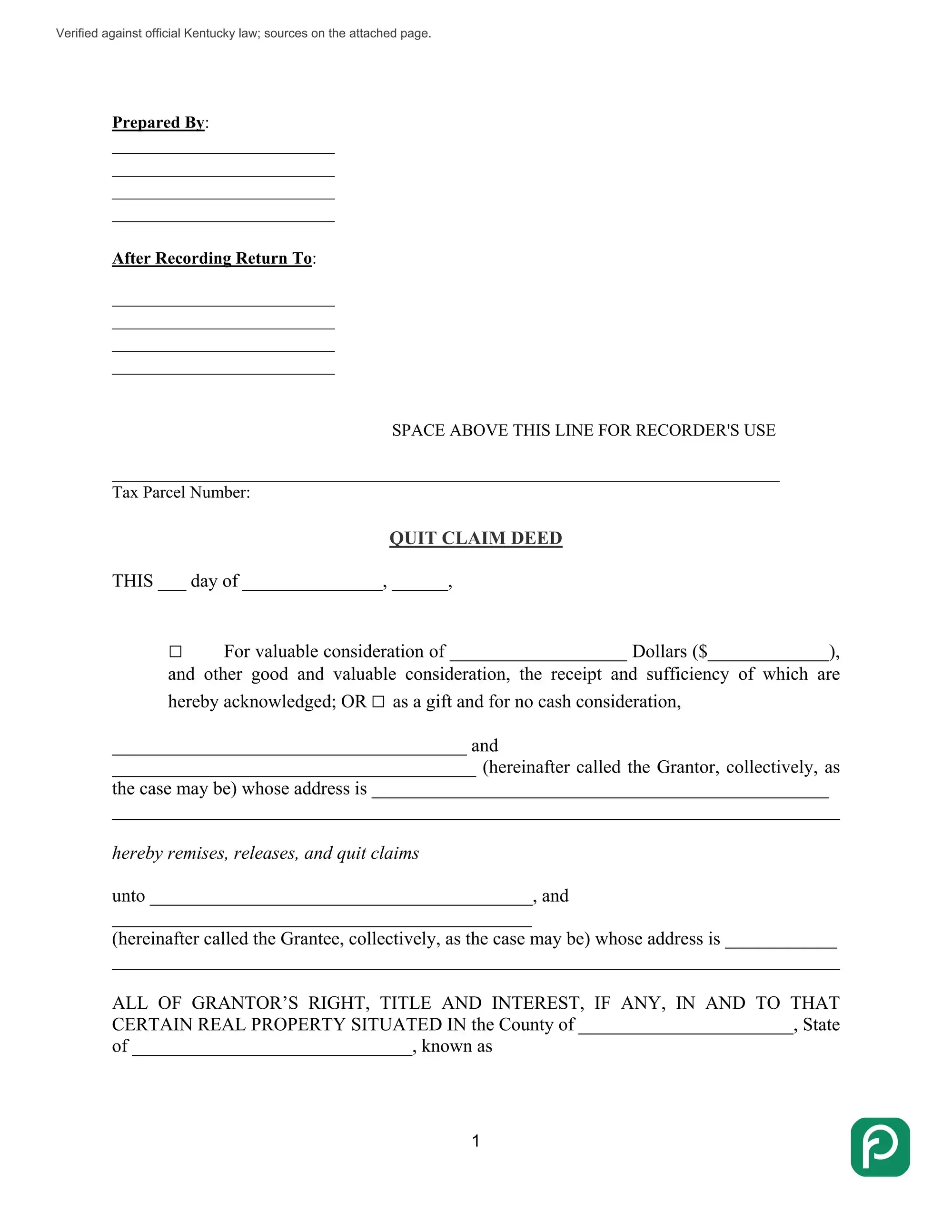
The FormsPal Kentucky quitclaim deed runs eight pages, and page 3 is blank on purpose. Fill in the parts below in order, then take the signed deed and certificate to the county clerk. You can complete the PDF in our PDF editor or print it and write by hand.
Keep a copy of the signed and notarized deed for your records before you file the original.
Below is a short answer to a common question about a Kentucky quitclaim deed. It rests on the statutes linked in the source list. For advice on your own deed, ask a Kentucky attorney.
Fill in the deed with the full names and mailing addresses of the grantor and the grantee. Add the in-care-of address for the property tax bill and a statement of the full consideration.[3] Add the sworn, notarized certificate that matches the transfer, and have the grantor acknowledge the deed.[2] The county clerk may not accept a deed that does not meet these rules.[3]

General information, not legal or tax advice.
Every legal statement on this page comes from one of the three Kentucky Revised Statutes sections listed here. Open a link to read the full text of the section, and check it again before you rely on it for a filing.
