
A Mississippi quitclaim deed is a written document that transfers whatever interest the person signing it (the grantor) has in a piece of land to another person (the grantee). It passes only the grantor's own title, so the person receiving it should check the property's history first.[1.1] People commonly use a quit claim deed to move land between family members or to clear up a title question. Download the form above or create one online.
Last Updated: October 2026. This guide is reviewed and updated regularly to reflect current Mississippi law. If you notice an error or outdated information, please contact us.
Build Your Document
Answer a few simple questions to make your document in minutes
Save and Print
Save progress and finish on any device, download and print anytime
Sign and Use
Your valid, lawyer-approved document is ready
A Mississippi quitclaim deed has to meet four points of state law. It is a signed and delivered writing, it passes title as the statute describes, it is acknowledged or proved, and it is recorded with the chancery clerk. Each point comes from the Mississippi Code and is explained below.
If the transfer is a sale of a home with one to four dwelling units handled by a licensed real estate broker or salesperson, the seller must give the buyer a property condition disclosure statement before title transfers (Sections 89-1-501 and 89-1-503 of the Miss. Code Ann.). Transfers between co-owners, to a spouse or lineal relative, and of land with no dwelling are excluded.[1.3]
A deed that follows the statutory form is enough to convey the grantor's interest in the property it describes. An equivalent instrument that makes the transaction plain is not invalid because it lacks the statutory wording.[1.1] The statute describes the effect of the writing this way:
Such writing shall have the effect to transfer, according to its terms, the title of the person signing and delivering it, with all its incidents, as fully and perfectly as if it were transferred by feoffment with livery of seizin, notwithstanding there may be an adverse possession thereof.
The deed passes only the title the grantor actually holds. Anyone accepting a quitclaim deed should check the property's history and title first.
A quitclaim and release passes all the estate or interest the grantor has in the land, and it bars the grantor and his heirs from later asserting an adverse title acquired afterward (Section 89-1-39 of the Miss. Code Ann.).[1.4]
An estate in land, meaning ownership for life or by inheritance, or a lease of more than one year, can be conveyed only by a writing that is signed and delivered. A spoken promise to give someone land does not do it. The grantor signs the deed and hands it over to the grantee.[1.2]
An estate of inheritance or freehold, or for a term of more than one (1) year, in lands shall not be conveyed from one to another unless the conveyance be declared by writing signed and delivered.
Conveyances of land, including deeds of trust and mortgages, are void as to creditors and later purchasers for valuable consideration without notice. The exception is a deed that is acknowledged or proved and lodged with the clerk of the chancery court of the proper county to be recorded. Limited exceptions appear in Sections 89-5-101 through 89-5-113.[3] The form has a notary block on page 5.
Recording protects the deed against third parties. A conveyance of land is not good against a purchaser for valuable consideration without notice, or against any creditor, unless it is lodged to be recorded. The deed is lodged with the clerk of the chancery court of the county where the land is situated.
After filing, the order in which deeds were filed decides priority between competing conveyances of the same land. Limited exceptions appear in Sections 89-5-101 through 89-5-113.[2]
Section 89-5-24 of the Miss. Code Ann. sets format standards for any document presented to the chancery clerk for recording, including single-sided pages, type of at least ten points, white twenty-pound paper, signatures in black or blue ink with the name typed beneath, a three-inch top margin with three-quarter-inch margins elsewhere, and the property's legal description on the first page below that top margin. A document that does not meet these standards is still recorded on payment of an additional fee, and the defect does not affect its validity.[1.5]
The chancery clerk's fee for recording a deed is $25.00 for the first five pages and $1.00 for each additional page (Section 25-7-9 of the Miss. Code Ann., in the fee schedule in force through December 31, 2027).[1.6]
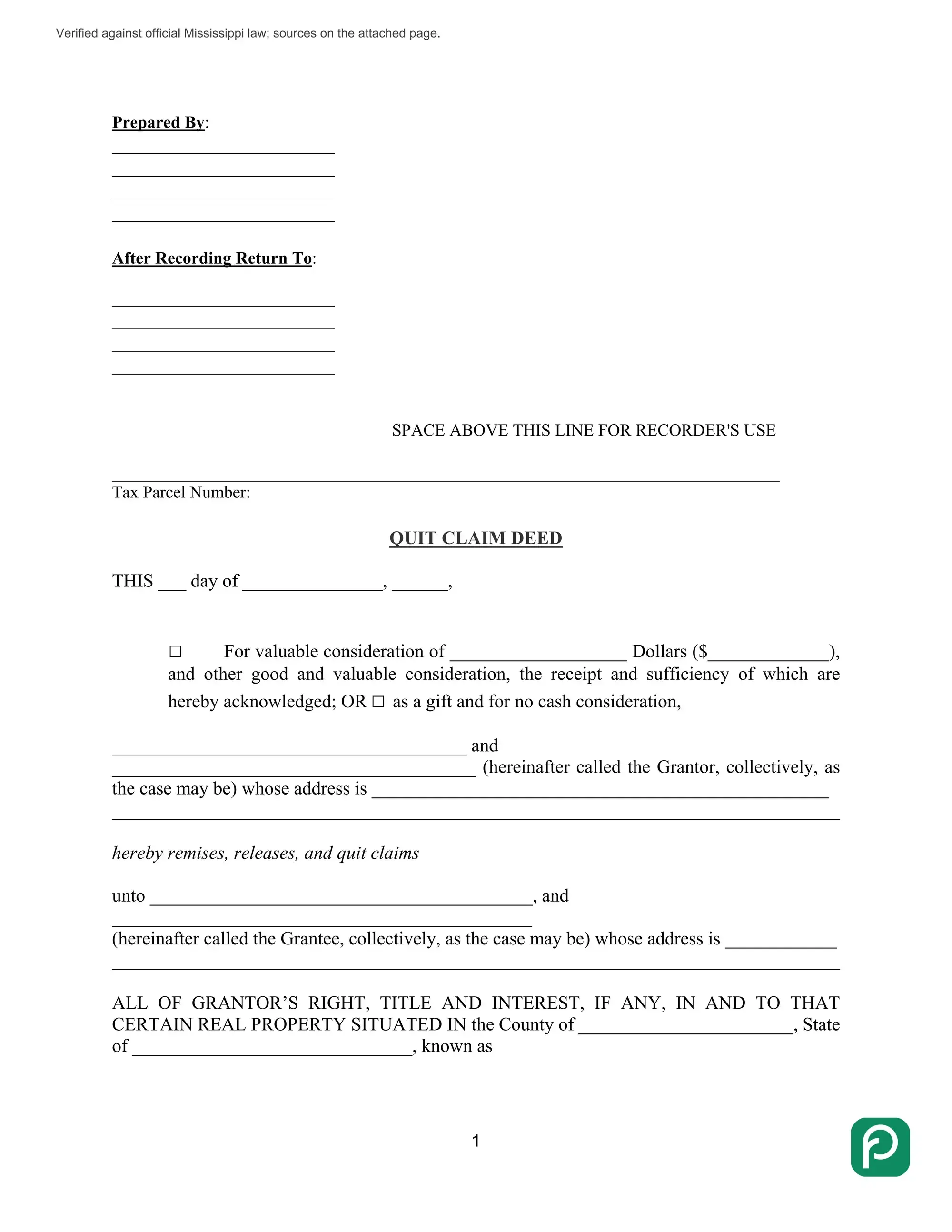
The Mississippi quitclaim deed form follows a fixed order, and the steps below match it part by part. Download the form above or create one online, then work through each part. You can also browse quitclaim deed forms for other states or our full set of deed forms.
Once the deed is signed and acknowledged, it is lodged with the clerk of the chancery court of the county where the land is situated to be recorded.[2]
Tip: Print a blank copy and practice on it first, using made-up names such as Anna Baker and Ben Carter. Then fill out the final copy and keep a copy of the signed deed for your records.
It transfers, according to its terms, the title of the person who signs and delivers it, with all its incidents. The statute says this works as fully and perfectly as an old common-law transfer by feoffment with livery of seizin. It holds even if someone else is in adverse possession of the land.[1.1]

General information, not legal or tax advice.
Unless noted otherwise, the sources below are from the Mississippi Code.
