
Updated:
A Vermont quitclaim deed is a deed with no warranty of title. Under 27 V.S.A. § 341, the grantor signs it and acknowledges it before a notary public. This guide covers what the deed includes, who signs it and how to record it.
Key facts
Build Your Document
Answer a few simple questions to make your document in minutes
Save and Print
Save progress and finish on any device, download and print anytime
Sign and Use
Your valid, lawyer-approved document is ready
A Vermont quitclaim deed transfers whatever interest the grantor holds in Vermont land to the grantee, without any promise that the title is clear or that the grantor owns the property at all.
The grantor is the owner who gives up the interest. The grantee is the person who receives it. The deed passes the grantor's share as it stands: a full title, a part share, or nothing if the grantor holds nothing.
A quitclaim deed is one of several forms of deeds. The quitclaim deed guide covers the same document in other states.
A quitclaim deed differs from a warranty deed in one point: the warranty deed carries the grantor's promises about the title, and the quitclaim deed carries none.
A warranty deed gives the grantee a claim against the grantor if a defect in the title turns up later. A quitclaim deed gives no such claim. A buyer who pays full value for land usually asks for a warranty deed for that reason.
The grantee takes the property as it is, potentially with all attached liens, claims or other encumbrances, because the grantor does not warrant the quality of the title.
If a title problem appears later, the grantee has limited legal recourse against the grantor. A title search before signing shows the liens and claims already listed against the land.
A Vermont quitclaim deed suits a transfer between people who know the property and each other, where no buyer pays market value and nobody needs a promise about the title.
Common reasons to use one:
A quitclaim deed is a poor fit for a sale to a stranger, because the buyer pays for the property and gets no promise about the title in return.
In a financed sale, ask the lender which deed it accepts before anyone signs. A warranty deed is the usual choice when the buyer wants the grantor to stand behind the title.
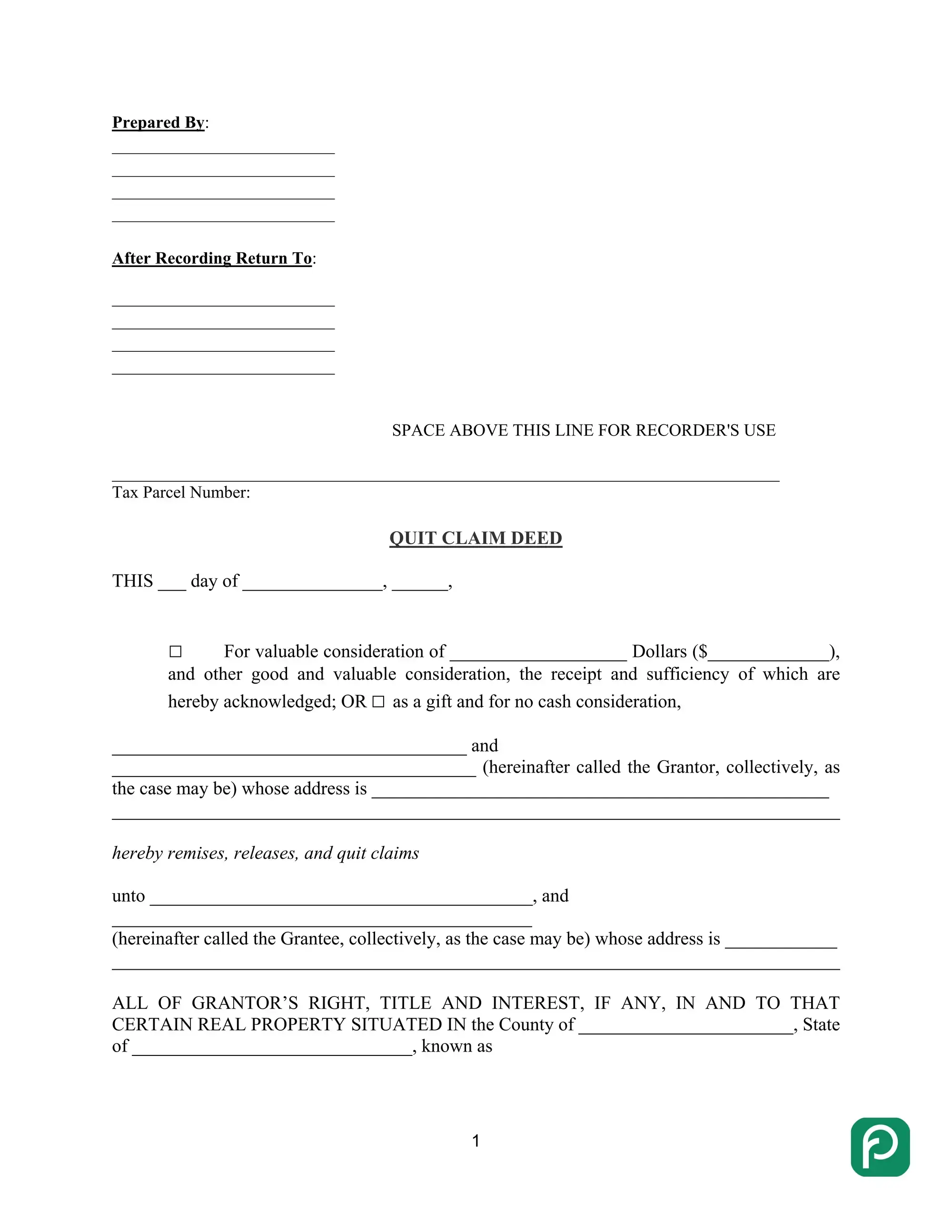
A Vermont quitclaim deed names the parties, describes the land, states the amount paid and closes with the grantor's signature and a notary's acknowledgment.
Gather these details before you fill in the form:
The legal description identifies the land by its boundaries or its lot and survey reference, and the deed copies it exactly from the grantor's current deed.
A long description goes on a separate page labeled "Exhibit A", and the deed refers to that exhibit. A street address alone is not a legal description.
The consideration is the amount the grantee pays for the property, and the deed states it in numbers and in words when there is a payment.
For a gift, the amount line shows that no money changes hands. A price is written twice, once in numbers and once in words, and the two match.
The form asks for the Tax Parcel ID Number and the homestead status of the property, so the deed points to the right parcel in the town's tax listings.
The parcel number appears on the property tax bill and on the current deed. The homestead status marks whether the property is used as a main home.
A Vermont quitclaim deed is signed by the grantor and acknowledged before a notary public, as 27 V.S.A. § 341 requires for every deed or conveyance of land or of an interest in land.
27 V.S.A. § 341 names the signature of the party granting the land; it sets no signature line for the grantee. The notary acknowledgment is the grantor's statement to the notary that the signature is the grantor's own act.
The signing takes place in front of the notary, with the deed filled in and unsigned.
A Vermont quitclaim deed is recorded at length in the clerk's office of the town in which the land lies, under 27 V.S.A. § 341, not with a county office.
Recording puts the transfer in the town's land records, where a later buyer, lender or title searcher looks for it. The town clerk charges a recording fee; ask the clerk's office for the current amount before the visit.
A property transfer return goes to the town clerk at the time the deed is delivered for recording, in the case of a transfer by deed, under 32 V.S.A. § 9606(a)(1).
Under 32 V.S.A. § 9608(a), no town clerk records or receives for recording a deed without a properly executed transfer tax return attached, except a transfer exempt under 32 V.S.A. § 9603(17).
The return travels with the deed, so prepare both before the trip to the clerk's office.
Recording follows the signing, at the clerk's office of the town where the land lies.
A Vermont quitclaim deed is filled out in five parts: the parties, the payment, the land, the tax details and the signature block, each copied from papers the grantor already holds.
Read the whole form once more before the signing. A misspelled name is easier to fix before the notary sees the deed.
Yes, the deed is acknowledged by the grantor before a notary public under 27 V.S.A. § 341.
The deed is recorded at length in the clerk's office of the town in which the land lies, under 27 V.S.A. § 341.
Yes, in the case of a transfer by deed, a property transfer return is delivered to the town clerk when the deed is delivered for recording (32 V.S.A. § 9606(a)(1)).
No, a quitclaim deed transfers only the grantor's interest and does not release a mortgage, lien or other claim on the property. Talk to the lender before quitclaiming mortgaged land.
Yes, "quick claim deed" is a common misspelling of quitclaim deed, the deed that passes an owner's interest with no warranty of title.
Look at your current deed or your closing papers. Copy the description exactly as it is written, and attach it as “Exhibit A” if it is long.

General information, not legal or tax advice.
