
A Wyoming quitclaim deed is a written document that passes the ownership interest the grantor (the person giving up the property) holds to the grantee (the person receiving it).[1.1] It carries no implied warranty of title, in contrast to other property deed types, such as a general warranty deed or a special warranty deed, that give explicit guarantees about the title's clarity and history.[1.4] The grantee takes the property as it stands, with any title problems.
Last Updated: October 2026. This guide is reviewed and updated regularly to reflect current Wyoming law. If you notice an error or outdated information, please contact us.
Build Your Document
Answer a few simple questions to make your document in minutes
Save and Print
Save progress and finish on any device, download and print anytime
Sign and Use
Your valid, lawyer-approved document is ready
In practice, people often use quitclaim deeds to move property between family members. Common examples are adding a spouse to the title, moving real estate into a family trust, or finishing an informal agreement after a divorce. A quitclaim deed fits best when the parties trust each other, because the grantee takes the property with no promise about the title. For a plain gift of property, a gift deed is a related option.
A Wyoming quitclaim deed passes all the estate the grantor could lawfully convey, and nothing more. The deed must be acknowledged by the party executing it, the grantor, before any notarial officer. Recording the deed protects the grantee against later buyers who act in good faith and record first.[1.1][1.2][1.3]
You may also see this document written as a quit claim deed, with the word split in two. Both spellings name the same document.
Wyoming law sets out what a deed of quitclaim and release does in a few short rules. Together they define what the grantee actually receives:
A deed of quitclaim and release shall be sufficient to pass all the estate which the grantor could lawfully convey by deed of bargain and sale.
Wyo. Stat. Ann. § 34-1-113 says a deed must be acknowledged by the party or parties executing it before any notarial officer.[1.2] Wyoming does not require you to sign in the notary's presence: an acknowledgment is your declaration before the notarial officer that you signed the deed knowingly and willingly (Wyo. Stat. Ann. § 32-3-102). The officer must confirm your identity from satisfactory evidence before certifying it, so bring photo ID (§ 32-3-111).[2.1]
Under Wyo. Stat. Ann. § 34-1-120, a conveyance of real estate that is not recorded as required by law is void as against a later buyer. That buyer must act in good faith, pay valuable consideration for the same property, and have the conveyance recorded first.[1.3]
After signing, take the acknowledged deed to the county clerk's office for the county where the land lies. Under Wyo. Stat. Ann. § 34-1-118, the certificate of acknowledgment entitles the deed to be recorded in that office.[1.6]
Wyoming requires a sworn statement of the sale details with the deed: the grantee or the grantee's agent signs a statement under oath giving the names and addresses of both parties, the date of transfer, the legal description and the full amount paid, and the county clerk will not record the deed until it is received (Wyo. Stat. Ann. § 34-1-142).[1.7]
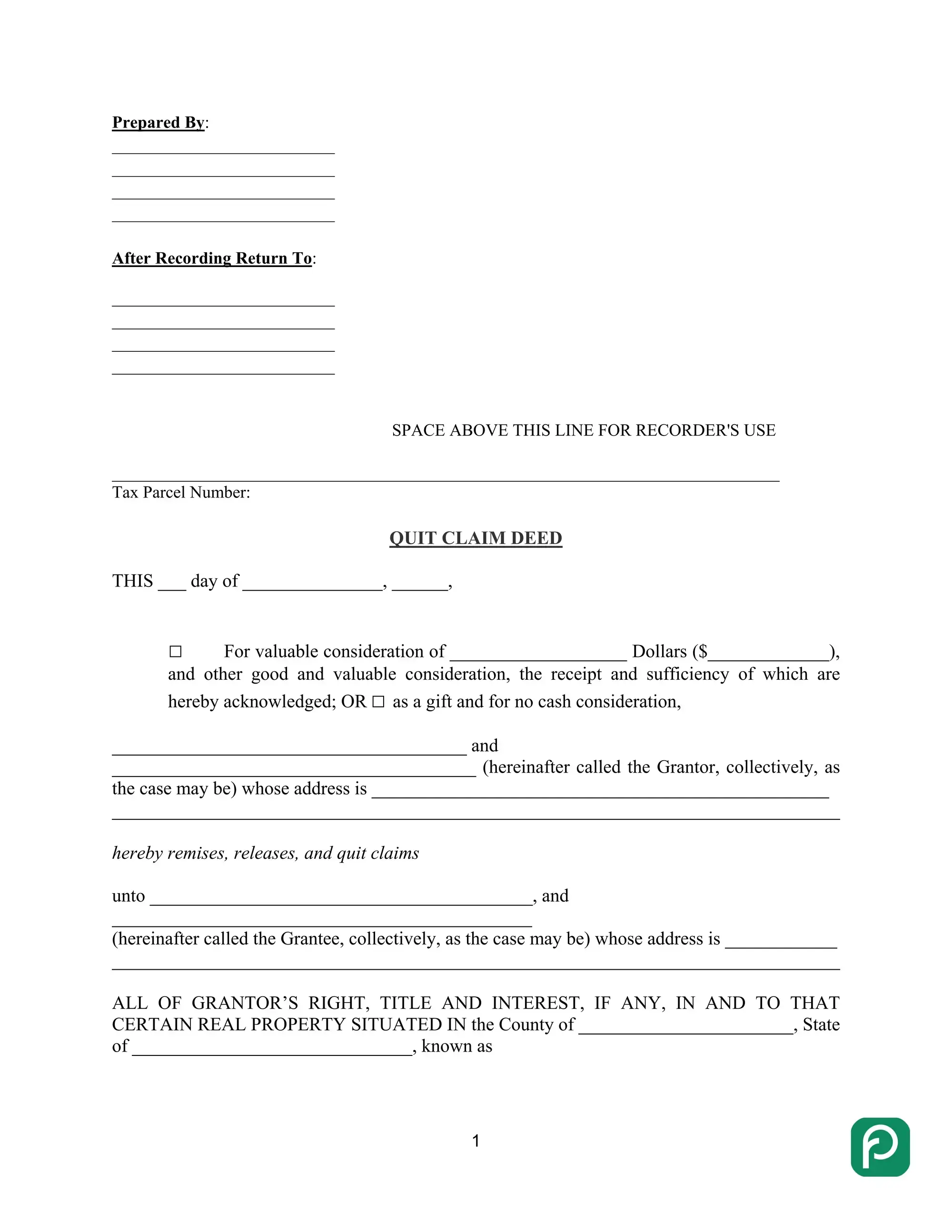
Wyoming's statute offers a short quitclaim form that names the grantor and the grantor's place of residence, the consideration, the grantee and a description of the real estate (Wyo. Stat. Ann. § 34-2-104), and a deed in substance in that form is a sufficient quitclaim under § 34-2-105.[1.8] An equivalent instrument that makes the parties' transaction plain is not invalid for want of the statutory wording.[1.1] The FormsPal Wyoming quitclaim deed form names the grantor and the grantee and gives an address for each. It also states whether the transfer is for payment or a gift and identifies the property by county, state and parcel.
The Wyoming quitclaim deed form runs from the header blocks on page 1 to the notary section on page 5. Fill in each part in order, then sign and have the acknowledgment completed. The steps below follow the form's own order and labels.
After the notary completes the acknowledgment, make a copy for your records and record the original as described under Recording Requirements.
These answers about a Wyoming quitclaim deed rest on the Wyoming statutes cited at the end of this page. Each one is short and points to the section it comes from. They cover three common questions that people ask before they sign or record a deed:
Fill in the Wyoming quitclaim deed form from top to bottom, then sign it and have it acknowledged before a notarial officer.[1.2] A deed in the statutory form is sufficient to pass all the estate the grantor could lawfully convey.[1.1] By itself, it implies no covenant and does not pass title the grantor acquires later.[1.4][1.5]
The deed passes the grantor's right, title and interest in the property described, and nothing more than the interest the grantor then holds.[1.1] No covenant of title is implied, and the deed does not extend to after acquired title unless it says so.[1.5] Recording it protects the grantee against a later good-faith buyer.[1.3]
A deed of quitclaim and release is sufficient to pass all the estate the grantor could lawfully convey by deed of bargain and sale, so it can transfer property to a buyer.[1.1] The buyer receives only what the seller holds, with no implied warranty of title.[1.4]

General information, not legal or tax advice.
