
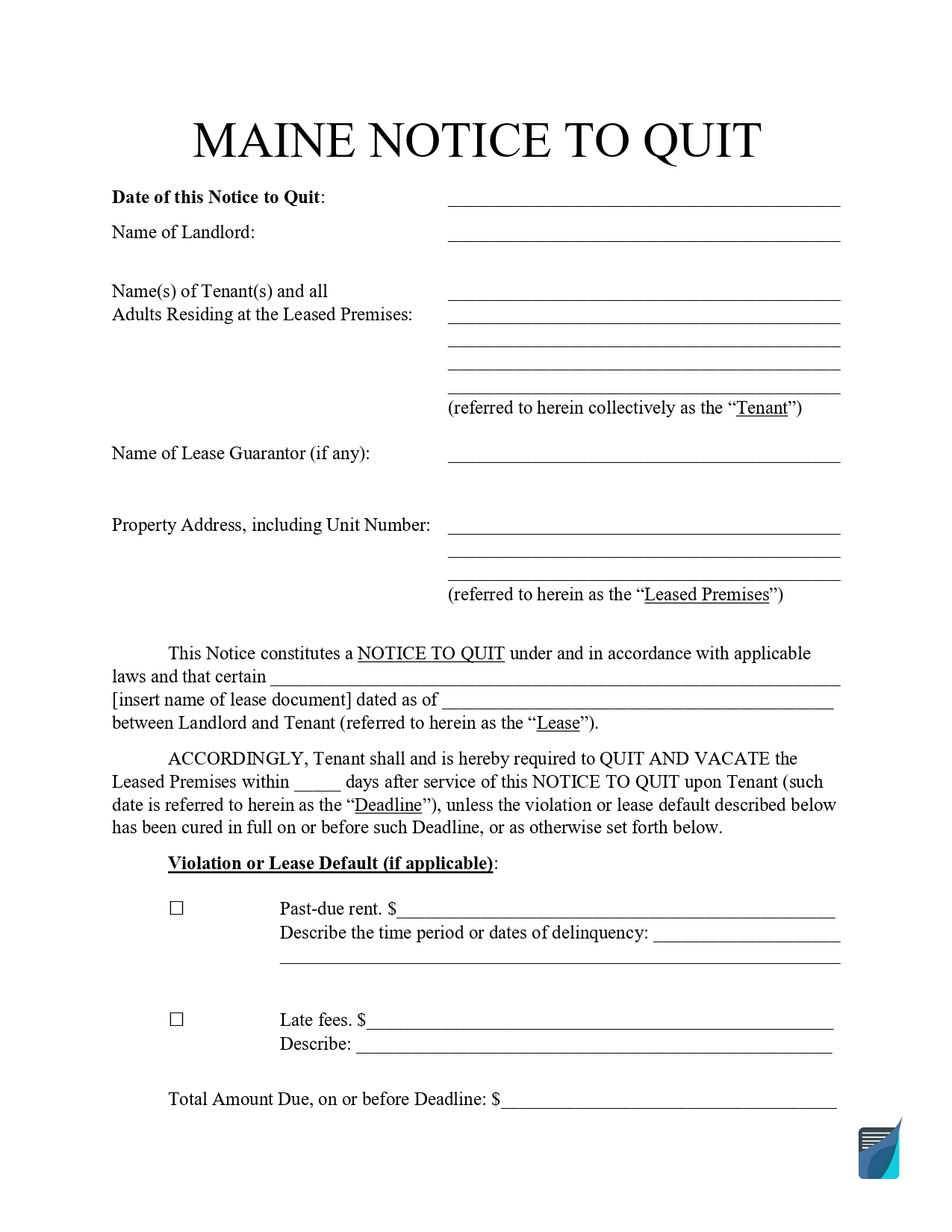
A Maine eviction notice is a written notice a landlord serves on a tenant to end the tenancy for nonpayment of rent, property damage, a nuisance, or without cause. It comes before the landlord files a case in court. The reason for the notice sets its length. A landlord can give seven days' notice for nonpayment, property damage, or a nuisance, and must give thirty days' notice to end a tenancy at will without cause.[1]
Last Updated: September 2026. This guide is reviewed and updated regularly to reflect current Maine law. If you notice an error or outdated information, please contact us.
Build Your Document
Answer a few simple questions to make your document in minutes
Save and Print
Save progress and finish on any device, download and print anytime
Sign and Use
Your valid, lawyer-approved document is ready
A landlord cannot remove a tenant or a tenant's belongings without going through the courts first.[2] A tenant can void the rent portion of a nonpayment notice by paying what is owed before the notice period ends. The tenant can also get the tenancy reinstated later by paying all rent owed and the landlord's filing and service fees before the court issues a writ of possession.[1]
Maine law sets the eviction notice period by the reason for the notice. A landlord who wants to end a tenancy at will without cause must give thirty days' written notice. A landlord with proof of unpaid rent, property damage, or a nuisance can give seven days' notice instead. Every notice must name the specific ground for the eviction and tell the tenant they have the right to contest it in court.[1]
Maine's eviction notice is sometimes called a "notice to quit." Both names refer to the same document.
Maine law also sets how a notice must be delivered. A landlord or their agent must make at least three good faith attempts to serve the tenant in hand before switching to mail. When personal service fails, the landlord can switch to mail. The landlord mails the notice by first class mail to the tenant's last known address and also leaves a copy at the tenant's last and usual place of abode.[1]
When the ground is unpaid rent, the notice must also state the amount of rent owed as of the notice date.[1] It must also include a specific statutory warning about what paying does to the notice. Maine law requires this exact language on the notice:
If you pay the amount of rent due as of the date of this notice before this notice expires, then this notice as it applies to rent arrearage is void. After this notice expires, if you pay all rental arrears, all rent due as of the date of payment and any filing fees and service of process fees actually paid by the landlord before the writ of possession issues at the completion of the eviction process, then your tenancy will be reinstated.
In practice, that means a tenant can void the rent portion of the notice by paying what is owed before the notice period ends. The tenant can still get the tenancy reinstated later by paying all arrears, current rent, and the landlord's filing and service fees before the court issues a writ of possession.[1]
For example, suppose a landlord serves Ben Carter a nonpayment notice for last month's rent. Ben can void the rent portion of that notice by paying what he owes before the seven days run out. If Ben instead lets the notice expire, his case may go to court. He can still keep his tenancy by paying all the rent he owes, the current rent, and the landlord's filing and service fees before the court issues a writ of possession.
A rent payment is late for late-fee purposes only if it is not made within 15 days of the due date, and a late penalty may not exceed 4% of one month's rent and requires written notice at the start of the rental agreement (14 M.R.S. § 6028). A seven-day rent-arrears notice is still possible once rent is seven days or more behind.[3]
| Nonpayment of Rent | 7 days |
| Property Damage, Nuisance, or Illegal Activity | 7 days |
| No-Cause Termination (Tenancy at Will) | 30 days |
| State Law | Me. Rev. Stat. tit. 14, § 6002 |
Maine landlords use a handful of eviction notices, and the right one depends on why the tenancy is ending. A seven-day notice covers unpaid rent, property damage, or a nuisance. A thirty-day notice ends a tenancy at will without cause, and a shorter notice is available to victims of domestic violence, sexual assault, or stalking.[1]
7-Day Notice for Nonpayment, Damage, or Nuisance
A landlord can give seven days' written notice with proof of any of the following:
A tenant can void the rent portion of this notice by paying what is owed before the notice expires.[1]
30-Day No-Cause Notice
Either the landlord or the tenant can end a tenancy at will without stating a reason by giving thirty days' written notice. Either side can waive that thirty-day period in writing, but only at the time the notice is given.[1] For example, if a landlord wants Anna Baker to move out for no particular reason, the landlord must give her thirty days' written notice. Anna and her landlord could also agree in writing, at the time the notice is given, to waive that thirty-day period.
Notice for Victims of Domestic Violence, Sexual Assault, or Stalking
A tenant who is a victim of domestic violence, sexual assault, or stalking can end a tenancy at will, or a lease of less than one year, with seven days' written notice. The tenant must also provide the documentation the statute requires. A victim under a lease of one year or more can end the tenancy with thirty days' written notice and the same documentation.[1]
The seven-day notice also reaches a tenant who is a perpetrator of domestic violence, sexual assault, or stalking against another tenant, and a tenant or guest who commits violence, a threat of violence, or sexual assault against another tenant, a guest, the landlord, or the landlord's agent. This ground does not apply to a tenant who is a victim (14 M.R.S. § 6002(1)(D), (E)).[1]
A seven-day notice is also available when the person occupying the premises is not an authorized occupant (14 M.R.S. § 6002(1)(F)).[1]

A landlord cannot remove a tenant without going through the courts. Maine law bars a landlord from willfully seizing, holding, or denying a tenant access to the rented premises other than through proper judicial process.[2]
Changing the locks, removing a tenant's belongings, or shutting off utilities without a court order is not allowed under Maine law, even when the tenant is behind on rent.[2] For example, if Anna Baker falls behind on rent, her landlord cannot change her locks, remove her belongings, or shut off her utilities to force her out. The landlord must go through the courts, even when Anna owes back rent.
It is common practice for a landlord to keep a copy of the notice and proof of how it was delivered in case the matter goes to court. In practice, an eviction that reaches court generally follows these steps:
A tenant who still owes rent can avoid that last step by paying everything owed, including the landlord's filing and service fees, before the court issues the order for removal.[1]
Once the case is filed, the summons and complaint are served the same way as in other civil actions. After at least three good-faith attempts on three different days to serve the tenant, the landlord may both mail the papers first-class to the tenant's last known address and leave them at the tenant's last and usual place of abode, and then files an affidavit of that service with the court (14 M.R.S. § 6004(1)).[5]
A 7-day eviction notice in Maine is a written notice a landlord can give when there is proof of one of three problems: unpaid rent, property damage, or a nuisance. The seven-day notice ends a tenancy faster than the standard thirty-day, no-cause notice, since it requires the landlord to show a specific reason.[1]
A tenant can void the rent portion of the notice by paying what is owed before the notice period ends.[1]

Other Eviction Notice Forms by State
Maine law sets the notice period by the reason for the eviction. Seven days' notice covers unpaid rent, property damage, or a nuisance, and thirty days' notice ends a tenancy at will without cause. Either side can waive the thirty-day notice in writing when it is given. Every notice must state the specific ground for the eviction and tell the tenant they have the right to contest it in court.[1] A landlord must also go through the courts rather than remove a tenant directly.[2]
General information, not legal or tax advice.
