
Maryland Eviction Notice Forms

A Maryland eviction notice is a written notice a landlord serves on a tenant to warn of a lease problem or to end a periodic tenancy, before the landlord files an eviction case in the District Court. Maryland law does not require a landlord to send this kind of notice before filing a nonpayment case, but a written notice still gives the tenant a chance to fix the problem or move out without a court hearing.

A Maryland landlord may evict a tenant for one of these reasons:

  • Failure to pay rent
  • Failure to move out at the end of the lease, known as "holding over"
  • A breach of the lease, such as having more occupants than the lease allows

State and county attorneys and community associations can also start an eviction case against a tenant involved in illegal drug activity on the property.
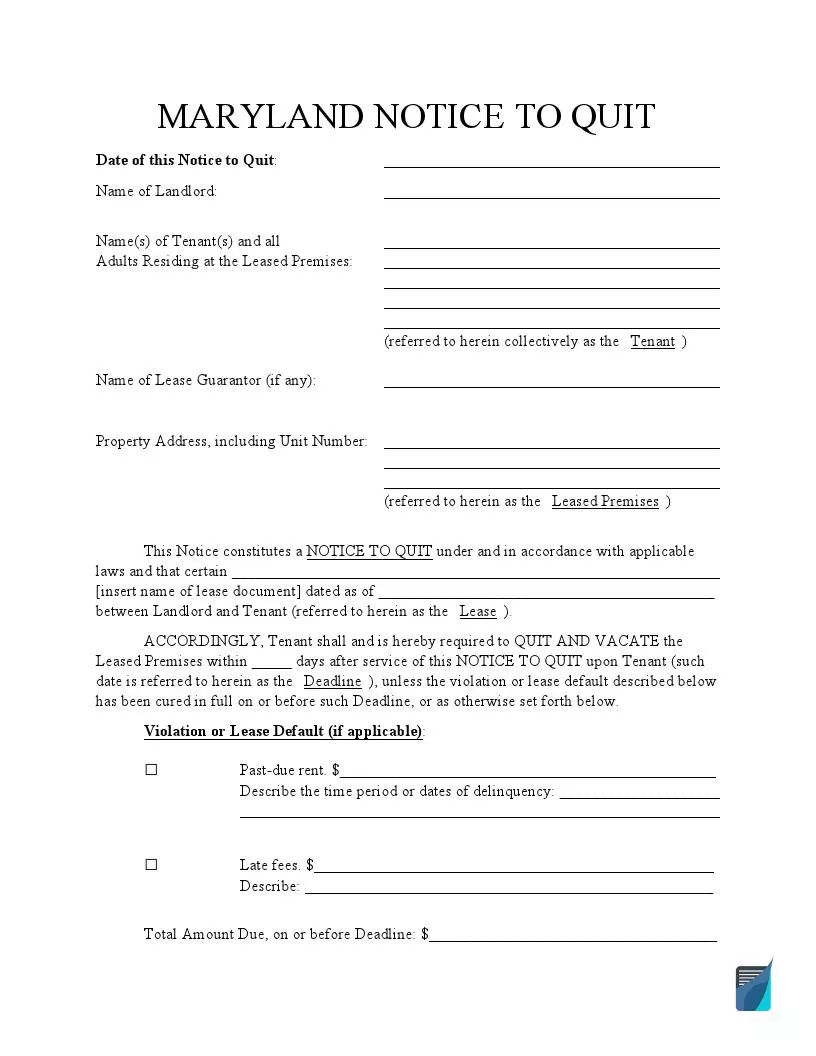
Maryland Eviction Notice Form

Create a free high-quality Maryland Eviction Notice online now!

Build Your Document

Answer a few simple questions to make your document in minutes

Save and Print

Save progress and finish on any device, download and print anytime

Sign and Use

Your valid, lawyer-approved document is ready

... or download your Maryland Eviction Notice Forms as a PDF file

Last Updated: September 2026. This guide is reviewed and updated regularly to reflect current Maryland law. If you notice an error or outdated information, please contact us.

A Maryland "notice to quit" is the same document people also call a "notice to vacate" or simply an "eviction notice." All three names describe the same written notice a landlord sends before going to court.

In Maryland, the state's and the county attorneys and community associations can also start an eviction process against the tenant if the tenant has been involved in illegal drug-related activities.

Can You Be Evicted in Maryland Without Going to Court?

No. A landlord may not force a tenant out by self-help. Maryland law limits what a landlord can do outside the court process. A landlord may not take possession or threaten to take possession of the rental, lock the tenant out, or cut off services such as water or electricity to push the tenant out, even after the eviction case has started.[1]

except as provided in paragraph (2) of this subsection, a landlord may not take possession or threaten to take possession of a dwelling unit from a tenant or tenant holding over by locking the tenant out or any other action, including willful diminution of services to the tenant.
Md. Code Ann., Real Prop. § 8-216

Maryland Eviction Laws

Maryland law sets separate timelines for the two main kinds of eviction cases, and every notice under Maryland law has to be in writing. The rules below cover the nonpayment notice, the appeal window, and the timelines for ending a lease without a breach.

  • Nonpayment of rent. The tenant must receive a written notice at least 10 days before the landlord can go to court to seek possession.[2]
  • Appeal window. Either the tenant or the landlord may appeal a district court judgment to the circuit court within 4 days of the ruling.[2]
  • Month-to-month tenancy or short lease term. A landlord or tenant who wants to end a month-to-month tenancy, or a written lease for a term longer than one week, must give 60 days notice before the tenancy ends.[3]
  • Year-to-year tenancy. A year-to-year tenancy needs 90 days notice before the current year of the tenancy expires.[3]

No lease in the state of Maryland can ask for a late rent fee higher than five percent of the owed rent.

Maryland Eviction Notice Laws Details

Rent Grace Period None
Notice of Non-Payment 10 days
Month-to-Month Termination Notice 60 days
Year-to-Year Termination Notice 90 days
State Laws Maryland Annotated Code, Real Property, Sections 8-401 to 8-501

How Many Days Notice Must Be Given to Evict in Maryland?

The tenant must get written notice at least 10 days before an eviction for nonpayment of rent.[2] No notice at all is legally required before a nonpayment case is filed, but a 10-day notice period applies once the landlord chooses to give one and wants to rely on it in court. Notice periods differ for ending a tenancy without a breach, covered above.

Eviction Notice Types Used in Maryland

Although landlords in Maryland are free to go to court once they find a breach of the lease, many give the tenant a notice first. The list below covers the notice types FormsPal's software can build for you.

  • Notice to Quit for a Month-to-Month Tenancy. Either party may end a month-to-month lease, or a written lease for a term of more than one week, with 60 days notice before the tenancy ends.[3] A year-to-year tenancy needs 90 days notice instead.[3]
  • Notice to Quit for Non-Compliance with the Lease. If a tenant breaches the lease, for example by keeping a pet the lease does not allow, the landlord can use this notice to ask the tenant to fix the problem before going to court.
  • Notice to Quit for Non-Payment of Rent. When a tenant has not paid rent, the landlord can send this notice and give the tenant a chance to pay the outstanding balance before the eviction case begins.

A tenant facing a nonpayment case keeps a right of redemption. At any time before the eviction order is actually carried out, the tenant can stop the case by paying all past-due amounts the court finds owed.[2] Payment must go to the landlord or the landlord's agent in cash, certified check, or money order, plus any court costs and fees the court has awarded.[2]

This right does not apply to a tenant against whom three judgments of possession for rent due and unpaid have been entered in the 12 months before the current case began.[2]

Template Preview
Create a free high-quality Maryland Eviction Notice online now!

Eviction Process in Maryland

Every step below runs through the District Court, and Maryland law does not let a landlord skip the court process no matter what the lease says. The steps run from the first notice to the day the sheriff carries out the warrant of restitution.

  1. Give the notice. A landlord who thinks the tenant will fix the problem without a court case can send a written notice first and see if the issue gets resolved.
  2. File the case in court. The landlord, or the landlord's qualified agent or attorney, files a written complaint under oath or affirmation in the District Court of the county where the rental is located.[2]
  3. Attend the hearing. The court sends a summons by first-class mail to the tenant, and to any assignee or subtenant, directing them to appear at trial on the fifth day after the complaint is filed.[2] The court may adjourn the trial, but not exceeding 1 day unless every party consents to a longer adjournment.[2] A tenant who does not attend is likely to lose the case, and either side may appeal the judgment to the circuit court within 4 days.[2]
  4. Wait for the possession order and warrant. When the court rules for the landlord, the judgment also orders that possession be handed back within 4 days after the trial.[2] The court may extend that to as much as 15 days if a doctor certifies that moving sooner would endanger the health of the tenant or another occupant.[2] If the tenant does not comply with the possession order within 7 days, the court issues its warrant of restitution at any time after those 7 days expire.[2] The landlord must act on that warrant within 60 days from the later of the date the court issued it or any date the court later extends, or the warrant expires and the judgment for possession is stricken.[2] Separately, if the landlord waits more than 60 days after the judgment or the end of any stay to order the warrant at all, the judgment is stricken the same way.[2] The administrative judge of the district must stay execution of the warrant, from day to day, during extreme weather conditions affecting the property.[2] Once a stay for extreme weather ends, the eviction must be given priority and completed within 5 days after the extreme weather conditions cease.[2]

Eviction Court Forms

Maryland's eviction case uses a small set of standard court forms. The summons tells the tenant when and why to appear, and the warrant of restitution is the document that finally authorizes the sheriff to remove the tenant and hand possession back to the landlord. The list below explains what each form is for.

  • Summons for a Breach of Lease. The court uses this summons to notify a tenant that the landlord has sued over a breach of the lease and that the tenant must appear in court.
  • Summons for Rent Non-Payment. This summons notifies the tenant of a nonpayment case and directs the tenant to appear at trial on the fifth day after the complaint was filed.[2]
  • Warrant of Restitution. This is the form that authorizes the eviction itself and returns possession of the property to the landlord.

This page is general information about Maryland eviction law, not legal advice. For a specific case, talk with a Maryland attorney or your local District Court.

Sources

  1. Md. Code Ann., Real Prop. § 8-216.
  2. Md. Code, Real Prop. § 8-401.
  3. Md. Code, Real Prop. § 8-402(c).