
It’s normal to feel uneasy about asking for a letter of recommendation, as many don’t want to trouble a professor, manager, or mentor. Still, recommendation letters are a common and important part of applications for jobs, universities, scholarships, and internships. Decision-makers simply want to hear from someone who can speak to your work, character, and achievements.
A strong letter of recommendation offers insights that resumes and transcripts can’t show. With it, admissions officers and employers understand how you work in real situations and how others see your strengths. In this article, you’ll learn how to ask for a recommendation letter, who to approach, when to make your request, and what details to share. You’ll also find templates to make the process simpler.
What Is a Recommendation Letter?
Let’s start by explaining what a recommendation letter is and why it matters. Imagine you’re applying for a job, scholarship, internship, or college program. You send in your resume, transcripts, test scores, and application forms. Even with all that, the people reviewing your application usually want to hear from someone who knows you well and can talk about your skills based on real professional experience.
A recommendation letter is a brief note written by someone like a professor, manager, or mentor who knows your work. In it, they talk about your skills, work habits, character, and achievements. They might share a story about a project you did well, how you helped a team, or how you faced a challenge. These real examples help others see what it’s like to work or study with you.
Put simply, a recommendation letter gives your application extra support by sharing someone else’s view of your work. It shows that someone who knows you believes in your abilities and potential. Such letters make a real difference when it comes to jobs, admissions, scholarships, and other chances. Furthermore, they could be the deciding factor in establishing your credibility.
Who You Should Ask for a Recommendation?
Recommendation letters usually most effective when they come from someone who knows your work. Relying solely on a big title is not advisable. The strongest potential recommenders are the people who have seen what you can do during your academic and professional career. They’ve taught you, supervised you, or worked with you long enough to talk about your strengths in a real way.
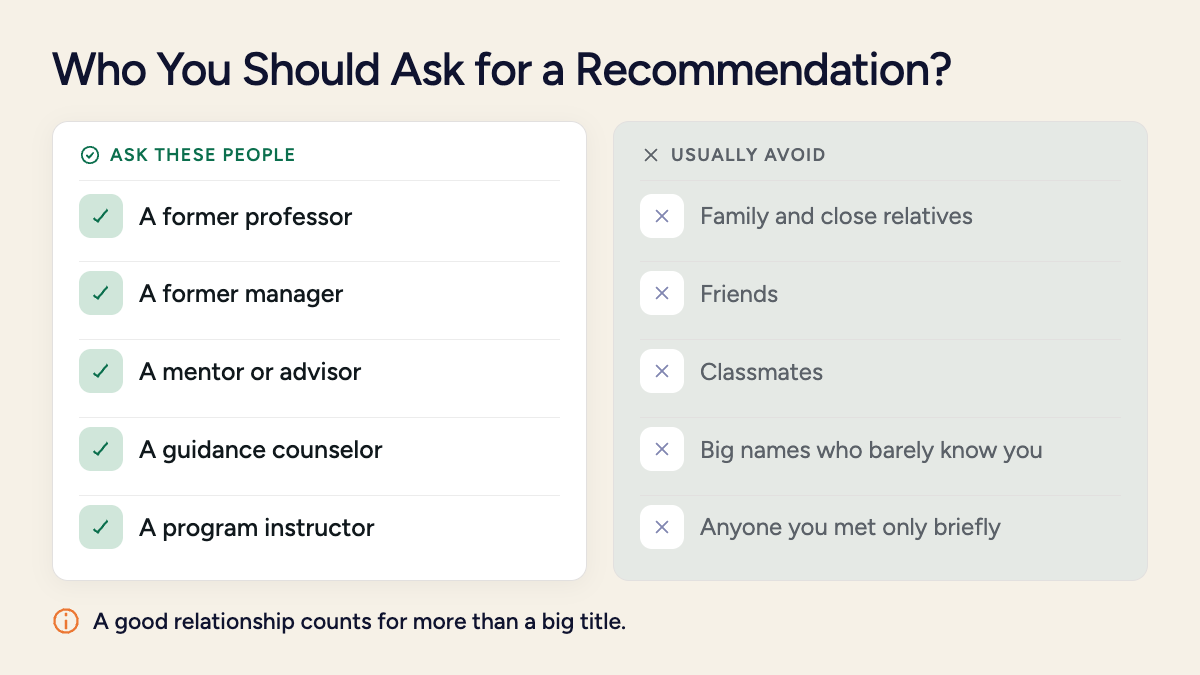
So, choosing the right person is very important and some good potential letter writers include:
- a former professor who taught you in a class related to your goals
- a former manager or supervisor from a job or internship
- a mentor or advisor who is familiar with how you work
- a high school guidance counselor, if you’re applying to college
- an instructor from an educational program you completed
These are often the best people to write letters for job applications, college applications, or graduate school because they can connect your skills to the next step you want to take. They can also give some insights about how you handled your work, got along with others, or made progress.
A good relationship also counts for a lot. Someone who knows you pretty well will usually write a better letter than someone important who barely remembers you.
Some people may seem like an easy choice, but they’re not the best option for writing recommendation letters. You should usually avoid asking family members, close relatives, friends, classmates, well-known professionals who barely know you, or anyone you only met briefly. The problem is simple - they usually don’t know your work well enough to give an objective description of your skills, work ethic, and achievements.
When to Ask for a Letter of Recommendation?
Request recommendations at least three to six weeks before the deadline to give your recommender sufficient time to review your materials. For college, grad school, or competitive scholarships, consider asking even earlier.
For those who plan to apply to college, start thinking about recommendation letters during your junior year. That gives you time to build relationships with teachers or mentors who may later support your application. Keep track of each application deadline and check the admissions office requirements.
You should also give the writer everything they need upfront. That usually covers your resume, transcript, personal statement, and information about the program or job you’re applying for. With all the details, it becomes much easier to write letters that highlight your strengths and academic accomplishments.
Finally, keep track of the deadline and send a polite reminder if necessary. A short follow-up message about a week before the due date is usually enough. Most recommenders appreciate the reminder, especially when they are balancing many responsibilities at the same time.
Steps for Requesting a Letter of Recommendation
Don't know how to ask for a letter of recommendation? Here are the steps to help you make your request and give your recommender all the information they need.
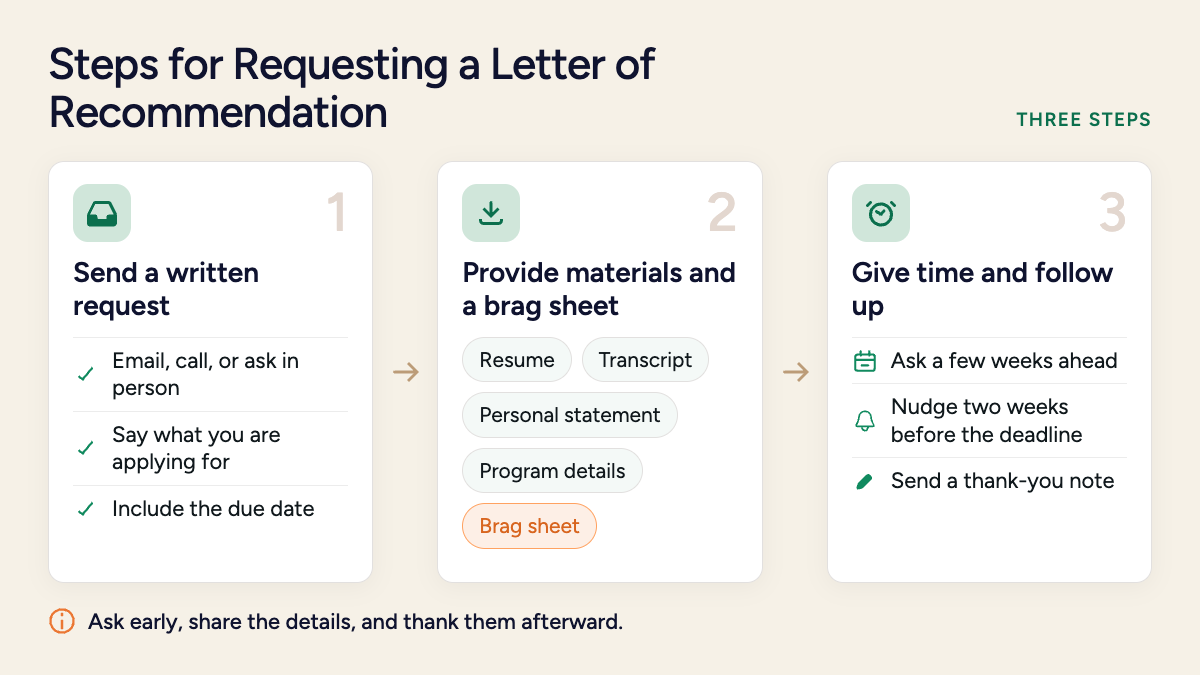
1. Send a Formal Letter or Written Request
Begin with a polite written request. Most people reach out by email, but you can also start with a face-to-face conversation or a short video call. If they agree, send a formal letter or message to confirm your request.
Choose someone who knows your work well, such as a professor, supervisor, or another faculty member. Most students ask for recommendations in their junior or senior year when getting ready for college or graduate applications.
In your message, explain what you are applying for and include the due date. If the program needs a printed recommendation, you can give the writer a stamped envelope so they can mail the letter directly.
2. Provide Materials and a Brag Sheet
Once the person agrees to help, share the information they need to write recommendation letters that sound specific and detailed. A short brag sheet often works well because it summarizes your achievements and goals.
| Recommendation Type | Materials You Should Provide |
| College Applications | Resume or activity list, transcript, personal statement, list of colleges, extracurricular activities, application deadline, submission instructions |
| Graduate School | Current resume/CV, transcript, statement of purpose, research experience, program details, application deadline |
| Job Applications | Resume, job description, list of projects or achievements, skills you want emphasized, due date |
| Scholarships | Resume, transcript, essay or personal statement, scholarship description, achievements list, deadline |
| Internships or Fellowships | Resume, transcript (if required), program description, goals for the internship, submission instructions |
These materials help the recommender understand your background and prepare additional letters if needed.
3. Give the Letter Writer Ample Time and Follow Up
Writing a recommendation letter takes time and effort. Reach out to your recommender a few weeks before the deadline so they have plenty of time to write it.
If you have not heard back as the deadline gets closer, send a short follow-up email about two weeks before it is due. A polite reminder is usually enough. You can also send a brief handwritten note to thank the person for their support.
Notice how the person responds. If you sense hesitation, it may be better to ask someone else who feels confident recommending you. A supportive recommender will usually write a stronger letter that highlights your work and achievements.
Letter of Recommendation Request Template
Below are several brief templates for your consideration. Feel free to change the details so they fit your application and your relationship with the person writing your recommendation.
College Application Request
Subject: Recommendation Letter Request (College Application)
Dear [Teacher’s Name],
I hope you are doing well. I am currently preparing my college applications and wanted to ask if you would be willing to write a letter of recommendation for me.
I really enjoyed being in your [class name] class and appreciated the support you gave during the semester. I believe your perspective on my academic work and classroom participation would strengthen my application.
The application deadline is [date]. If you agree, I will send my resume, transcript, activity list, and the submission instructions from the college.
Thank you very much for considering my request.
Best regards,
[Your Name]
Grad School Recommendation
Subject: Request for Graduate School Recommendation Letter
Hello [Professor’s Name],
I hope everything is going well. I am applying to a graduate program in [field or program name], and I was wondering if you would feel comfortable writing a recommendation letter for me.
Working with you during [course, research project, or program] was an important part of my academic experience, and I believe your recommendation would provide helpful insight into my work and research interests.
The application deadline is [date]. I can send my CV, transcript, statement of purpose, and any other materials you may need.
Thank you for your time and consideration.
Sincerely,
[Your Name]
Job Applications
Subject: Recommendation Letter Request
Hi [Name],
I hope you’re doing well. I’m applying for a position at [company or organization], and I wanted to ask if you would be willing to provide a recommendation for me.
Working with you at [company, internship, or project] was a valuable experience, and I believe your perspective on my work and professional skills would support my application.
The deadline for submitting the recommendation is [date]. If you’re comfortable with this, I can send my resume and details about the position.
Thank you for considering my request.
Best,
[Your Name]
Polite Formal Request
Subject: Letter of Recommendation Request
Dear Ms./Mr. [Last Name],
I hope you are doing well. I am applying to [program, job, or scholarship], and I would like to ask if you would be willing to write a letter of recommendation for me.
Your guidance during [class, project, or program] had a meaningful impact on my development, and I believe your recommendation would strengthen my application.
The deadline for submission is [date]. If you agree, I will provide my resume, transcript, and the necessary submission instructions.
Thank you for your time and support.
Sincerely,
[Your Name]