
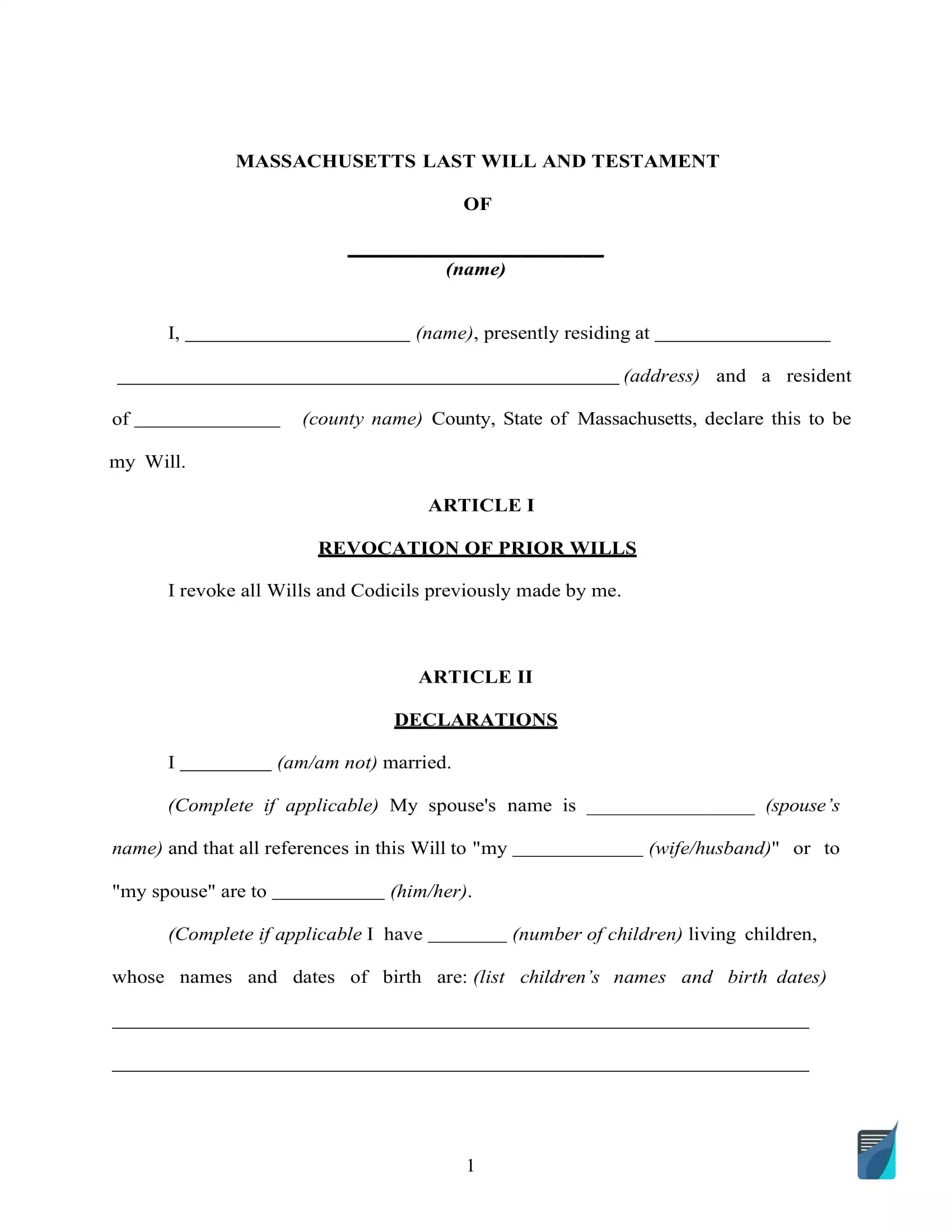
A Massachusetts last will and testament is a written document in which a person (the testator) names who receives their property and who carries out those wishes after death. Massachusetts law, under Mass. Gen. Laws ch. 190B, sets the rules for making one. Below is a free Massachusetts will template, the state's signing requirements, and a step-by-step guide to filling it out.
A last will differs from a living will or a power of attorney. It takes effect only after death and has no power while the testator is alive.
Massachusetts sets specific rules for a will to be legally valid. Under Section 2-502 of the Mass. Gen. Laws ch. 190B, a will must be in writing, signed by the testator, and signed by at least two witnesses who watched the signing or heard the testator acknowledge it.[1] The table below summarizes the core statute, and the paragraphs after it explain each part.
The will must be in writing. It must also be signed by the testator, or, at the testator's direction and in the testator's conscious presence, signed in the testator's name by someone else. This lets a testator who cannot physically sign still have a valid will, as long as another person signs for them while the testator directs it.[1]
At least two witnesses must sign the will. Each witness must have either watched the testator sign or heard the testator acknowledge the signature, or the will itself, before the witness signs.[1]
Last Updated: September 2026. This guide is reviewed and updated regularly to reflect current Massachusetts law. If you notice an error or outdated information, please contact us.
| Requirement | State law | |
| Governing statute | Chapter 190B, Massachusetts Uniform Probate Code, Article II | |
| Form of the will | In writing | Section 2-502 |
| Signing requirement | Testator's signature, plus at least two witnesses | Section 2-502 |
| Self-proving wills | Allowed, with a notarized affidavit | Section 2-504(b) |
A self-proving affidavit lets the witnesses skip testifying in the probate court. Without a self-proving affidavit, the witnesses may need to testify during probate to confirm the will was properly signed.[2]
1. Think about your possibilities. Make a decision whether you need to seek the services of lawyers or prepare your last will by yourself (either by working with a free last will and testament form or using a do-it-yourself document builder).
2. Specify your information. Establish yourself as the testator and indicate these particulars: full name and address (city, county, and state). Go over the information you wrote along with the remainder of the section carefully.

3. Designate the executor (or executrix). The next step is to decide on the executor of your last will and testament. This person will be your personal representative in charge of ensuring that every little thing you lay out in this document gets done. To do that, you will need to specify the executor’s full name, along with their residence information (city, county, and state).
Be sure you appoint a person who resides in the same state as you do, if possible. It is common practice to name someone in-state because handling an out-of-state executor's duties can take weeks, months, or sometimes even years.
In practice, choose an adult you trust who is capable of managing the estate's affairs.

4. Choose a guardian (optional). It’s possible to appoint a trusted person as a guardian in case you have underage or dependent children that must be taken care of after your death. In case there are no instructions concerning who exactly should look after your children, the guardian will be selected by the local court.

5. Specify your beneficiaries and what they get. This is where you indicate those who are going to receive your assets. Fill out their full names, addresses, and your relationship to them (spouse, child, friend).
Write down your assets and explain exactly how you would like to distribute them to your beneficiaries. Such property can include cash, shares, realty, company control, money for arrearage, as well as any physical items of commercial value you possess.

6. Proceed with the witnesses signing the document. Under Section 2-502 of the Mass. Gen. Laws ch. 190B, a will must be signed by at least two witnesses who watched the signing or the testator's acknowledgment.[1] After a complete review of every passage in your last will, all signatories (you and your two witnesses) must write their full names and full addresses and sign the will. Without a self-proving affidavit, the witnesses may need to testify during probate to confirm the will was properly signed.[2]


A Massachusetts will is invalid if it skips any of the state's core formalities. Under Section 2-502 of the Mass. Gen. Laws ch. 190B, that means missing the testator's signature (or a validly authorized proxy signature), missing the two required witnesses, or never putting the will in writing.[1]
Yes. Massachusetts law allows someone else to sign a will in the testator's name if they do it at the testator's direction and in the testator's conscious presence. The testator can also simply sign the will personally, which is the more common approach.[1]
Attaching a self-proving affidavit to your will helps make the probate process easier for your witnesses.[2]
Each witness must either watch the testator sign the will or hear the testator acknowledge the signature, or the will itself, and then sign as a witness. Massachusetts requires at least two such witnesses for the will to be valid.[1]
Many people update an estate plan over time. A common way to do this is a codicil, a short document describing the specific changes. Another option is to set the old will aside and create a new one.
If something big happens in your life that can affect your will, such as a new child or buying a house, it is common practice to revisit your will or create a new one.
| Related documents | When to create it |
| Codicil | Your last will needs one or a few small changes. |
| Self-proving affidavit | You want the probate to be easier when it’s necessary. |
| Living will | You want to make sure your end-of-life treatment is carried out according to your wishes. |
| Living trust | You would like to skip probate by having your assets in a trust. |
General information, not legal or tax advice.
Unless noted otherwise, the sources below are from the Mass. Gen. Laws ch. 190B,.
