
An Iowa last will and testament is a document that contains the final directions of a person, called the testator. It establishes precisely how their estate will be distributed among their family. Wills in Iowa must be in writing and signed by the testator to be legally valid.[2] It is a good idea to make a will regardless of the size of your estate.
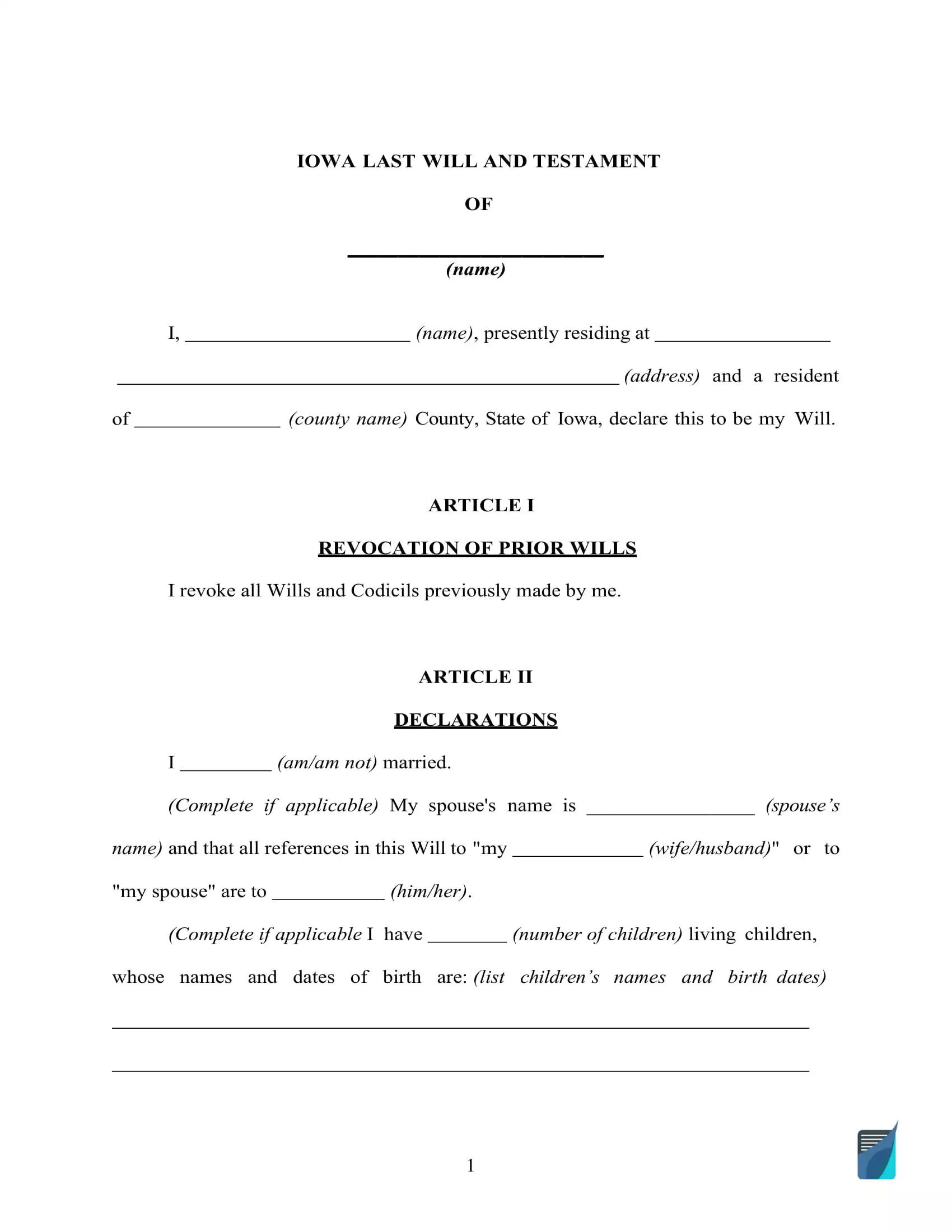
If you are in need of a high-quality Iowa last will form, you can download it below in PDF and DOC formats. Besides that, we provide some tips on will writing and requirements and answer common questions.
Build Your Document
Answer a few simple questions to make your document in minutes
Save and Print
Save progress and finish on any device, download and print anytime
Sign and Use
Your valid, lawyer-approved document is ready
An Iowa last will and testament must meet the formalities in Iowa Code 633.279 to be valid. It must be in writing, signed by the testator, or signed by another person in the testator’s presence and at the testator’s express direction.[2] Two competent witnesses must sign in the testator’s presence and in each other’s presence.[2] The testator must be at least 18 years old and of sound mind at the time of signing.[1][4] The table below summarizes these Iowa requirements.
| Requirements | State laws | |
| Statutes | Chapter 633 – Probate Code; Subchapter VI – Wills | |
| Definitions | 633.3 Definitions and use of terms | |
| Signing requirement | Two witnesses | 633.279 Signed and witnessed |
| Age of testator | 18 and older | |
| Age of witnesses | 16 and older | 633.280 Competency of witnesses |
| Self-proving wills | Allowed | 633.279 Signed and witnessed |
| Handwritten wills | Might be recognized if witnessed according to state law | |
| Oral wills | Not recognized | |
| Holographic wills | Not recognized | |
| Depositing a will | Possible at the clerk of an Iowa county court office A fee is county-specific | 633.286 Deposit of will with clerk |
Last Updated: September 2026. This guide is reviewed and updated regularly to reflect current Iowa law. If you notice an error or outdated information, please contact us.
A self-proving affidavit is optional, but Iowa Code 633.279 lets a self-proved will be admitted to probate without testimony of witnesses once the affidavit is signed and notarized alongside the will.[1] Ask your notary to prepare this extra page when you finalize your Iowa last will and testament.
1. Consider your possibilities. One thing to decide upon, first, is if you wish to write the entire document by hand or utilize a fillable last will and testament form that we offer here. You can also create it via our tool, which will let you customize more things in your last will.
2. Specify your information. Fill in your full name and address (the city, county, and state of residence) to establish the testator of the will.

3. Establish the executor. Now is the time to choose the executor of your last will and testament, the person in charge of making sure that everything you lay out in this document gets done.
You will need to specify the executor’s full name, followed by their residential information (city, county, and state). Ensure that you choose a person who lives in the same state as you do. If you don’t, there’ll be more paperwork and unnecessary hassle connected with the procedure resulting from different special policies every state has with regards to out-of-state executors (Iowa – 633.64 Qualification of fiduciary — nonresident).

4. Appoint the guardian (optional). You are able to choose a trusted person as a guardian if you’ve got underage or dependent children that must be taken care of. If there are no directions regarding what person should take care of your children, the guardian will be chosen by the court.

5. Specify your beneficiaries. This is where you indicate people who are going to receive your property. For every beneficiary, fill out these particulars: full legal name, address, and the way they are related to you. The beneficiaries are usually your closest loved ones, but you can also include your close friends or even charitable organizations.
6. Designate property. It’s possible to indicate which of the inheritors gets this or that piece of property. If you don’t, the assets are going to be allocated evenly among the beneficiaries. Money for arrearage, real estate, shares, company ownership, cash, as well as any material items of commercial worth in your possession can be mentioned in your last will and testament. But, any jointly acquired assets, as well as your life insurance, cannot go to your will.

7. Ask witnesses to finalize the document. Under Iowa Code 633.279, your last will needs to be signed by two competent witnesses who are at least 16 years old.[2][3] A witness does not have to be disinterested for the will to be valid, but naming a witness who is also a beneficiary risks that witness losing part of their own gift unless two other disinterested witnesses also sign.[6] Now, you and your two witnesses must sign the paper after writing your full legal addresses and names.

A valid Iowa last will and testament does more than name who gets your property. It identifies you as the testator, names an executor, and follows the state’s signing rules so a probate court will honor it.[2] Missing any of these pieces is one of the most common reasons an Iowa will gets challenged.
Even a complete will can fail probate over a signing mistake. Watch for these four issues:

Wills in Iowa do not have to be notarized. But, you can make your will self-proving, and you’ll need to visit a notary in order to accomplish that. In case you make your last will self-proving, the court will not need to make contact with the witnesses to determine the credibility of the document, which will facilitate the probate.[1]
There are usually two requirements to fulfill: soundness of mind and being of a certain age. In Iowa, you’ve got to be over 18 years to create a last will. Being of sound mind means that you have a detailed knowledge of the property you own, your closest beneficiaries and family members (you must know and remember them), and understand clearly what a last will is and how it works.[1][4]
Full disinheritance of a spouse is difficult under Iowa law. Iowa Code 633.238 gives a surviving spouse an elective share, letting them claim up to one third of the decedent’s real property in place of what the will provides.[5] An express written relinquishment of that right, such as a valid premarital agreement, can waive the elective share.[5] Without that kind of written waiver, the elective share still applies even if the will tries to disinherit the spouse.
Yes, you’re allowed to alter it at any time by using a codicil (for minor changes) or creating a new will from scratch.
Iowa law offers a presumption that the absence of the will means it was revoked by the testator. And in most cases, it is very hard to prove the will’s existence. Nonetheless, it is possible, and here’s an example of such a case.
| Related documents | When to make it |
| Codicil | There are a few minor changes you want to make to your will. |
| Self-proving affidavit | You want the probate to be quicker when it’s necessary. |
| Living will | You would like to state what health care you want if you cannot communicate that yourself. |
| Living trust | You want to skip probate by putting your assets in a trust. |
This page is general information about Iowa last wills, not legal advice. For advice on your situation, talk to a Iowa attorney.
