
In Kansas, a living will is a legally recognized document that lets a person state in advance whether life-sustaining procedures should be used if they later become unable to communicate their wishes. A Kansas living will must be signed by the declarant, or by another person in the declarant’s presence and at the declarant’s expressed direction. It takes effect when two physicians certify that the declarant has an incurable condition that will end in death whether or not life-sustaining procedures are used.[1]
Last Updated: September 2026. This guide is reviewed and updated regularly to reflect current Kansas law. If you notice an error or outdated information, please contact us.
Kansas living wills, called declarations under state law, are governed by Kan. Stat. Ann. § 65-28,103. The declaration must be signed by the declarant, or by someone else in the declarant’s presence and at the declarant’s direction. Its execution must then be attested either by two witnesses or by a notary public.[1]
By signing, each witness confirms that the declarant is personally known to them and appears to be of sound mind. The witness also confirms they are not related to the declarant by blood or marriage, entitled to any part of the estate, or financially responsible for the declarant’s medical care.[1]
Note: Kansas law allows a declaration to be witnessed by two people or acknowledged before a notary public.[1] The Kansas living will form provided on this page includes only a witness acknowledgment, so plan on two qualifying witnesses when you sign.
Under K.S.A. § 65-28,104, you may revoke your declaration at any time by destroying it, by a signed and dated written revocation, or by a verbal statement made in front of a witness who is 18 or older and who signs and dates a writing confirming it. A verbal revocation takes effect when your attending physician receives that writing.[2]
Any adult may sign a Kansas declaration (K.S.A. § 65-28,103(a)).[1]
Three rules from Kan. Stat. Ann. § 65-28,103 govern the declaration once it is signed, covering who must be told about it, where it is kept, and when it does not apply.[1]
These forms only protect the declarant’s wishes if the people who need to see them can find them. Give a signed copy to the attending physician, keep the original in an accessible place, and let close family members know where to find it.
| Document Name | Kansas Living Will Form |
| State Form Name | Kansas Declaration |
| Signing Requirements | Two Witnesses or Notary Public |
| Validity Requirements | K.S.A. 65-28,103 |
| State Laws: Kansas Statutes, Sections 65-28,101 to 65-28,109 | |
Yes. Kansas law requires the declaration to be signed by the declarant, or by another person in the declarant’s presence and at the declarant’s expressed direction.[1] This signature requirement applies no matter which template you use to prepare the document.
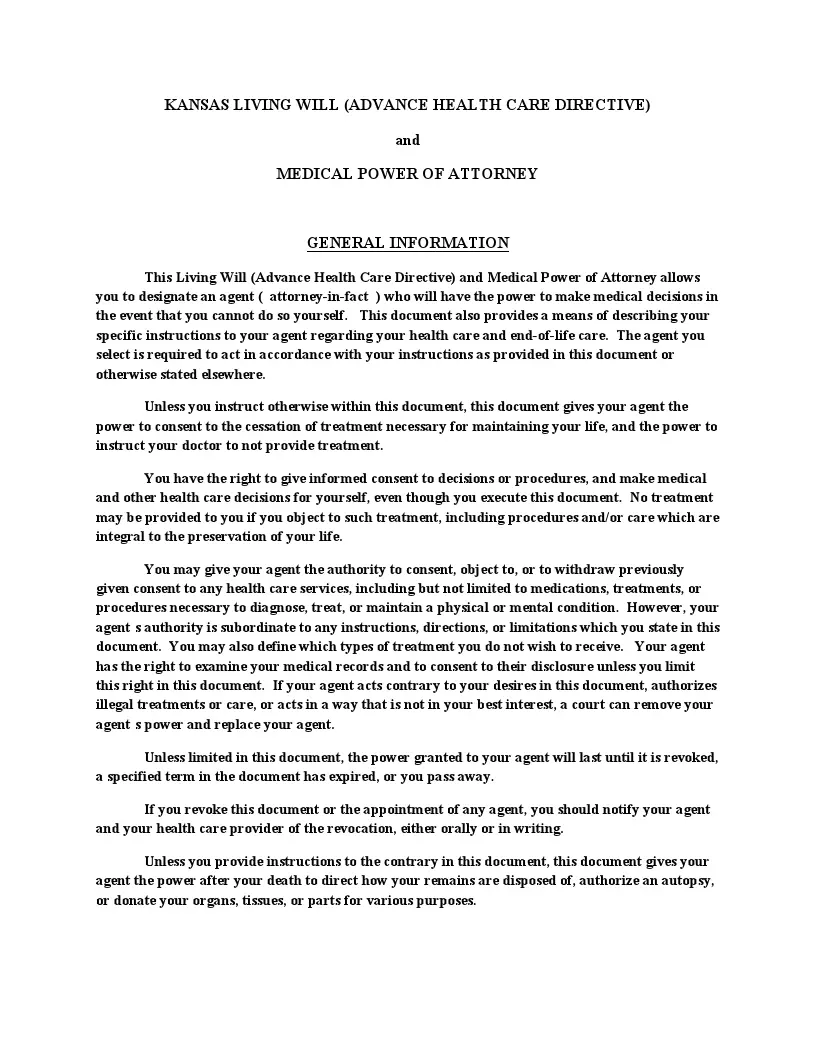
A living will only states your own wishes for end-of-life care. A medical power of attorney goes further and names a person, called your agent, to make health care decisions for you. That agent can act whenever you cannot decide for yourself, not only at the end of life.
The Kansas living will form on this page combines both documents. You get a declaration of your wishes and, if you fill in the agent section, a medical power of attorney in the same form.
The Kansas living will form on this page combines a declaration on end-of-life care with an optional medical power of attorney naming a health care agent. Follow the steps below in order, using the page numbers to find each part of the form.
After signing, give copies to your physician, your named health care agent, and any close family members who should know your wishes.

Other Living Will Forms by State
General information, not legal or tax advice.
