
A South Dakota living will is a written declaration of your wishes for end-of-life medical treatment, including artificial nutrition and hydration. You use it if a terminal condition later leaves you unable to communicate those wishes yourself. Under South Dakota’s own sample form at S.D. Codified Laws § 34-12D-3, it applies when you are in a terminal condition, your death is imminent, and you cannot communicate your medical decisions.[1]
Last Updated: September 2026. This guide is reviewed and updated regularly to reflect current South Dakota law. If you notice an error or outdated information, please contact us.
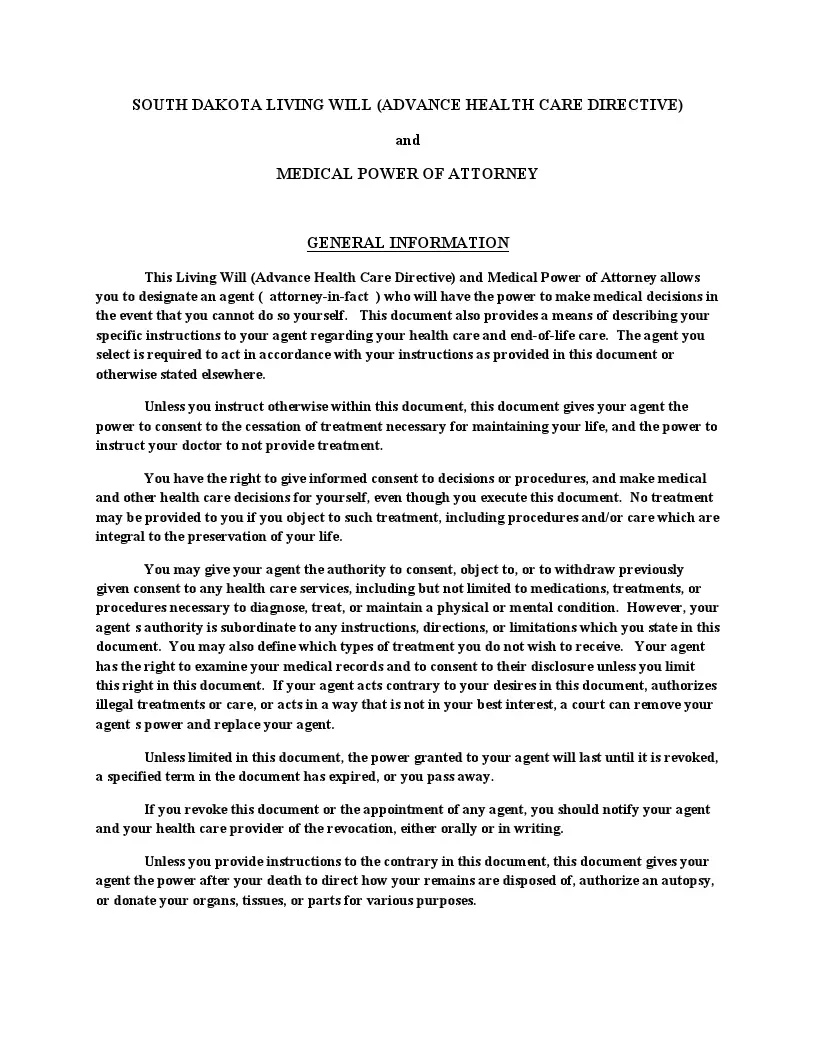
FormsPal’s South Dakota template combines this declaration with a medical power of attorney. You can name a health care agent to carry out decisions your declaration does not cover, all in one document.
This state’s living will law is in the South Dakota Codified Laws, Chapter 34-12D, Natural Death and Life-Sustaining Procedures. The state’s own optional sample declaration, printed at S.D. Codified Laws § 34-12D-3, must be signed by you and by at least two witnesses, and it also includes a signature line for a notary public.[1] The sections below cover what the sample form asks for and how to revoke a living will you no longer want.
Each witness signs a statement that you voluntarily signed the document in their presence, so the witness portion of the form is not just a name line.[1]
The declarant voluntarily signed this document in my presence.
In practice, many people update or revoke an old living will by:
Keeping your copies current after any change helps make sure your health care providers see the version you actually want used.
Any competent adult may sign a declaration at any time (SDCL § 34-12D-2).[2]
| Document Name | South Dakota Living Will Form |
| State Form Name | South Dakota Living Will Declaration |
| Signing Requirements | At Least Two Witnesses |
| Governing Law | S.D. Codified Laws § 34-12D-3 |
Popular Local Living Will Forms
FormsPal’s online builder for this document creates a combined living will and medical power of attorney. The state’s own sample form at S.D. Codified Laws § 34-12D-3 covers only the living will, so compare the two before you decide which one to use.
Filling out this combined living will and medical power of attorney form means completing two related documents in one filing. You cover your end-of-life treatment wishes and, if you choose to use it, your agent’s authority to act for you. Follow the form’s own order below, page by page. You can fill it out on your own device with FormsPal’s PDF editor, or print it and complete it by hand.
This legal document only helps if the people caring for you can find it. After you sign the form, give copies to your family, your physician, and any health care facility where you receive treatment, so they can act on your decisions when the time comes. Keep the signed original somewhere safe and easy to locate.
South Dakota’s own sample living will declaration, printed at S.D. Codified Laws § 34-12D-3, includes a signature line for a notary public along with the two witness lines.[1] FormsPal’s builder for this document does not include a notary block, so if you want your living will notarized, use the state’s own sample form or add a notary acknowledgment yourself. Banks, county courthouses, and many shipping stores offer notary services, so scheduling one before you gather your witnesses can save a trip.

A South Dakota living will is valid when it follows the state’s own sample declaration form. Under S.D. Codified Laws § 34-12D-3, that means you sign the document, at least two witnesses sign it too, and each witness signs a statement that you voluntarily signed in their presence. The sample form also includes a signature line for a notary public.[1] Using a different format is fine too, as long as your document meets these same signing and witnessing requirements.
General information, not legal or tax advice.
