
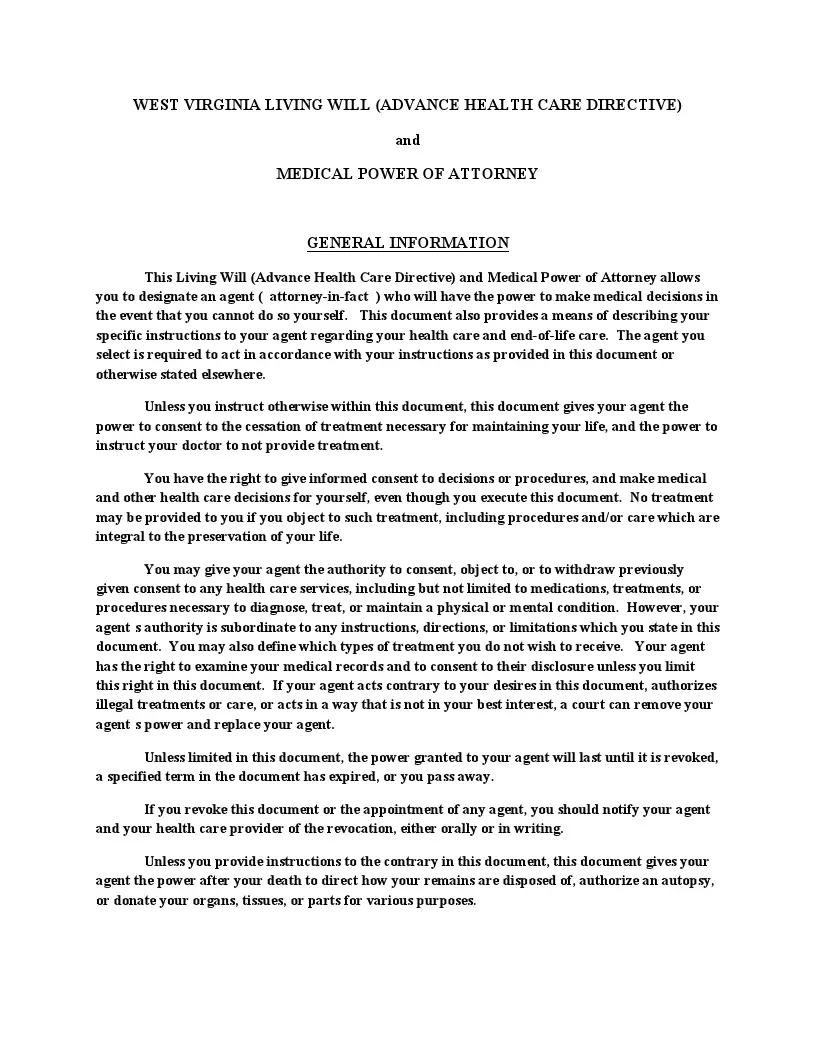
A West Virginia living will is a written document, one of the advance directives recognized under the state’s Health Care Decisions Act. It lets you state which life-prolonging medical treatments you want or refuse if you become terminally ill or otherwise unable to communicate your own health care decisions.
Last Updated: September 2026. This guide is reviewed and updated regularly to reflect current West Virginia law. If you notice an error or outdated information, please contact us.
Build Your Document
Answer a few simple questions to make your document in minutes
Save and Print
Save progress and finish on any device, download and print anytime
Sign and Use
Your valid, lawyer-approved document is ready
The document covers your wishes on life-sustaining medical treatment, artificial nutrition and hydration, pain relief, and other end-of-life care decisions.
Tell your family, your doctor, and any health care agent or medical power of attorney that you have a living will and where to find it. Some people keep a copy with their medical records or in a registry their providers can access.
West Virginia’s living will law, Section 16-30-4 of the state code, sets rules for who may witness your signature and what the notary must do, so your health care decisions hold up when your medical care team needs them. Below is the exact text of the statute, followed by an explanation in plain language.
A living will, medical power of attorney, or combined medical power of attorney and living will made pursuant to this article shall be: in writing; executed by the principal or by another person in the principal’s presence at the principal’s express direction if the principal is physically unable to do so; dated; signed in the presence of two or more witnesses eat least 18 years of age; and signed and attested by such witnesses whose signatures and attestations shall be acknowledged before a notary public.
In plain terms, your living will must be written down and dated. If you can sign it yourself, you do. If you are physically unable to sign, someone else can sign for you as long as you are present and you tell them to. You need at least two witnesses who are 18 or older, and their signatures must be notarized before a notary public.[1.1]
West Virginia law does not let just anyone witness your living will. A witness cannot be:[1.1]
These limits keep the people who give you medical care, or who benefit from your estate, out of the health care decisions your living will makes for you.
By signing, your witnesses are stating in writing that they did not sign your name for you and are 18 or older. They are also stating that they are not related to you, not in line to inherit from you, not responsible for paying your medical bills, and not your doctor or your named representative.[1.1] This keeps your health care decisions reliable.
Section 16-30-4(g) of the state code sets out this exact declaration and witness language, which is the basis for the West Virginia living will form on this page.[1.2]
Providers must follow a properly executed living will once they know of it. A provider without actual knowledge of it is not liable for failing to follow it (W. Va. Code § 16-30-22(a)).[3.1]
Under W. Va. Code § 16-30-18, only you, or someone acting at your express direction, may revoke your living will, at any time, by destroying it, by a signed and dated written revocation that takes effect on delivery to your attending physician, or by a verbal statement made in front of a witness 18 or older who signs a confirming writing, effective when communicated to your attending physician.[2.1]
| Document Name | West Virginia Living Will Form |
| State Form Name | West Virginia Health Care Decisions Act |
| Signing Requirements | Two Witnesses and Notary Public[1.1] |
| Validity Requirements | § 16-30-4[1.1] |
| State Laws: West Virginia Code § 16-30-4[1.1] | |
The West Virginia living will form has six parts to complete: your declaration, your medical treatment decisions, any extra instructions, your signature, your witnesses’ signatures, and the notary’s acknowledgment. Completing these steps carefully helps make sure your health care decisions are clear to your family and your medical care team if you become terminally ill.
Two witnesses and a notary public must be present for the signing steps below.[1.1] You can fill in the PDF on your screen with our online PDF editor before you print it.

A West Virginia living will must meet five requirements under Section 16-30-4 of the state code. It must be in writing, signed by you or, if you are physically unable, by someone else at your direction, dated, signed in front of at least two witnesses who are 18 or older, and notarized.[1.1]
The same signing rules apply to your health care decisions if you create a medical power of attorney, or a combined living will and medical power of attorney, since West Virginia covers all three documents under this one law.[1.1]
General information, not legal or tax advice.
