
A Pennsylvania medical power of attorney is a written document in which you, the principal, name an agent to make health care decisions if you cannot. Pennsylvania law requires it to be dated, signed and witnessed by two adults.[1] The free Pennsylvania medical power of attorney form below combines the appointment with an advance directive and downloads as a PDF.
Last Updated: October 2026. This guide is reviewed and updated regularly to reflect current Pennsylvania law. If you notice an error or outdated information, please contact us.
Build Your Document
Answer a few simple questions to make your document in minutes
Save and Print
Save progress and finish on any device, download and print anytime
Sign and Use
Your valid, lawyer-approved document is ready
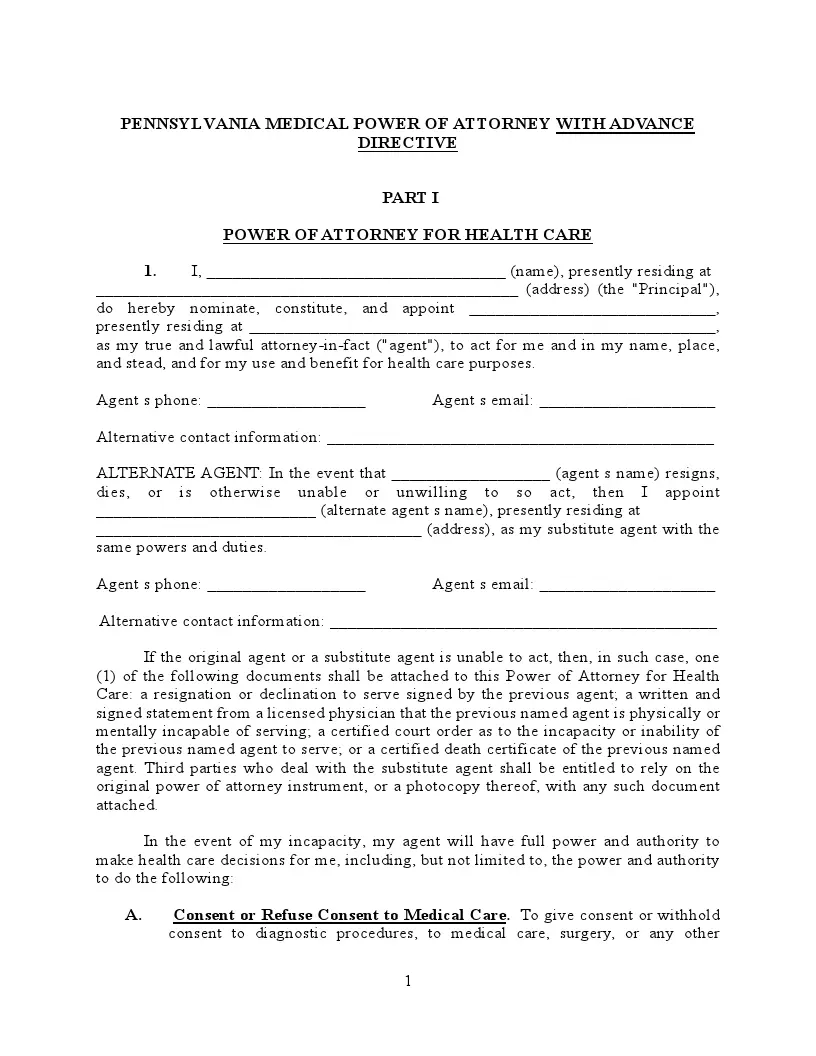
A Pennsylvania medical power of attorney lets you appoint a person you trust, called your agent, to speak for you on health care matters when you cannot. The agent deals with doctors and hospitals on your behalf and can ask for your medical records. The powers are the ones written in the form you sign.
The FormsPal template is titled Pennsylvania Medical Power of Attorney with Advance Directive. Part I names your agent and an alternate agent, Part II states end-of-life wishes, and Part III holds general provisions. For other documents, browse our Pennsylvania power of attorney forms, or read how the medical power of attorney form works in general.
Pennsylvania’s signing rules for a health care power of attorney sit in one section of the Pennsylvania Consolidated Statutes, 20 Pa.C.S. § 5452.[1] They cover how the document is signed, who may sign for you and who may witness it. The sections below put each rule in plain words. Pennsylvania law also lets a health care power of attorney be in any written form that identifies you, appoints a health care agent and declares that you authorize the agent to make health care decisions on your behalf.[2]
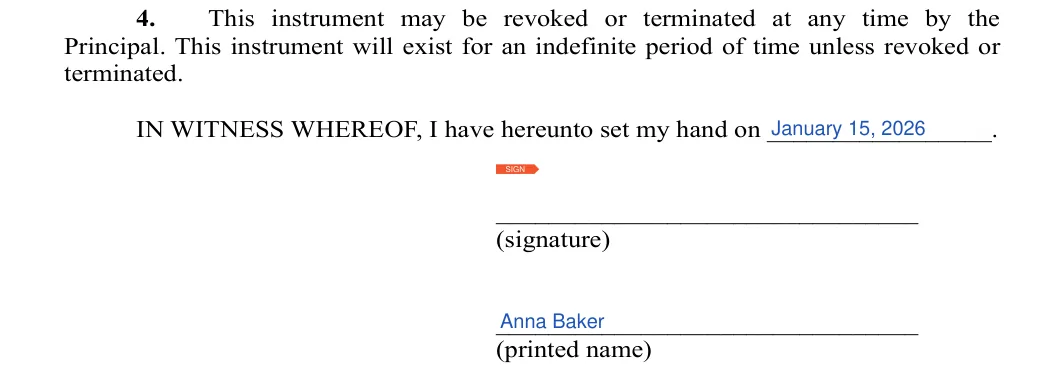
A Pennsylvania health care power of attorney must be dated and signed by the principal, by signature or mark. If the principal is unable to sign but specifically directs another individual to sign, that individual may sign on behalf of and at the direction of the principal.[1]
A health care provider and its agent may not sign on a principal’s behalf if the provider or agent provides health care services to the principal.[1]
The document must also be witnessed. The statute puts the rule this way.
witnessed by two individuals, each of whom is 18 years of age or older.
That means two witnesses, and each one must be an adult. An individual who signs the document on behalf of and at the direction of the principal may not witness it.[1]
Page 7 of the template is a notary acknowledgment that a notary public completes. Notarization of the document is not required by Pennsylvania law. The form set out in 20 Pa.C.S. § 5471 notes that a document that is both witnessed and notarized is more likely to be honored by the laws of some other states.[2]
Before you fill in the form, it helps to talk through a few points with the person you want as agent. This is common practice, not a Pennsylvania rule.
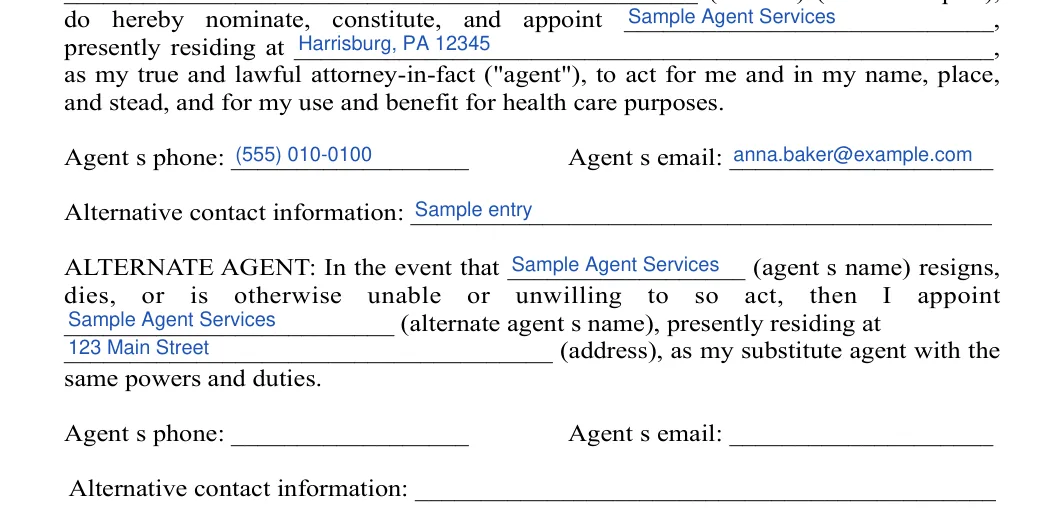
The form states that only one original is executed and that your agent may make photocopies. Page 1 asks for a phone number, an email address and an alternative contact line for both the agent and the alternate agent, so have these ready.
| Document Name | Pennsylvania Medical Power of Attorney Form |
| FormsPal Template | Pennsylvania Medical Power of Attorney with Advance Directive, nine pages |
| State Law | 20 Pa.C.S. § 5452[1], in Subchapter C, sections 5451 to 5465[2] |
| Signing Requirements | Dated and signed by the principal[1], with two witnesses who are 18 or older[1] |
| Who Can’t Witness | An individual who signs on the principal’s behalf[1] |
| Who Can’t Be the Agent? | Your attending physician or other health care provider, or an owner, operator or employee of a health care provider in which you are receiving care, unless related to you by blood, marriage or adoption[2] |
| Avg. Time to Fill Out | 8 minutes |
| # of Fillable Fields | 29 |
| Available Formats | Adobe PDF |
Popular Local Medical POA Forms
MPOA templates are some of the most commonly used ones in the USA. The following are probably the most asked durable power of attorney papers.
The FormsPal template has three parts, a signature page, a notary acknowledgment, a page of general information and a witness page. What each part says comes from the printed text of the form, not from the statute. Read all nine pages before you sign.
The advance directive is a serious statement about end-of-life care. If it does not match what you want, talk to a lawyer or your doctor before you sign. You can also compare it with our Pennsylvania living will form.
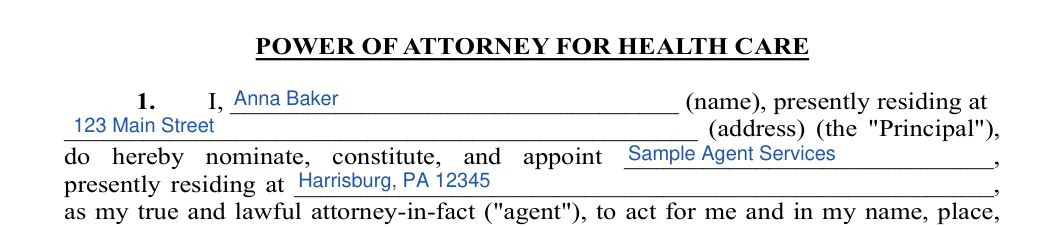
The form has 29 fillable fields, on pages 1, 6, 7 and 9. The six steps below follow the form in order. Pages 2 to 5 and page 8 are printed text with no blanks, so read them before you sign. To fill in the downloaded PDF on screen, use our online PDF editor.
The screenshots under each step show the FormsPal Pennsylvania medical power of attorney template filled with sample entries in blue, so you can see where each answer goes. The names, addresses, dates and amounts are examples only.
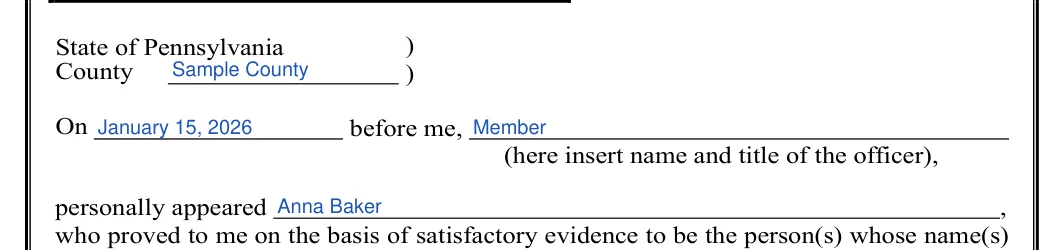

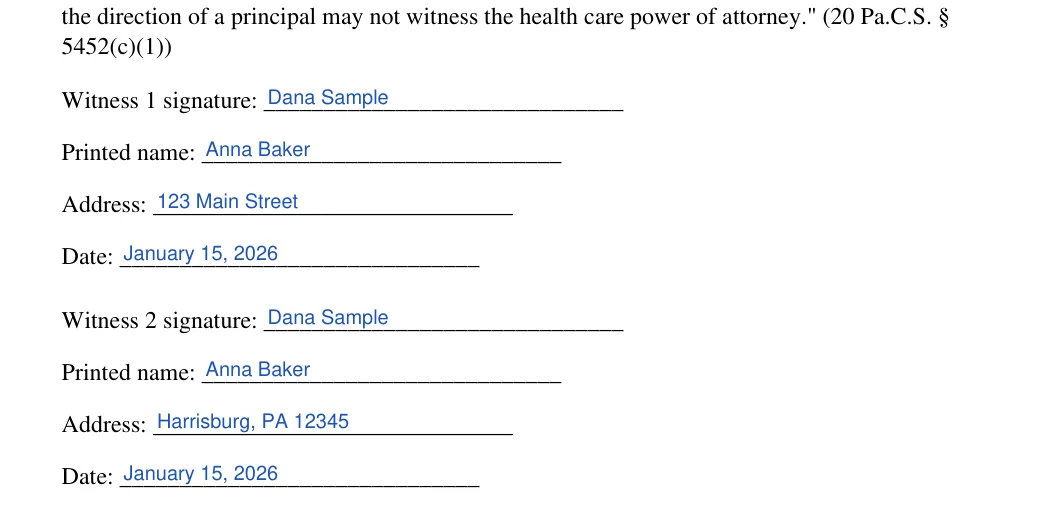
Filling in the blanks is only part of the job. The steps below cover what happens around the form. They run from getting the template and reading its printed pages to signing, finding witnesses and sharing copies with the people who need them.
Two. The document must be witnessed by two individuals, each of whom is 18 years of age or older.[1] The FormsPal template has a witness block for both people on page 9, with a line for each witness’s signature, printed name, address and date.
Each witness must be 18 years of age or older. An individual who signs the document on behalf of and at the direction of the principal may not witness it.[1]
If you are unable to sign but specifically direct another individual to sign, that individual may sign on your behalf and at your direction. A health care provider and its agent may not do so if they provide health care services to you.[1]
Yes. Pennsylvania requires the document to be dated and signed by the principal.[1]

You can download the Pennsylvania medical power of attorney as a PDF with 29 fillable fields, or build it online and print it. Either way, date and sign it, and have it witnessed by two individuals who are 18 or older.[1]
General information, not legal or tax advice.
