
A California durable power of attorney is a written document that lets you name an agent to manage your financial affairs on your behalf. It is one kind of durable power of attorney form, and it applies to financial matters only, not health care decisions or anything you have not stated in writing.
A power of attorney becomes durable when it stays valid after the principal, the person who signs it, becomes incapacitated. A general power of attorney is not durable. It ends automatically when the principal becomes incapacitated or dies, which is why many people choose a durable form instead.
California power of attorney forms – visit to get more California-specific power of attorney templates that you may require.
Build Your Document
Answer a few simple questions to make your document in minutes
Save and Print
Save progress and finish on any device, download and print anytime
Sign and Use
Your valid, lawyer-approved document is ready
Last Updated: September 2026. This guide is reviewed and updated regularly to reflect current California law. If you notice an error or outdated information, please contact us.
There is another term that you need to know before signing a durable power of attorney form. The person you appoint to act on your behalf in your power of attorney form would be called an “agent” or “attorney-in-fact” in the document. The two terms mean the same person and are used interchangeably throughout this guide and in the form itself.
There are several reasons to sign a durable power of attorney and name an agent. Having one in place means your family can manage your financial affairs without going to court if you become incapacitated. Without a signed power of attorney, a family in that position may instead have to ask the court for a conservatorship, a court-supervised arrangement in which a judge appoints someone to manage the incapacitated person’s affairs. A conservatorship can involve ongoing court oversight, hearings, and legal costs that a power of attorney avoids.
Choose an agent you trust completely, ideally someone who is also a beneficiary under your will.
Your agent, also called your attorney-in-fact, does not need to be a lawyer. Choose someone you trust to act in your best interest, such as a spouse, adult child, or close friend.
Before you sign, decide three things. Thinking this through in advance makes completing the form faster and reduces the chance you will need to redo it later.
Under Cal. Prob. Code § 4121, a valid California power of attorney must meet several formal requirements. The document must state the date it was signed, and it must be signed either by the principal or by another adult who signs in the principal’s name, in the principal’s presence and at the principal’s direction.
None of the witnesses may be the attorney-in-fact, and all witnesses must be adults.
To make the power of attorney durable, state in the document that it will not be affected by your incapacity.[2] You can instead make it a springing power of attorney, which becomes effective only once you become incapacitated, using the same section’s model language.[2] If the document does not include either statement, it takes effect immediately when you sign it.
Always think in advance what kind of powers you want to delegate to your attorney-in-fact, since these are the same categories you will initial on the form itself. These are just some of the examples of the categories of transactions that they can take care of for you:
| Document Name | California Durable Power of Attorney Form |
| Other Names | California Financial Durable Power of Attorney, CA DPOA |
| Relevant Laws | California Probate Code, Division 4.5 |
| Signing Requirements | Notary Public OR Two Witnesses |
| Avg. Time to Fill Out | 10 minutes |
| # of Fillable Fields | 37 |
| Available Formats | Adobe PDF |
Popular Local Durable POA Forms
DPOA docs are among the most commonly used ones within the USA. Here are some of the most requested durable power of attorney papers.
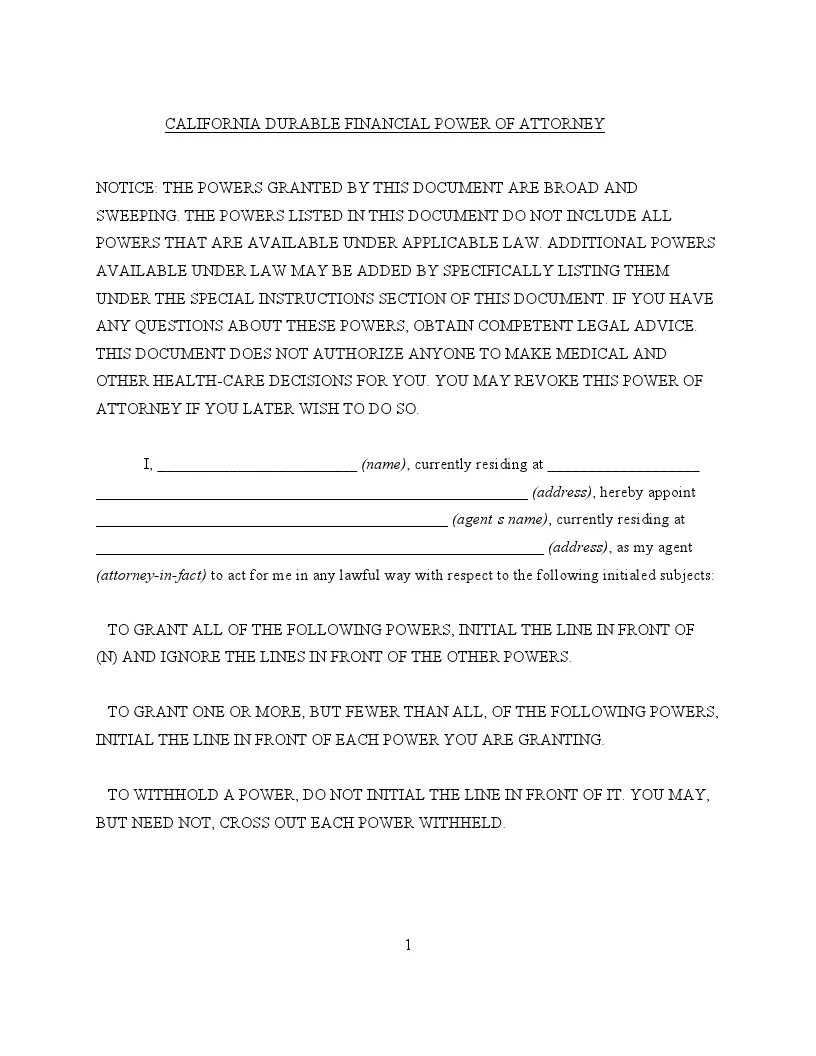
The California durable power of attorney form has seven parts to fill out, from naming your agent to signing before a notary public. Use FormsPal’s document builder above to complete every part automatically, or follow the steps below to fill out the downloaded PDF by hand. Each step names the page of the form where you will find it.
This particular form includes a notary acknowledgment but no separate signature lines for two witnesses. If you plan to sign before witnesses instead of a notary, attach a separate witness attestation that meets the state’s witness requirements. Keep it with the signed form, since a financial institution may ask to see it before honoring the document.


California law sets specific ways a power of attorney can be revoked and specific events that end an agent’s authority automatically.[4] The principal can revoke it at any time in the way the document itself allows, and a revocation in writing cannot be limited by anything the document says.[3] Termination is different from revocation: it happens automatically, without the principal needing to do anything, whenever one of the following events occurs.
An attorney-in-fact or another person who has not been told about a revocation or another terminating event is protected from liability if they continue to act in good faith under the power of attorney.[3][4]
Download the California durable power of attorney form below as a free PDF, or use FormsPal’s online builder above to create and print a personalized version in minutes. The downloadable form is the same document referenced throughout this guide. The online builder walks you through the same sections as the PDF, prompts you for any missing information, and lets you save your progress and finish later on any device or browser session.
This page is general information about California durable powers of attorney, not legal advice. For advice about your situation, talk to a California attorney.
Unless noted otherwise, the sources below are from the California Probate Code, published by the California Legislative Information.