
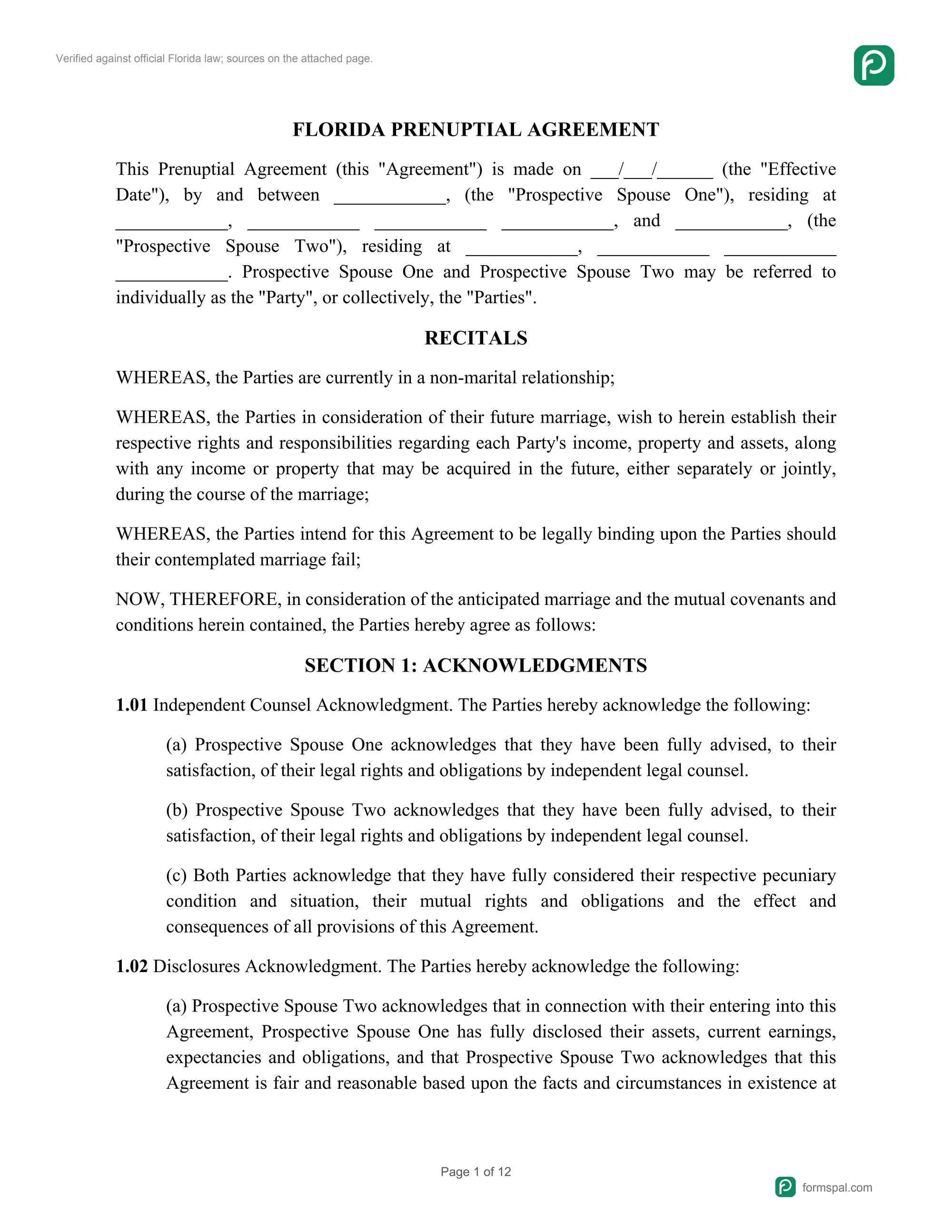
A Florida prenuptial agreement is a written contract two people sign before they marry that sets out how property, debt, and spousal support will be handled if the marriage ends. Florida law calls it a premarital agreement and defines it as an agreement between prospective spouses made in contemplation of marriage and effective upon marriage.[1]
Under section 61.079 of the Florida Statutes the document must be in writing and signed by both parties.[1] It takes effect the day you marry.[1] A blank prenuptial agreement template gives you the structure, and the rules below decide which terms a Florida court will enforce.
Build Your Document
Answer a few simple questions to make your document in minutes
Save and Print
Save progress and finish on any device, download and print anytime
Sign and Use
Your valid, lawyer-approved document is ready
Section 61.079 of the Florida Statutes is the single law that governs prenuptial agreements in this state. It sets out who may sign, what these agreements can cover, when they take effect, and the grounds on which a court may refuse to enforce one. A premarital agreement is enforceable without consideration other than the marriage itself.[1]
Timing is fixed by the statute too. The contract becomes effective upon marriage of the parties, so a signed document has no legal force if the wedding never happens.[1]
Popular Local Prenuptial Agreement Forms
A Florida prenuptial agreement is valid when it is in writing, signed by both parties, and entered into voluntarily by each spouse.[1] No payment or exchange is needed beyond the marriage itself.[1] The contract then becomes effective upon marriage.[1] Honest disclosure of assets is what protects it if one spouse later attacks it in court.
Section 61.079 asks for two things and nothing more. The contract must be in writing, and both parties must sign it.[1] The statute names no notary, no witnesses, and no filing with a court.[1]
Many couples still sign in front of a notary. That is a practical precaution rather than a legal requirement, and it makes the signatures easier to prove years later.
The statute sets no waiting period before the wedding. Signing weeks or months ahead still helps, because a document produced days before the ceremony invites a later claim that one spouse had no real choice.
Each spouse should hand over a fair and reasonable disclosure of their assets and financial obligations before signing.[1] A spouse may waive it, but only voluntarily and expressly, in writing.[1] Thin financial information is not enough on its own to undo an agreement. It counts when a court also finds the contract was unconscionable when it was executed.[1]
Section 61.079 lists the subjects prenuptial agreements may settle.[1] The list is broad and reaches assets, spousal support, estate planning, and the law used to read it. Other matters are open too, as long as they do not violate Florida public policy or a law imposing a criminal penalty.[1]
Two limits sit outside the couple's control, and both exist to protect people who cannot bargain for themselves. A premarital agreement may not adversely affect a child's right to support.[1] A spousal support waiver also gives way when it would push one spouse onto public assistance. The court may then order the other spouse to provide support to the extent necessary to avoid that.[1]
A Florida court will refuse to enforce one of these agreements when the challenging spouse proves either of two things. Either that spouse did not execute the agreement voluntarily, or the deal was the product of fraud, duress, coercion, or overreaching.[1] A third route exists for terms that were unconscionable when they were signed.
An issue of unconscionability of a premarital agreement shall be decided by the court as a matter of law.
The judge decides that question, and the test looks at the day the contract was signed rather than the day of the divorce.[1]
Most prenuptial agreements that fail in Florida fail for one of the same handful of avoidable reasons.
Yes. Florida enforces prenuptial agreements that meet section 61.079.[1] The spouse who wants out must prove one of the statutory defenses. An agreement put in writing, signed by both parties, and backed by honest disclosure of assets is hard to unwind years later.
Waiting does not help a spouse who wants to challenge it. Any statute of limitations on a claim under a premarital agreement is tolled during the marriage, so the clock does not run while the couple stays together.[1]
A void marriage is the one case where the document survives only in part. If a marriage is determined to be void, the agreement is enforceable only to the extent necessary to avoid an inequitable result.[1]
A valid prenup can place almost any asset beyond a divorce court's reach. The parties may fix their rights and obligations in any property of either or both of them, whenever and wherever it was acquired.[1] Two things stay outside the couple's control, whatever the contract says.
Without a prenup, Florida's default property division is equitable distribution rather than an automatic 50-50 split, and assets one spouse owned before the marriage are generally non-marital. Prenuptial agreements let you protect a house, an account, or a business by naming it as separate, whatever the title says, instead of leaving the division to a judge.
Start from the form above, fill in the terms the two of you have agreed, and sign before the wedding. The steps below follow what section 61.079 requires, from disclosure through both signatures.[1] Give yourselves enough time that neither spouse is reading it for the first time on the day it is signed.
After the wedding you cannot rewrite the deal by conduct or by a handshake. A premarital agreement may be amended, revoked, or abandoned only by a written agreement signed by the parties.[1] Keep the signed original with your other legal papers so the two versions are easy to compare in future.
Last Updated: September 2026. This guide is reviewed and updated regularly to reflect current Florida law. If you notice an error or outdated information, please contact us.

Other Prenuptial Agreement Forms by State