
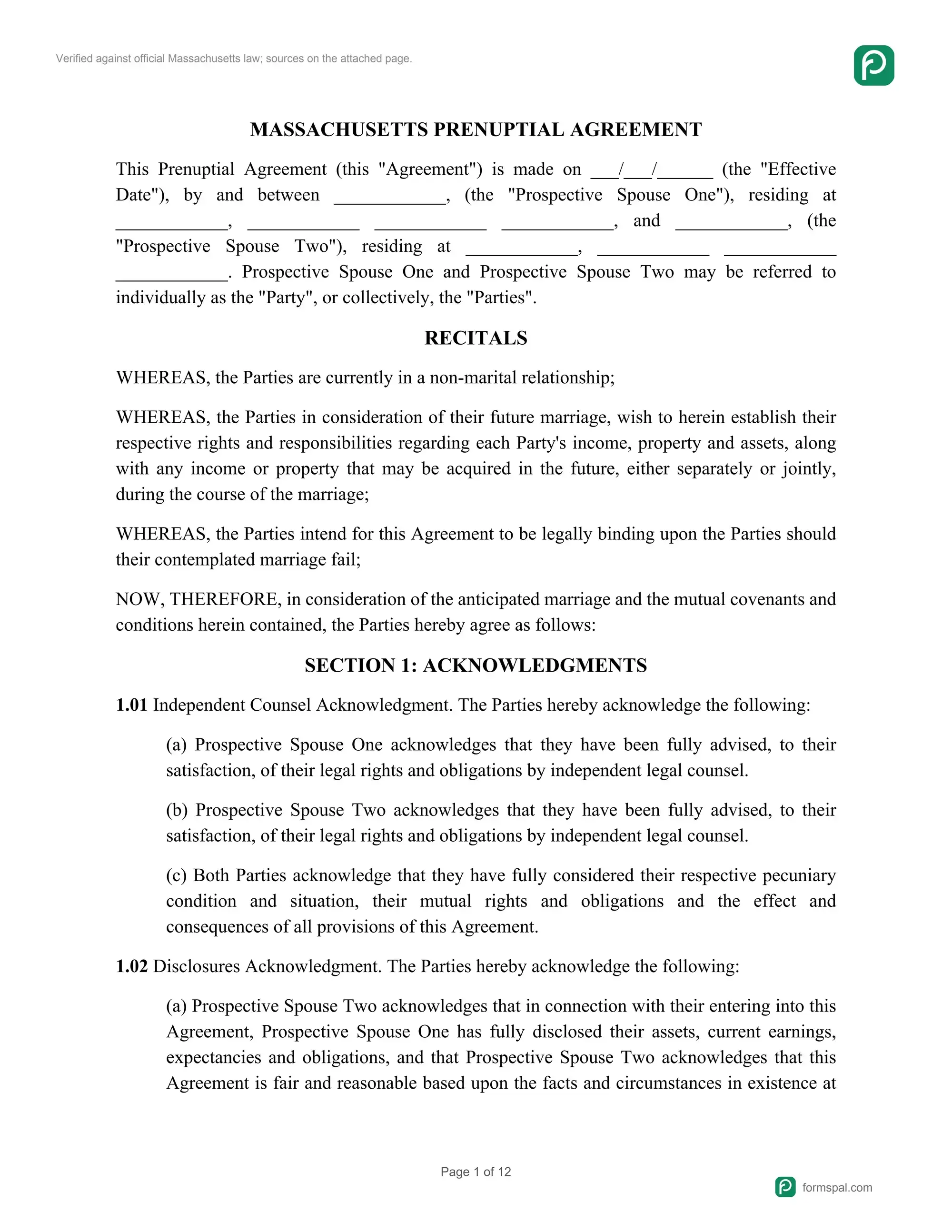
A Massachusetts prenuptial agreement is a written contract signed before the wedding. It decides who keeps the real estate, personal property, and rights of action each spouse owns at the time of the marriage if that marriage later ends. The parties may make it at any time before marriage.[1] Its limitations then take effect the moment the marriage is solemnized, as if they sat in a deed conveying the property.[1]
A prenuptial agreement can reach property, debt, and spousal support. Massachusetts law does not let it set child support. Until it is recorded, it is void as to everyone except the two spouses and their heirs and personal representatives.[2] Use the form above, or build the same document for another state from our prenuptial agreement template.
Build Your Document
Answer a few simple questions to make your document in minutes
Save and Print
Save progress and finish on any device, download and print anytime
Sign and Use
Your valid, lawyer-approved document is ready
Couples use a prenup to settle three questions while they still agree on the answers:
A prenup lists the assets and debts each spouse brings in and sets rules for assets acquired in the future. Couples reach for these contracts most often when their incomes differ sharply, when one of them owns a business, or when either has children from an earlier marriage.
Popular Local Prenuptial Agreement Forms
Massachusetts covers prenuptial agreements in two sections of Chapter 209 of the General Laws. Section 25 lets the parties make a written contract before marriage and says what the document may do to their property.[1] Section 26 adds the paperwork, namely a schedule of the affected property and recording in the registry of deeds.[2] Massachusetts law sets the form of the document, and case law supplies the fairness test a judge applies. Both sections are short, and both deal only with antenuptial agreements.
Section 25 asks for one thing, a written contract.[1] The parties may make it at any time before the marriage, from the engagement up to the day of the ceremony.[1] Massachusetts law requires no notary and no witness for the document itself.[1][2]
Each spouse signs it, and each signature should be voluntary. Many couples still sign in front of a notary, since a notarized signature is harder to dispute later. Signing well before the wedding, rather than days before it, removes any argument that one spouse was rushed.
A prenup is not complete on its own. Section 26 requires a schedule of the affected property, annexed to the contract.[2] The description has to be clear enough that a creditor of either spouse can tell that property from everything else the couple owns.[2]
That creditor test is the drafting standard. "My investment accounts" does not meet it. Name the institution, the account type, and the balance on a stated date, and do the same for real estate, vehicles, and business assets.
The prenup and its schedule have to be recorded, and there is a deadline. File them either before the marriage or within ninety days after it.[2]
Which registry of deeds receives the filing depends on where the spouses live:[2]
A schedule of the property intended to be affected, containing a sufficiently clear description thereof to enable a creditor of the husband or wife to distinguish it from other property, shall be annexed to such contract; and such contract and schedule shall, either before the marriage or within ninety days thereafter, be recorded in the registry of deeds for the county or district where the husband resides at the time of the record, or, if he is not a resident of this commonwealth, then in the registry of deeds for the county or district where the wife resides at the time of the record, if it is made before the marriage, or where she last resided, if made after the marriage. If the contract is not so recorded, it shall be void except as between the parties thereto and their heirs and personal representatives.
Missing the ninety-day deadline does not destroy your prenup between the two of you. An unrecorded prenup stays binding on the spouses and on their heirs and personal representatives. What it loses is effect against everyone else, so a creditor may treat those assets as though the prenup never existed.[2]
The Secretary of the Commonwealth lists every registry of deeds and the towns each one covers on its official website.
A Massachusetts prenup can cover the whole or any designated part of the real or personal property either spouse is possessed of at the time of the marriage, and any right of action as well. Under its terms that property remains or becomes the property of one spouse.[1] It may also limit to a husband or wife an estate in fee or for life in any part of the property, and may designate any other lawful limitation.[1]
That last clause is where spousal support and debt terms fit, since the law does not list the permitted subjects one by one.
Couples most often use a prenup for:
Four things belong outside prenuptial agreements:
Yes. Chapter 209 of the General Laws authorizes prenuptial agreements in two sections. Section 25 lets the parties make a written contract at any time before the marriage, and Section 26 makes that agreement effective against creditors once it is recorded.[1][2] Massachusetts courts still apply a two-look test: the agreement must be fair and reasonable when it is signed, and again when a spouse asks a court to enforce it.
Massachusetts family law reviews prenuptial agreements through what practitioners call the first look and the second look. On the first look a judge examines how the prenup was negotiated and executed. The question is whether the bargain was fair and reasonable at that moment.
Massachusetts law does not require separate legal counsel for each party. Independent advice still makes the first look easier to survive, because it is harder to argue afterwards that a party did not understand the terms.
The second look happens at the divorce. A court asks whether enforcing the prenup now would leave one spouse unable to support themselves, and whether the result is still fair and reasonable. A prenup that looked reasonable at execution can still fail this step, if enforcing it years later would strip a spouse of substantially all marital rights. Under current Massachusetts law, courts generally enforce prenuptial agreements that clear both looks.
A prenup works by fixing in advance what a court would otherwise decide in the event of a divorce or a death. The couple signs before they are married. Its limitations take effect the moment the marriage is solemnized, exactly as if they had been written into a deed conveying the property.[1] Recording it extends that effect to creditors and other third parties.[2]
The statute does not prescribe a drafting process, but in practice the sequence runs like this:
Either spouse can change course in the future. A written amendment from both parties adjusts the terms, and a written revocation ends it.
Last Updated: September 2026. This guide is reviewed and updated regularly to reflect current Massachusetts law. If you notice an error or outdated information, please contact us.

Other Prenuptial Agreement Forms by State
Unless noted otherwise, the sources below are from the M.G.L. c. 209,.