
A Virginia prenuptial agreement is a written contract signed before the wedding that sets out how property, debt, and spousal support will be handled if the marriage ends. Virginia law calls it a premarital agreement. It binds without consideration, and it takes effect the moment the couple marries.
The Virginia Premarital Agreement Act supplies the rules, at Sections 20-148 through 20-155. It fixes what these agreements may cover, the formalities that make it valid, and the narrow grounds for refusing to enforce it.[1] The contract cannot settle child support or custody. We publish a prenuptial agreement template for every state.
Build Your Document
Answer a few simple questions to make your document in minutes
Save and Print
Save progress and finish on any device, download and print anytime
Sign and Use
Your valid, lawyer-approved document is ready
Divorce is not the only trigger. Section 20-150 of the Va. Code lets the agreement decide how property passes on separation, on marital dissolution, and on the death of a spouse.[3] The same section lets the couple name the law that governs how their contract is read.[3]
Before signing, exchange a full list of assets, debts, and income, and keep proof that you did. Section 20-151 lets a court refuse to enforce an agreement that was unconscionable when it was signed.[4] That ground opens only where the challenging spouse never received a fair and reasonable disclosure and never waived it in writing.[4]
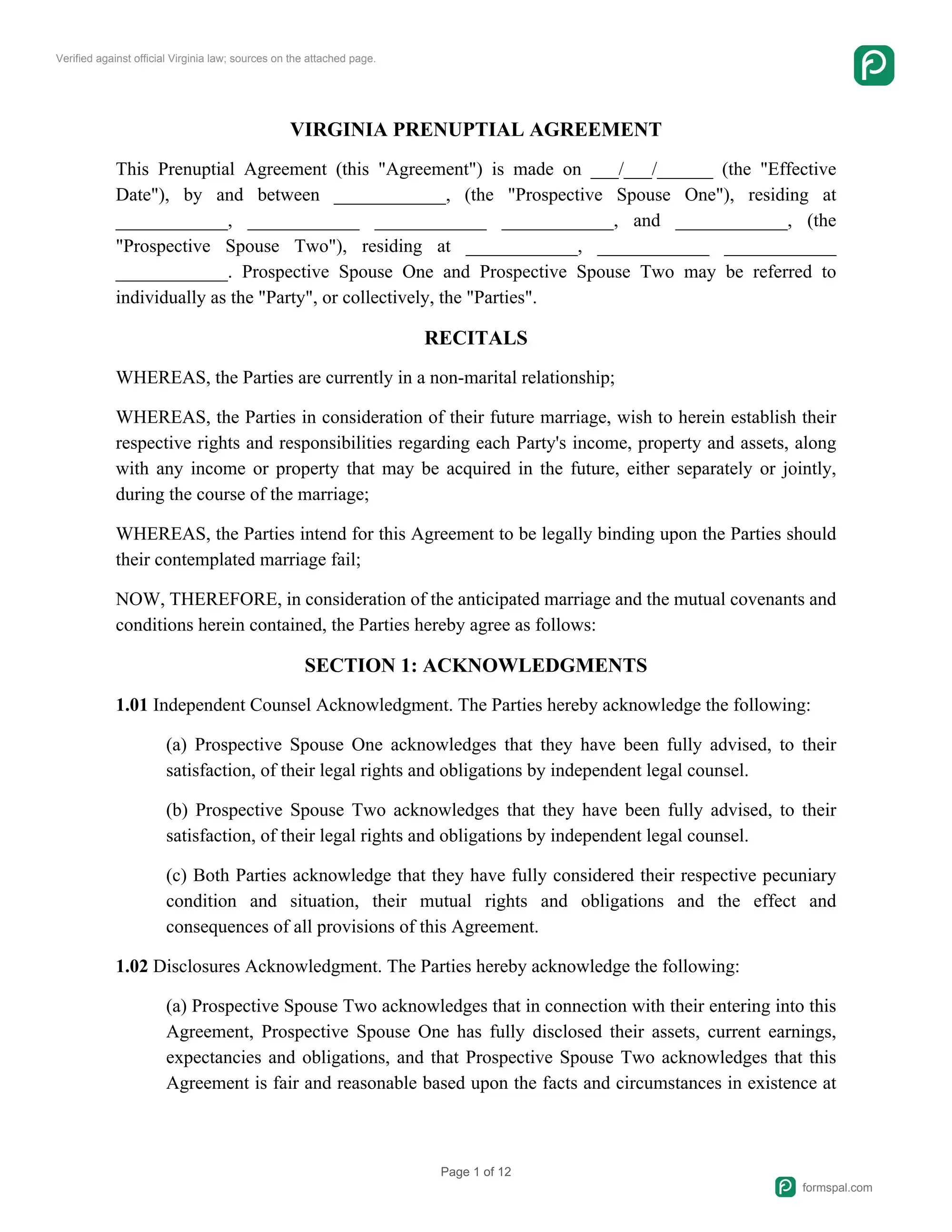
Use our form-building software to generate and download the Virginia Prenuptial Agreement Form.
The Virginia Premarital Agreement Act governs prenups across the Commonwealth. Section 20-148 of the Va. Code defines a premarital agreement as a contract between prospective spouses, made in contemplation of marriage, that is to be effective upon marriage.[1] Sections 20-149 through 20-153 add the signing formalities, the matters the contract may settle, the grounds for refusing to enforce it, and the rule for changing it later.
A premarital agreement shall be in writing and signed by both parties. Such agreement shall be enforceable without consideration and shall become effective upon marriage.
Virginia asks for two things and no more. The agreement has to be in writing, and both parties have to sign it.[2] Neither spouse needs to give the other anything in return, because the statute makes these agreements enforceable without consideration.[2]
The contract then waits for the wedding. It becomes effective upon marriage, so a signed agreement does nothing until the couple actually marry.[2] Virginia does not add a notary or a witness requirement on top of the two signatures.
Married couples are not shut out. Section 20-155 lets spouses settle the same rights and obligations between themselves, except that such marital agreements become effective immediately upon their execution.[7]
Time works differently inside a marriage. Any statute of limitations on a claim under a premarital agreement is tolled during the marriage of the parties.[5] Equitable defenses that limit the time for enforcement, including laches and estoppel, stay available to either party.[5]
One trap catches separating couples. A reconciliation of the parties after the signing of a separation or property settlement agreement shall abrogate such agreement, unless otherwise expressly set forth in the agreement.[7]
Popular Local Prenuptial Agreement Forms
The spouse resisting the contract carries the burden. Section 20-151 makes the contract unenforceable only where that person proves one of the following.[4]
Any issue of unconscionability is decided by the court as a matter of law.[4] Recitations in the agreement create a prima facie presumption that they are factually correct, so a clause reciting that both parties disclosed their finances carries real weight.[4]
The statute reads property broadly. Section 20-148 covers an interest, present or future, legal or equitable, vested or contingent, in real or personal property, including income and earnings.[1] A salary, a pension, a business stake, and a house bought years before the wedding all sit inside that definition.
Without an agreement in place, a divorcing couple fall back on Section 20-107.3. The court sorts each asset and debt into separate property, marital property, or part separate and part marital.[8] It then weighs a list of statutory factors to reach a fair and equitable monetary award.[8]
Virginia prenuptial agreements can settle far more than who keeps the house. Section 20-150 of the Va. Code sets out the matters the parties may contract about. It closes with a catch-all for any other matter that does not violate public policy or a statute imposing a criminal penalty.[3]
Section 20-150 closes its list of permitted subjects with a limit. A couple may agree on any other matter, including their personal rights and obligations. The term just cannot violate public policy or a statute imposing a criminal penalty.[3] Two kinds of clause fall outside that line.
Child support and custody are the clearest example. Virginia courts decide those questions on the child’s best interests at the time they arise, so prenuptial agreements cannot settle them in advance.
The criminal-penalty limit does the rest of the work. A term that pays a spouse for conduct the criminal law punishes, or that tries to contract around it, sits outside what Section 20-150 allows.[3]
Yes. A Virginia premarital agreement that is in writing and signed by both parties binds them from the day they marry, and it needs no consideration to do so. A court will refuse to enforce it on only two grounds. The spouse resisting it must prove that the signature was not voluntary, or that the deal was unconscionable and made without fair financial disclosure.[4]
Everything else is argument about the facts. Because recitations in the agreement are presumed factually correct, a careful prenup that records the disclosure each spouse made is hard to unpick years later.[4]
Yes, but only on paper. Both spouses have to agree, and the change has to be written down and signed. After marriage, Section 20-153 allows a premarital agreement to be amended or revoked only by a written agreement signed by the parties.[6] A spoken promise will not do it.
The amendment costs nothing to make binding. The amended agreement, or the revocation, is enforceable without consideration, so neither spouse has to pay the other for the change to hold.[6]
Yes. Virginia puts no attorney between a couple and a valid prenup. Section 20-149 asks only that the agreement be in writing and be signed by both parties, so many couples draft one themselves or start from a template.[2] The risk sits in Section 20-151 instead, where an agreement signed without fair and reasonable financial disclosure is the kind a court can refuse to enforce.[4]
The steps below follow the order the statute assumes.
Family law attorneys for each spouse are not required in Virginia, but both statutory attacks on a prenup are about process rather than price. Rushed timing feeds the voluntariness challenge, and a thin financial disclosure feeds the unconscionability challenge.
Last Updated: September 2026 - This guide is reviewed and updated regularly to reflect current Virginia law. If you notice an error or outdated information, please contact us.

Other Prenuptial Agreement Forms by State
Unless noted otherwise, the sources below are from the Va. Code.