
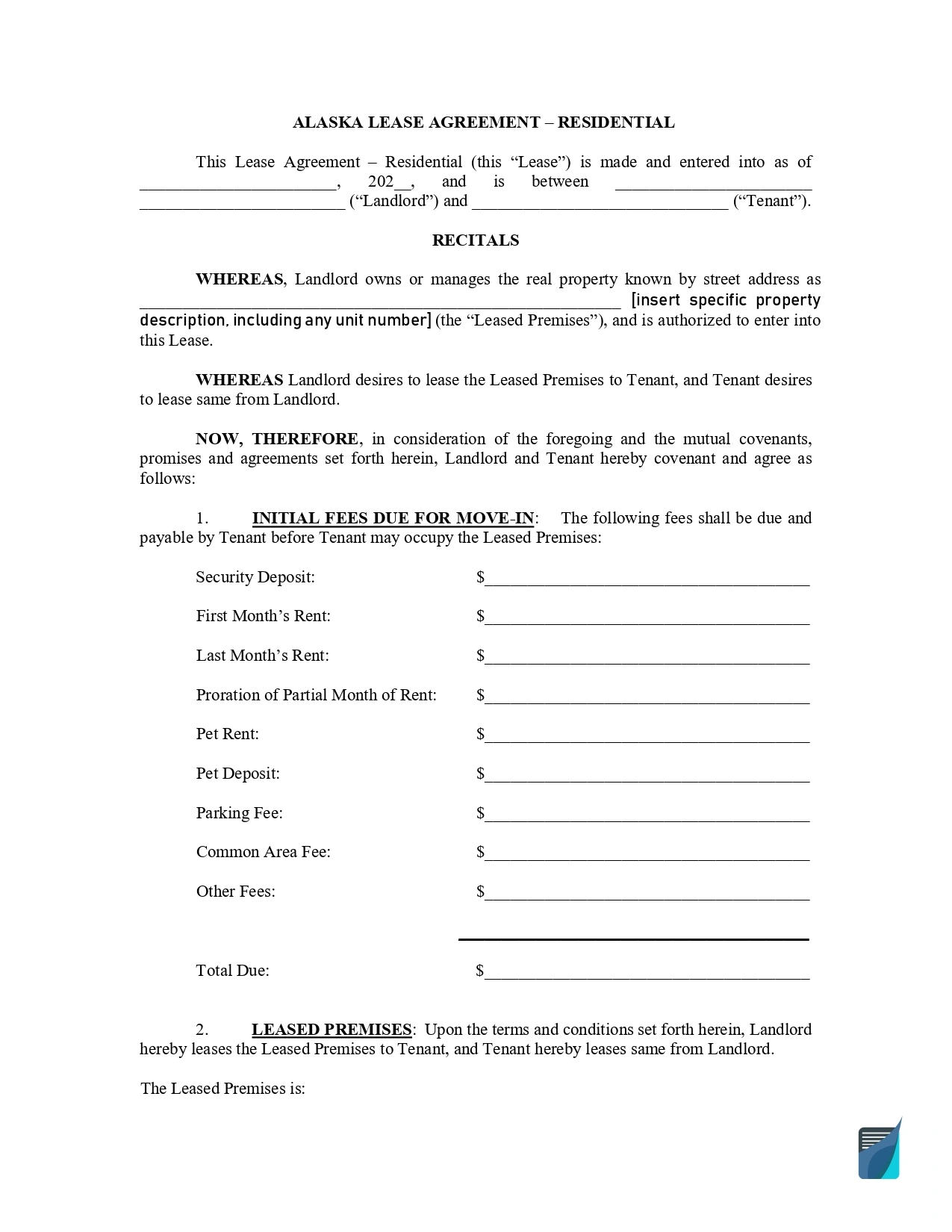
The Alaska rental lease agreement is a legally binding contract between a landlord and a tenant that outlines the terms under which the tenant can rent property from the landlord. This document specifies details such as the duration of the lease, the rent amount, and the payment schedule. The Alaska lease agreement also covers the responsibilities of each party’s maintenance, repairs, and utilities.
Last Updated: September 2026. This guide is reviewed and updated regularly to reflect current Alaska law. If you notice an error or outdated information, please contact us.
Build Your Document
Answer a few simple questions to make your document in minutes
Save and Print
Save progress and finish on any device, download and print anytime
Sign and Use
Your valid, lawyer-approved document is ready
Every rental lease agreement in Alaska must follow the state’s landlord-tenant law. Tenants often handle minor upkeep, such as replacing light bulbs or air filters, while the landlord covers major repairs and structural issues.
An Alaska rental lease agreement is also called an Alaska residential lease agreement or an AK rental lease. Both names refer to the same document.
Alaska’s landlord-tenant law is the Alaska Uniform Residential Landlord and Tenant Act, found in Alaska Statutes Title 34, Chapter 3. This law sets the cap on a security deposit, the deadline for returning it, and the notice a landlord or tenant must give to end a month-to-month or week-to-week tenancy. It also sets what a landlord must tell a tenant in writing before the tenancy begins. The sections below cover what an Alaska lease agreement must follow under this law.
Alaska law caps a security deposit at two months’ periodic rent, however the landlord describes it. A landlord who wilfully fails to comply with these deposit rules risks paying the tenant up to twice the amount wrongfully withheld.[1.1]
For example, a rental that costs $1,200 a month cannot carry a security deposit above $2,400. A landlord who wrongfully keeps that deposit could end up owing the tenant as much as $4,800.
When the lease ends, the deadline to return the deposit depends on whether the tenant gave proper notice. If the tenant gives the notice the law requires to end the tenancy, the landlord must mail the written accounting and any refund within 14 days after the tenancy ends and the tenant returns possession. That window extends to 30 days when the landlord is deducting for damage.[1.1]
If the tenant does not give that notice, the landlord has 30 days to mail the refund and accounting, counted from when the tenancy ends, the tenant returns possession, or the landlord learns the unit was abandoned.[1.1]
For example, if a lease ends June 1 and the tenant gave proper notice, the refund is due by June 15, or by July 1 if the landlord is deducting for damage. Count either deadline with our deadline calculator.
Before the tenancy begins, Alaska law requires the landlord to tell the tenant in writing who manages the property. The tenant must also be given the name and address of the owner, or of the person authorized to act for the owner for legal notices.[1.2]
Either the landlord or the tenant can end a month-to-month tenancy with written notice given to the other at least 30 days before the rental due date named in the notice. A week-to-week rental, while rent is current, can be ended by either side with written notice at least 14 days before the termination date named in the notice.[2]
In Alaska, various lease agreements accommodate different rental needs and scenarios. These agreements are tailored to the specifics of the rental arrangement, such as the duration of the lease and the type of property involved:
| Document Name | Alaska Rental Lease Agreement Form |
| Other Names | AK Rental Lease, Alaska Residential Lease Agreement |
| Relevant Laws | Alaska Stat. §§ 34.03.070, 34.03.080, 34.03.290 |
| Security Deposit Amount | Two months’ periodic rent |
| Security Deposit Return | 14 days with proper notice (30 days if the landlord deducts for damage, or if the tenant gave no notice) |
| Avg. Time to Fill Out | 18 minutes |
| # of Fillable Fields | 119 |
| Available Formats | Adobe PDF |
After you download the file, you can fill it in and sign it using our online PDF editor.
Most disputes over an Alaska lease agreement come from decisions made before move-in, not after. Avoiding a few common mistakes when you sign protects both the landlord and the tenant and makes the security deposit and notice rules easier to enforce later.
The questions below answer what Alaska tenants and landlords most often ask about a lease agreement, including the deposit limit, the return deadline, and the notice needed to end a month-to-month tenancy. Each answer names the Alaska Statute section it comes from. Topics covered:
If the tenant gives the notice Alaska law requires when ending the tenancy, the landlord must mail the written accounting and any refund within 14 days after the tenancy ends and the tenant returns possession. That window is 30 days if the landlord is deducting for damage, or if the tenant did not give the required notice.[1.1]
Alaska law caps a security deposit at two months’ periodic rent, no matter what the landlord calls it. A landlord who wrongfully withholds part of the deposit can be made to pay the tenant up to twice the amount withheld.[1.1]
Alaska law does not use the term notice to vacate. The closest rule is the notice to end a month-to-month tenancy: either the landlord or the tenant must give written notice at least 30 days before the rental due date named in the notice.[2] If you need a formal eviction notice instead, see our eviction notice forms.

General information, not legal or tax advice.
Unless noted otherwise, the sources below are from the Alaska Statutes.
