
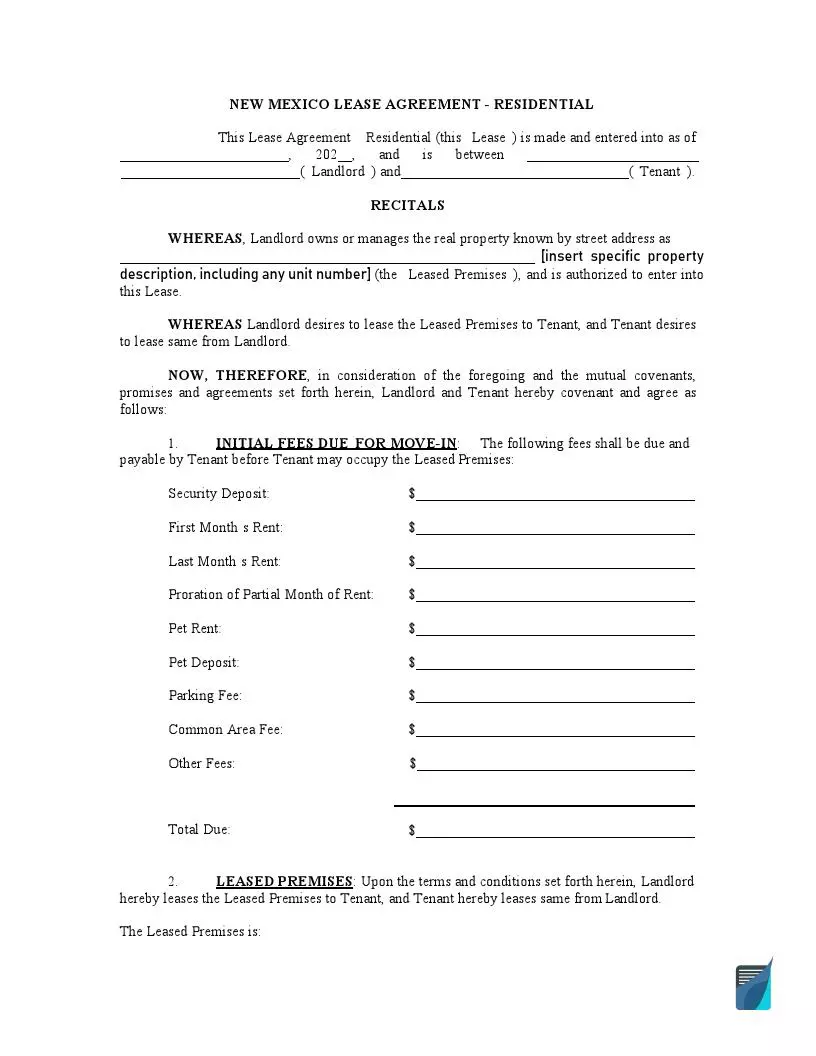
A New Mexico lease agreement is a written contract between a landlord and a tenant for renting residential property in New Mexico. New Mexico's Uniform Owner-Resident Relations Act governs how the agreement is created and ended, the security deposit, and each party's duties. The lease can run for a fixed term, month-to-month, or week-to-week, and should record the rent, the deposit, and everyone who will occupy the property. Putting the agreement in writing protects both sides if a dispute over rent, repairs, or the deposit comes up later.
Last Updated: September 2026. This guide is reviewed and updated regularly to reflect current New Mexico law. If you notice an error or outdated information, please contact us.
Build Your Document
Answer a few simple questions to make your document in minutes
Save and Print
Save progress and finish on any device, download and print anytime
Sign and Use
Your valid, lawyer-approved document is ready
Most New Mexico leases renew on a month-to-month basis once the initial term ends. The party who wants to end the tenancy then has to send written notice within the time state law allows. A few terms appear throughout this agreement:
New Mexico's Uniform Owner-Resident Relations Act sets the rules that New Mexico rental agreements must follow. It covers required disclosures, the security deposit, late fees, and notice to end the tenancy, plus what happens if the tenant falls behind on rent or abandons the unit. The sections below walk through each rule and what it means for a New Mexico lease agreement.
New Mexico law requires the landlord to give the tenant a written rental agreement before the tenancy begins.[2.6] At or before the start of the residency, the landlord must also disclose two contacts in writing:[2.5]
A complete New Mexico lease agreement generally includes:
Before signing, read the full agreement carefully. FormsPal’s chat with PDF tool can help you work through a long lease and ask questions about specific clauses.
Most New Mexico leases call for the landlord to keep the premises safe and in good repair, including the electrical, plumbing, heating, and hot and cold water systems, along with other facilities and appliances the lease provides.
The tenant is generally expected to keep the premises clean and safe. In practice, this means:
New Mexico caps the security deposit a landlord can charge. For a lease that runs less than one year, the landlord cannot demand or receive more than one month’s rent as a deposit. There is no statutory cap for a lease of one year or longer.[2.3]
No deposit shall be retained to cover normal wear and tear.
A landlord may not keep any part of the deposit to cover normal wear and tear.[2.4] After the tenancy ends, the landlord has thirty days to act, counted from the termination date or the resident’s departure, whichever is later. The landlord must either return the deposit or send an itemized written list of deductions.[2.3]
A landlord who keeps a security deposit in bad faith is liable for a $250 civil penalty payable to the tenant, on top of returning what is owed.[2.3]
Example: Anna Baker rents an apartment in Albuquerque for $1,200 a month under a one-year lease. Her landlord cannot charge more than $1,200 as a security deposit, and if her lease allows a late fee, that fee cannot exceed $120 for a rental period in default.
Some New Mexico leases allow a late fee when the tenant does not pay rent on time. New Mexico law caps that fee at ten percent of the rent due for the rental period in default.[2.2]
New Mexico leases generally limit the property to residential use. Most also prohibit illegal activity on the premises, such as manufacturing or storing controlled substances, unlawful use of weapons, or prostitution.
If the tenant knowingly commits a substantial violation of this kind, or allows another person on the premises to do so, the landlord must deliver written notice describing the time, place, and nature of the violation. The rental agreement then ends on a date at least three days after the tenant receives that notice.[2.7]
When rent is unpaid on the due date, the landlord must give the tenant written notice of the nonpayment and of the intent to end the rental agreement. If the tenant still has not paid within three days of that notice, the landlord may terminate the agreement. The tenant must then immediately give up possession of the unit.[2.7]
Either the landlord or the tenant can end a month-to-month tenancy by giving the other party written notice at least thirty days before the next periodic rental date.[2.9] This includes notice the tenant sends to the landlord, which follows the same thirty-day rule.[1.1]
Ending a week-to-week tenancy takes less notice. Either party may end it with written notice given at least seven days before the termination date stated in the notice.[2.9]
New Mexico law defines abandonment as the resident’s absence from the dwelling for more than seven continuous days, without notice to the landlord. That absence counts as abandonment only once the rent has become delinquent.[2.1]
If the tenant voluntarily surrenders the premises, the landlord must store any personal property left behind for at least fourteen days from the date of surrender. If the resident has abandoned the premises instead, the landlord must store that property for at least thirty days.[2.8]
Either the landlord or the tenant may sue to enforce the lease or the Uniform Owner-Resident Relations Act. If that happens, the party who wins the case is entitled to reasonable attorney’s fees and court costs, as set by the court.[2.10]
A few avoidable mistakes cause most New Mexico deposit and notice disputes:
| Document Name | New Mexico Rental Lease Agreement Form |
| Other Names | NM Rental Lease, New Mexico Residential Lease Agreement |
| Relevant Laws | New Mexico Uniform Owner-Resident Relations Act |
| Security Deposit Amount | One month’s rent for a lease under one year, with no statutory limit for a lease of one year or longer.[2.3] |
| Security Deposit Return | Within 30 days of the termination date or the resident’s departure, whichever is later.[2.3] |
| Avg. Time to Fill Out | 18 minutes |
| # of Fillable Fields | 119 |
| Available Formats | Adobe PDF |
Here are direct answers to the questions New Mexico renters and landlords ask most about security deposits and notice periods. Each answer states the rule in plain terms and cites the exact section of the Uniform Owner-Resident Relations Act it comes from, so you can confirm it against the original statute.
Scuff marks from ordinary living are generally treated as normal wear and tear. New Mexico law does not allow a landlord to keep any part of the security deposit to cover it. A landlord may only deduct for damage beyond normal wear and tear, such as holes in the wall or stains from neglect.[2.4]
A New Mexico landlord has thirty days to act, counted from the end of the rental agreement or the tenant’s move-out, whichever is later. In that time, the landlord must return the security deposit or send an itemized written list of deductions.[2.3]
The cap on a New Mexico security deposit depends on the lease term:[2.3]
A 30-day notice to vacate is the written notice either the landlord or the tenant sends to end a month-to-month tenancy. The notice must reach the other party at least thirty days before the next periodic rental date, and the tenancy ends on that date if the notice was timely.[2.9] This is different from an eviction notice, which FormsPal also offers a free eviction notice template for. A landlord uses that document instead when ending the tenancy because the tenant violated the lease.

The statements in this guide rely on New Mexico’s Uniform Owner-Resident Relations Act and related state statutes. Each entry below lists the source document and the specific sections cited above, grouped by where they come from, so any rule can be checked against the original law.
General information, not legal or tax advice.
