
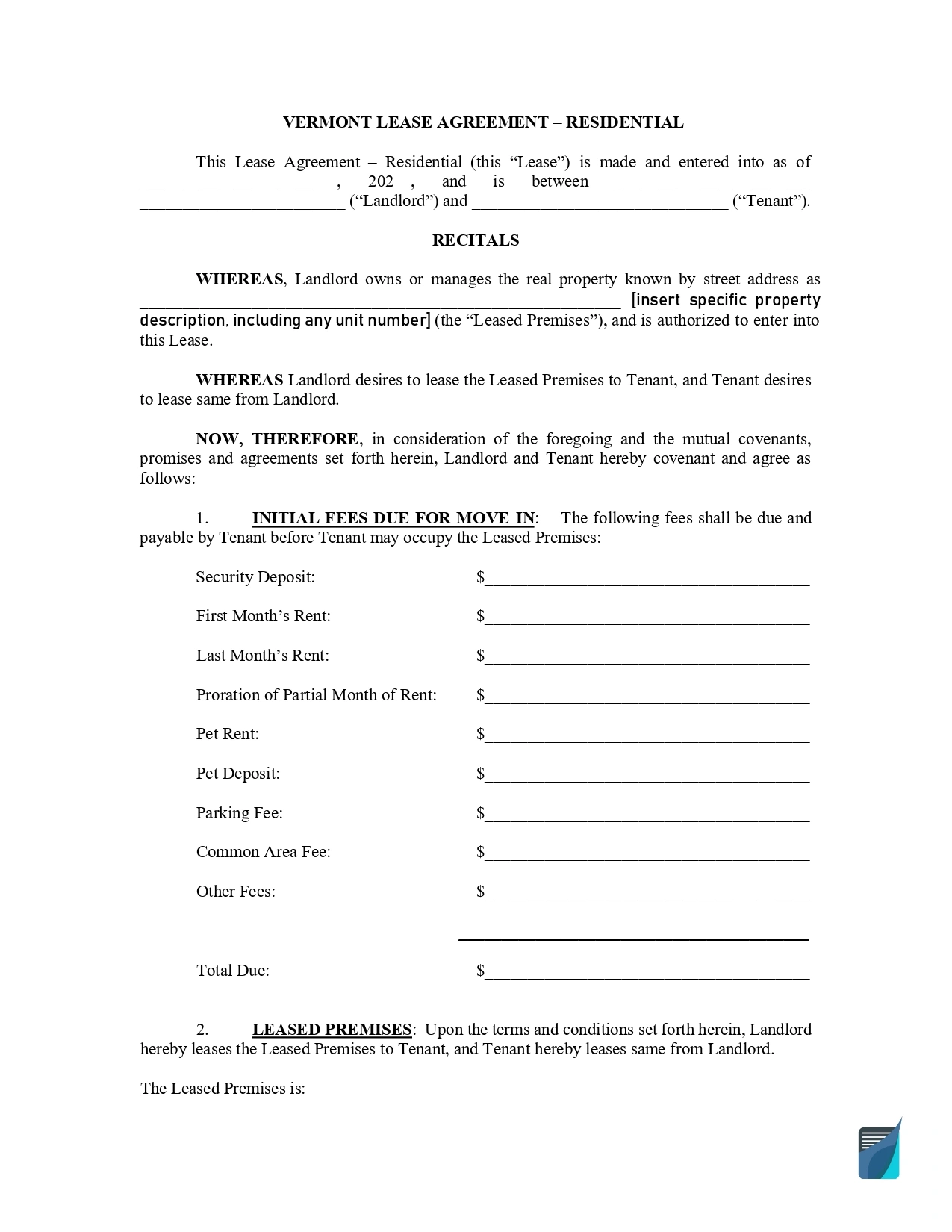
A Vermont lease agreement is a legally binding document that sets the terms under which a tenant may occupy and use a landlord’s property. It covers the length of the tenancy, the rent amount, the payment schedule, and the other terms both parties agree to.
Last Updated: September 2026. This guide is reviewed and updated regularly to reflect current Vermont law. If you notice an error or outdated information, please contact us.
Build Your Document
Answer a few simple questions to make your document in minutes
Save and Print
Save progress and finish on any device, download and print anytime
Sign and Use
Your valid, lawyer-approved document is ready
A written lease protects both the landlord and the tenant by setting out clear expectations, and it must comply with Vermont’s rental laws. FormsPal also offers rental agreement templates for every other state.
Vermont law sets requirements for how landlords handle a tenant’s security deposit, including when it must be returned, what happens if a landlord misses the deadline, and what happens when the property changes owners. These rules are part of Title 9, Chapter 137 of the Vermont Statutes Annotated.
State regulations regarding residential rental agreements can be found in Title 9, Chapter 137 of the Vermont Statutes Annotated.
In Vermont, a security deposit is money a tenant pays up front that the landlord holds as protection against unpaid rent or damage to the unit. Under 9 V.S.A. § 4461(b), the deposit may cover unpaid rent, damage beyond normal wear and tear, unpaid utility or other charges owed to the landlord or a utility, and the cost of removing items the tenant abandoned.[1]
Keep a copy of the signed lease and any move-in notes or photos. They help resolve questions about the condition of the unit if a dispute comes up later.
Vermont law requires the landlord to give the tenant a written statement itemizing any deductions, along with the remaining balance of the deposit. This statement and the balance must reach the tenant within 14 days after the landlord learns the tenant vacated the unit, provided the landlord received notice of the move-out date. For a seasonal rental that is not the tenant’s primary residence, the deadline is 60 days.[1] Use FormsPal’s deadline calculator to count the exact return date from the move-out date.
A landlord who misses this deadline forfeits the right to withhold any part of the deposit. A landlord whose failure to return the deposit is willful is liable for double the amount wrongfully withheld, plus reasonable attorney’s fees and costs.[1]
When a landlord’s interest in the property ends, for example through a sale, the law requires the security deposit to be transferred to the new landlord. The new landlord must then give the tenant actual notice of the new landlord’s name and address, along with a statement confirming the deposit was transferred.[1]
Under 9 V.S.A. § 4460, a landlord must give at least 48 hours' notice and may enter only between 9 a.m. and 9 p.m. to inspect the unit, make necessary or agreed repairs, supply agreed services, or show it to prospective buyers or tenants. Entry without the tenant's consent or notice is allowed only when the landlord reasonably believes there is imminent danger to a person or property.[3] Putting this expectation in writing in the lease helps both sides avoid disputes.
Federal law imposes certain disclosure obligations on landlords, especially for properties built before 1978. A key federal requirement is the disclosure of potential lead-based paint hazards in older properties, under 42 U.S.C. § 4852d.
For housing built before 1978, federal law requires the landlord to give the tenant an EPA-approved pamphlet on lead-based paint hazards and to disclose any known lead-based paint or hazards, with a lead warning statement and the disclosure attached to or included in the lease, before the tenant is bound (42 U.S.C. § 4852d).[4]
Vermont also requires the landlord to disclose, in a separate written notice at or before the lease is signed, whether any part of the rental is in a FEMA-mapped special flood hazard area (9 V.S.A. § 4466).[5]
A thorough rental contract generally covers:
In Vermont, lease agreements come in various forms to suit different rental needs:
All these agreements clearly outline the terms and conditions between landlords and tenants, ensuring that both parties understand their responsibilities and rights.
Vermont law requires a landlord who wants to end a tenancy without cause to give the tenant actual notice before the tenancy ends. How much notice is required depends on whether the tenancy is month-to-month, week-to-week, or for a fixed term, and how long the tenant has lived there.[2]
Vermont tenants have several rights tied to the security deposit. The landlord must return it within 14 days after the tenant moves out, or within 60 days for a seasonal rental. A landlord who misses the deadline forfeits the right to withhold any part of the deposit, and a willful violation makes the landlord liable for double the amount withheld, plus attorney’s fees. If the property is sold, the deposit must be transferred to the new landlord, who must then notify the tenant.[1]
A Vermont landlord must return the security deposit, along with a written statement of any deductions, within 14 days after learning the tenant vacated the unit. For a seasonal rental that is not the tenant’s primary residence, the landlord has 60 days.[1]
Vermont allows a landlord to end a tenancy without cause as long as proper advance notice is given. The notice period depends on the type of tenancy:
These notice periods come from the same Vermont law covered above.[2]
| Document Name | Vermont Rental Lease Agreement Form |
| Other Names | VT Rental Lease, Vermont Residential Lease Agreement |
| Relevant Laws | Vermont Statutes Annotated, Title 9, Chapter 137 |
| Security Deposit Amount | Not specified |
| Security Deposit Return | Fourteen (14) days after the lease ends |
| Avg. Time to Fill Out | 18 minutes |
| # of Fillable Fields | 119 |
| Available Formats | Adobe PDF |

General information, not legal or tax advice.
Unless noted otherwise, the sources below are from the 9 V.S.A..
