
An Iowa quitclaim deed is a written document that transfers the grantor's rights and interest in real estate to the grantee, with no promise that the title is clear. In practice, people often use these deed forms to move property between family members or into a living trust. Because quitclaim deeds carry no title guarantee, a grantee may want to run a title search first.
Last Updated: October 2026. This guide is reviewed and updated regularly to reflect current Iowa law. If you notice an error or outdated information, please contact us.
Build Your Document
Answer a few simple questions to make your document in minutes
Save and Print
Save progress and finish on any device, download and print anytime
Sign and Use
Your valid, lawyer-approved document is ready
Three sections of the Iowa Code shape every Iowa quitclaim deed. They cover the form of the deed, its acknowledgment, and its recording. Each one is explained in the sections below.
Section 558.20 of the Iowa Code covers how a deed is acknowledged. An acknowledgment is the part of the deed where the signer confirms the signing before a notary. For a deed that conveys real estate in Iowa, the acknowledgment must comply with Chapter 9B, the notarial acts law. That is true when it is made in Iowa, in another state, outside the United States, or under federal authority.[2]
The acknowledgment of any deed, conveyance, or other instrument in writing by which real estate in this state is conveyed or encumbered, whether made within this state, outside this state, outside the United States, or under federal authority, shall comply with the provisions of chapter 9B.
Section 558.41 of the Iowa Code is the rule on recording. Its wording is below.
An instrument affecting real estate is of no validity against subsequent purchasers for a valuable consideration, without notice, or against the state or any of its political subdivisions during and after condemnation proceedings against the real estate, unless the instrument is filed and recorded in the county in which the real estate is located, as provided in this chapter.
Signing a quitclaim deed does not finish the job. An unrecorded deed can lose out to a later buyer who paid for the property and had no notice of it.[3]
When the deed is filed, the recorder collects the recording fee and the auditor's transfer fee (Section 558.58).[4]
Section 558.19 of the Iowa Code lists forms of conveyance, including wording for a quitclaim deed. It says the listed forms, or other equivalent forms of conveyance, are sufficient.
The following or other equivalent forms of conveyance, varied to suit circumstances, are sufficient for the purposes herein contemplated.
In plain words, the statute does not require one exact wording. The listed forms are sufficient, and so are other equivalent forms of conveyance.[1]
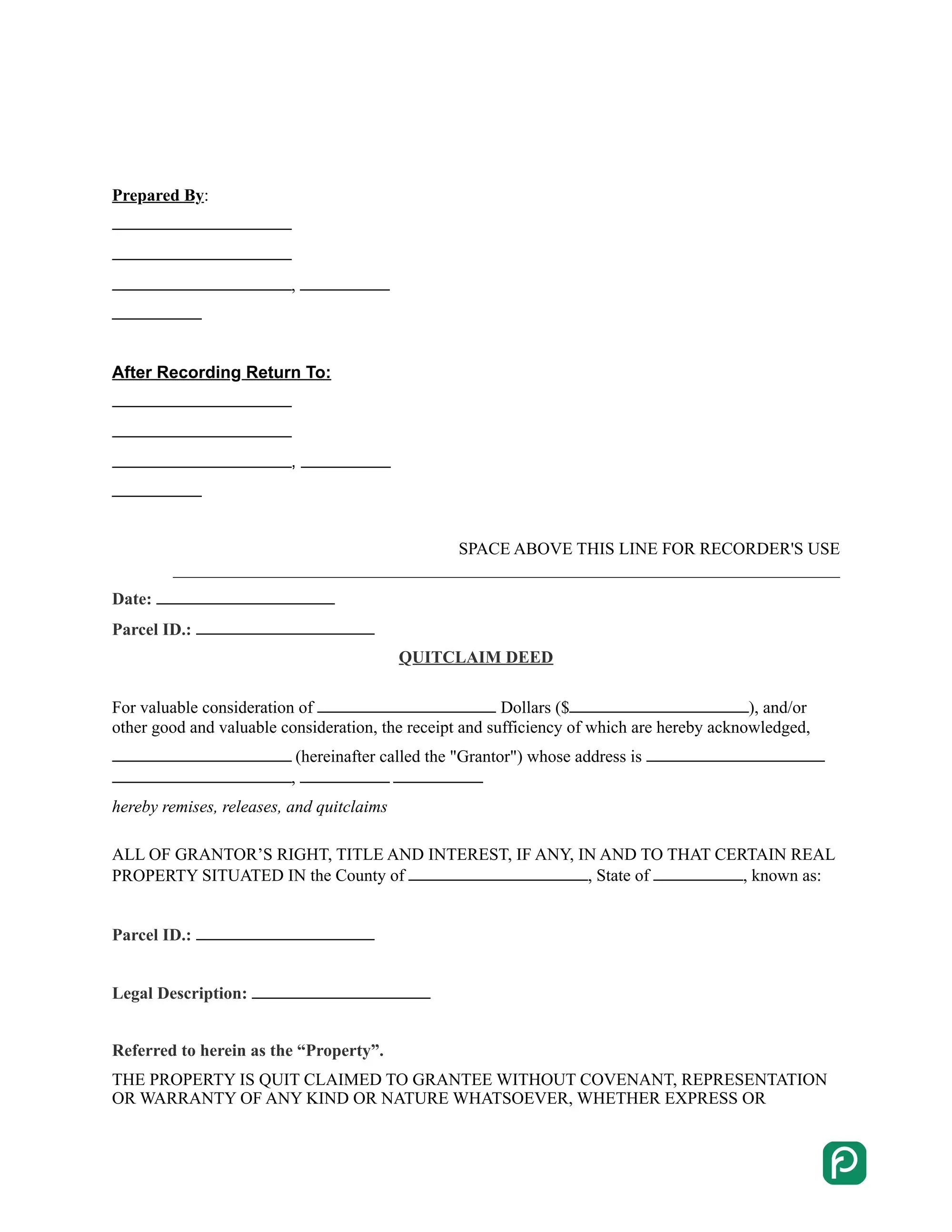
To fill out the Iowa quitclaim deed form, work through its pages in order. Page 1 holds the parties, date, and consideration, and page 2 holds the parcel number and the no-warranty language. Page 3 is blank, page 4 is the signature block, and page 5 is the notary acknowledgment. After signing, record the deed in the county where the property is located.[3]
Once the deed is signed and acknowledged, take it to the county recorder's office in the county where the property is located. Before you go, ask the office what to bring and what recording costs. When the deed is presented for recording, a declaration of value signed by at least one of the sellers or buyers, or their agent, must also be submitted to the county recorder, unless the transfer falls in one of the Section 428A.2 categories listed in Section 428A.1(2). It states the full consideration paid for the property.[6]
A groundwater hazard statement goes in with each declaration of value and reports whether the property has a known private burial site, a well, a solid waste disposal site, an underground storage tank, hazardous waste or a private sewage disposal system (Section 558.69). If none of these exists, no statement is filed and the deed instead carries the Section 558.69(8) exemption statement on its first page.[7]
These two questions come up most often about an Iowa quitclaim deed. The answers follow Iowa Code sections 558.19, 558.20, and 558.41. They cover the form of the deed, its acknowledgment, and its recording in the county.[1][2][3]
Prepare the deed on the statutory form or an equivalent form of conveyance.[1] Make sure the acknowledgment complies with the provisions of chapter 9B.[2] Then file and record the deed in the county where the property is located.[3]
File and record the deed in the county where the real estate is located. Until it is recorded there, it has no validity against later purchasers who pay for the property without notice.[3]

General information, not legal or tax advice.
Unless noted otherwise, the sources below are from the Iowa Code.
