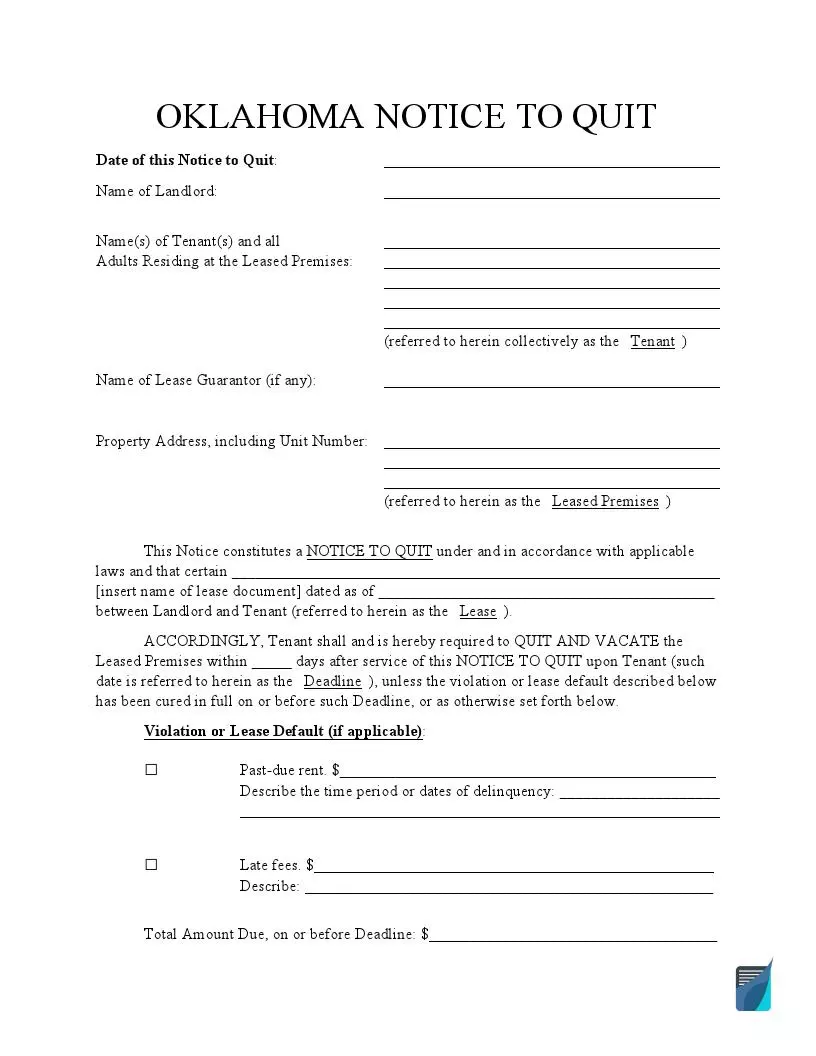
An Oklahoma eviction notice is a written notice a landlord serves on a tenant to end the tenancy for nonpayment of rent, a lease violation, or without cause, before filing an eviction case in court. Oklahoma law sets the minimum notice period, the required method of service, and the steps a landlord must complete before a court will grant possession.
Create a free high-quality Oklahoma Eviction Notice online now!
Build Your Document
Answer a few simple questions to make your document in minutes
Save and Print
Save progress and finish on any device, download and print anytime
Sign and Use
Your valid, lawyer-approved document is ready
... or download your Oklahoma Eviction Notice Forms as a PDF file
Rental relations in Oklahoma are governed by Title 41 of the Oklahoma Statutes and the Forcible Entry and Detainer Act. Under this law, a landlord may end a tenancy only for a reason the law allows, and must give the tenant written notice that meets the minimum period before filing an eviction case in court.
An Oklahoma eviction notice is also called a notice to quit or a notice to vacate. All three names refer to the same written notice a landlord serves to start the eviction process.
Every Oklahoma eviction notice should state the following details. The lease agreement sets the rent amount and the lease terms the notice refers back to.
The name of the tenant and any other occupant the notice is addressed to.
The physical address of the rental unit.
The lease provision or amount of unpaid rent at issue.
The action the landlord requires, such as payment, repair, or moving out.
The compliance deadline.
A warning of further action if the tenant does not comply.
The Oklahoma Statutes section the landlord is relying on.
The date and signature of the landlord or an authorized representative.
Notice periods differ by the reason for eviction.
Nonpayment of rent, when the tenant has rented the unit for less than three (3) months: five (5) days' written notice to pay or move out[1.4].
Nonpayment of rent, when the tenant has rented for three (3) months or longer: ten (10) days' written notice[1.3].
A landlord may terminate for nonpayment only if the tenant fails to pay within five (5) days after a written demand for payment[1.16].
Lease violation: the landlord delivers a written notice of noncompliance describing the problem. The tenancy ends no less than fifteen (15) days after the tenant receives it, unless the tenant fixes the problem within ten (10) days[1.17].
Month-to-month tenancy ending without cause: at least thirty (30) days' written notice from either party before the date upon which the termination is to become effective[1.8].
Year-to-year tenancy ending without cause: at least three (3) months' written notice before the end of the tenancy year[1.2].
A tenancy at will, or a periodic tenancy of three (3) months or less, including a tenancy with no written lease: the same thirty (30) day rule. When rent is paid more often than every thirty (30) days, the notice period matches that shorter interval[1.1].
Oklahoma law also sets how a notice must be delivered. The notice may be served on the tenant directly. If the tenant cannot be found, it may instead go to a person over twelve (12) years old who resides on the premises. A landlord may also post the notice at the property and mail a copy to the tenant's last known address[1.6].
When a notice is posted and mailed, it cannot end the tenancy sooner than ten (10) days after the posting and mailing[1.6]. Deadlines under Title 41 are counted by excluding the first day and including the last day[1.7].
Oklahoma law recognizes several types of eviction notice, and the notice a landlord uses depends on the reason for eviction. A landlord may use a different notice for nonpayment of rent, a lease violation, serious misconduct such as nuisance or waste, or a no-cause termination of a periodic tenancy.
Immediate notice. When a tenant at will commits waste, or the landlord-tenant relationship does not otherwise exist, no notice to quit is required before the landlord acts[1.5]. Landlords use this rule for serious misconduct such as property damage or a direct threat to the safety of others.
5-day notice for nonpayment. A landlord may use a 5-day notice to quit when a tenant who has rented for less than three months fails to pay rent when due[1.4]. If the tenant pays the rent in full within the five days, the notice does not end the tenancy.
10 to 15-day notice for lease violation. A landlord may use this notice, sometimes called a notice of noncompliance, when the tenant materially violates the lease. The tenant has ten days to fix the problem, and the tenancy ends no less than fifteen days after the tenant receives the notice if the problem is not fixed[1.17].
30-day notice to quit. Either the landlord or the tenant may use a 30-day notice, sometimes called a month-to-month eviction notice or lease termination letter, to end a month-to-month tenancy without giving a reason[1.8]. Ending a year-to-year tenancy without cause instead requires at least three months' written notice given before the end of the tenancy year[1.2].
You will need a relevant Eviction Notice form to fill in. You can find a copy online, download it, and print it out. But we suggest a much easier way. Just use our software developments to build the necessary legal form.
Create a free high-quality Oklahoma Eviction Notice online now!
Evicting a tenant in Oklahoma is a court process with several required steps. A landlord cannot remove a tenant without a court order, and must first serve the right eviction notice, then file a case in court if the tenant does not comply.
Choose the right eviction notice. The landlord picks the notice type that matches the reason for eviction, such as nonpayment of rent, a lease violation, or a no-cause termination of a periodic tenancy.
Wait for the notice period to end. If the tenant does not pay, cure the violation, or move out within the notice period, the landlord may file an eviction case at the county district court. Ask the court clerk for a list of the documents needed to file.
File the petition and summons. The landlord files a petition asking the court to decide the case. The court then issues a summons stating when and where the hearing will take place.
Attend the hearing and receive judgment. The court decides whether the eviction is granted. If the tenant does not respond, or the court rules for the landlord, the court can issue a writ of execution authorizing the sheriff to remove the tenant from the property.
Oklahoma law does not allow a landlord to force a tenant out without a court order. A landlord who wrongfully removes or excludes a tenant from possession faces a court claim for possession, plus damages of up to twice the average monthly rent or twice the tenant's actual damages, whichever is greater[1.13].
"If a landlord wrongfully removes or excludes a tenant from possession of a dwelling unit, the tenant may recover possession by a proceeding brought in a court of competent jurisdiction, or terminate the rental agreement after giving notice of such intention to the landlord, and in either case recover an amount not more than twice the average monthly rental, or twice his actual damages, whichever is greater."
Oklahoma Eviction Court Forms
Oklahoma eviction cases use a small set of court forms after the notice period ends. The landlord and the court complete the petition, summons, and affidavit as the case moves from filing through judgment.
Petition. The landlord's written claim describing the reason for eviction and asking the court to decide the case.
Summons. The court's notice to the tenant stating when and where the hearing will take place.
Affidavit. A written statement signed under oath by a party to the case.
Landlord and Tenant Duties in Oklahoma
Oklahoma's landlord-tenant law sets several duties that apply outside the eviction notice itself. These rules cover deposits, entry into the rental unit, occupancy limits, and required disclosures, and a landlord who ignores them can face separate legal consequences.
Security deposits. Any deposit the landlord collects must be held in an escrow account at a federally insured financial institution in Oklahoma[1.10].
Entry notice. Except in an emergency or when it is impracticable, the landlord must give the tenant at least one (1) day's notice before entering the rental unit, and may enter only at reasonable times[1.14].
Occupancy limits. Oklahoma law presumes an occupancy limit of two (2) persons per bedroom to be reasonable[1.11].
Methamphetamine disclosure. Before renting begins, a landlord who knows or has reason to know the unit was used to manufacture methamphetamine must disclose this to a prospective tenant[1.12].
Flood disclosure. If the landlord knows the property flooded within the past five years, that fact must be stated prominently and in writing in the rental agreement[1.9].
Abandoned property. Property a tenant leaves with the landlord for thirty (30) days or longer is considered abandoned, and the landlord may then dispose of it without liability to the tenant[1.15].
Other Oklahoma Forms
Different important Oklahoma templates readily available for download on FormsPal and that can be personalized in our simple document maker.
This page is general information about Oklahoma eviction notices, not legal advice. For advice on your situation, talk to an Oklahoma landlord-tenant attorney.
Published: Jun 21, 2022
Jennifer M. Settles
Author & Attorney
With over 25 years of experience as a business and transactional attorney, Jennifer has closed contracts, real estate transactions, and corporate deals for her clients.
Sources
The rules on this page come from Oklahoma's landlord-tenant statutes, cited below by section number so you can read the exact text of each provision the notice periods and duties above are based on.