
A North Dakota lease agreement is a written contract between a landlord and a tenant that sets the rent, the security deposit, the length of the tenancy, and each party's duties for a rental property in the state. The lease can run for a fixed term, such as one year, or convert to a month-to-month tenancy. It also sets how much notice either side must give to end or change the tenancy. FormsPal's free North Dakota lease agreement template lets landlords and tenants build, download, and sign this document online.
Last Updated: September 2026. This guide is reviewed and updated regularly to reflect current North Dakota law. If you notice an error or outdated information, please contact us.
Build Your Document
Answer a few simple questions to make your document in minutes
Save and Print
Save progress and finish on any device, download and print anytime
Sign and Use
Your valid, lawyer-approved document is ready
Our lease agreement forms help prevent misunderstandings or legal disputes by providing a clear framework for the rental relationship.
Chapter 47-16 of the North Dakota Century Code, titled “Leasing of Real Property,” sets the rules for security deposits, notice periods, lease terms, and disclosures that apply to landlords and tenants renting property in the state. It covers how much a landlord can charge and hold as a deposit, when a landlord may enter the rental unit, and how much notice either party owes before ending or changing a tenancy.
The North Dakota Century Code, Section 47-16-07.1, regulates security deposits for rental properties. Landlords must place the deposit in a federally insured interest-bearing savings or checking account for the tenant's benefit . Landlords do not owe interest on the deposit when the tenant's occupancy was shorter than nine months [1.5].
The law limits the deposit a landlord can demand to one month's rent, with exceptions allowing a greater amount, including:
Landlords can also charge a pet deposit for non-service animals, which cannot exceed $2,500 or two months' rent [1.5]. Upon lease termination, the landlord must give tenants an itemized statement of any deductions from the security deposit for:
This accounting, together with the deposit balance, must be delivered or mailed to the tenant's last known address within thirty days after the lease ends and the tenant returns possession . A landlord who withholds a security deposit without reasonable justification is liable for treble damages, meaning the landlord may have to pay the tenant three times the amount wrongfully kept [1.5].
Section 47-16-07.3 of the North Dakota Century Code addresses a landlord's right to enter a rented property. The statute does not set a fixed number of days for notice. Instead, unless notice is impractical, the landlord must first notify tenants and get their consent, which must name a specific time and cannot be withheld unreasonably [1.7]:
Unless it is impractical to do so the landlord shall first notify and receive the consent of the tenant which shall not be unreasonably withheld, which consent shall identify a time certain.
In practice, most North Dakota leases still spell out a specific notice window, such as 24 hours, so both sides know what to expect even though the statute itself only requires consent.
North Dakota law requires landlords to give tenants a statement describing the condition of the rental property's facilities at the time the rental agreement is signed [1.6]. In practice, this is usually a move-in checklist that the tenant and landlord both sign. It documents the property's condition before move-in, so both sides have something to point back to if a dispute over the security deposit comes up later.
For housing built before 1978, federal law also requires the landlord to give the tenant an EPA-approved lead hazard information pamphlet and to disclose any known lead-based paint or lead-based paint hazards before the tenant is obligated under the lease (42 U.S.C. § 4852d).[2.1]
How much notice a landlord or tenant owes depends on the type of tenancy. If a fixed-term lease converts to a month-to-month tenancy, either party may end it on the last day of a month by giving at least one calendar month's notice [1.9].
A year-to-year tenancy needs notice at least as long before the lease expires as the term of the tenancy itself, capped at one calendar month . A landlord also cannot enforce an automatic renewal clause, or decline to renew a fixed-term lease, unless tenants received written notice of that provision at least thirty days before the lease's expiration date [1.3].
For example, tenant Anna Baker's fixed-term lease at a Bismarck rental property converts to month-to-month. Either Anna or her landlord can now end it on the last day of any month by giving one calendar month's written notice first.
A North Dakota lease agreement is also called an ND rental agreement or a North Dakota residential lease agreement. All three names refer to the same document.
A landlord who wants to change the lease terms, including raising the rent, must give tenants written notice at least thirty days before the end of the month [1.4]. If the landlord does this, tenants may end the lease at the end of the month by giving the landlord at least twenty-five days' notice [1.8].
No city or other local government in North Dakota may pass an ordinance that controls how much rent a landlord can charge for residential or commercial property [1.2]. A landlord also cannot charge tenants a fee just to accept rent paid by cash, check, or money order [1.11].
Watch for this: a landlord who raises the rent without giving thirty days of written notice cannot enforce that change [1.4]. Tenants keep the old terms until proper notice is given.
For example, landlord Ben Carter wants to raise tenant Anna Baker's rent on a rental property starting November 1. He must deliver written notice by October 1, and Anna can then accept the new rent or end the tenancy with 25 days' notice.
North Dakota law also caps how long certain leases can run. A lease of agricultural land that reserves rent or another form of payment cannot run longer than ten years . A lease of a city lot on the same terms cannot run longer than ninety-nine years [1.1]. A lease that runs longer than these limits is not valid for the excess period.
If tenants leave personal property behind worth no more than $2,500 total, the landlord may keep or dispose of it without going to court. The landlord must first wait twenty-eight or more days after getting actual notice, or after it reasonably appeared, that the tenant had vacated [1.12]. Landlords who need to count that waiting period exactly can use FormsPal's deadline calculator to confirm the date.
North Dakota law lets a tenant terminate a lease early under specific domestic abuse protections. A tenant who ends a lease this way is still responsible for rent for the full month in which the tenancy ends, plus one additional month's rent [1.10]. The landlord still has a duty to try to re-rent the unit and reduce that cost.
| Document Name | North Dakota Rental Lease Agreement Form |
| Other Names | ND Rental Lease, North Dakota Residential Lease Agreement |
| Relevant Laws | North Dakota Century Code, Chapter 47-16 |
| Security Deposit Amount | One (1) month’s rental payment (if no pets) or two (2) months’ rent (with pets) |
| Security Deposit Return | Thirty (30) days after the lease expiration date |
| Avg. Time to Fill Out | 18 minutes |
| # of Fillable Fields | 119 |
| Available Formats | Adobe PDF |
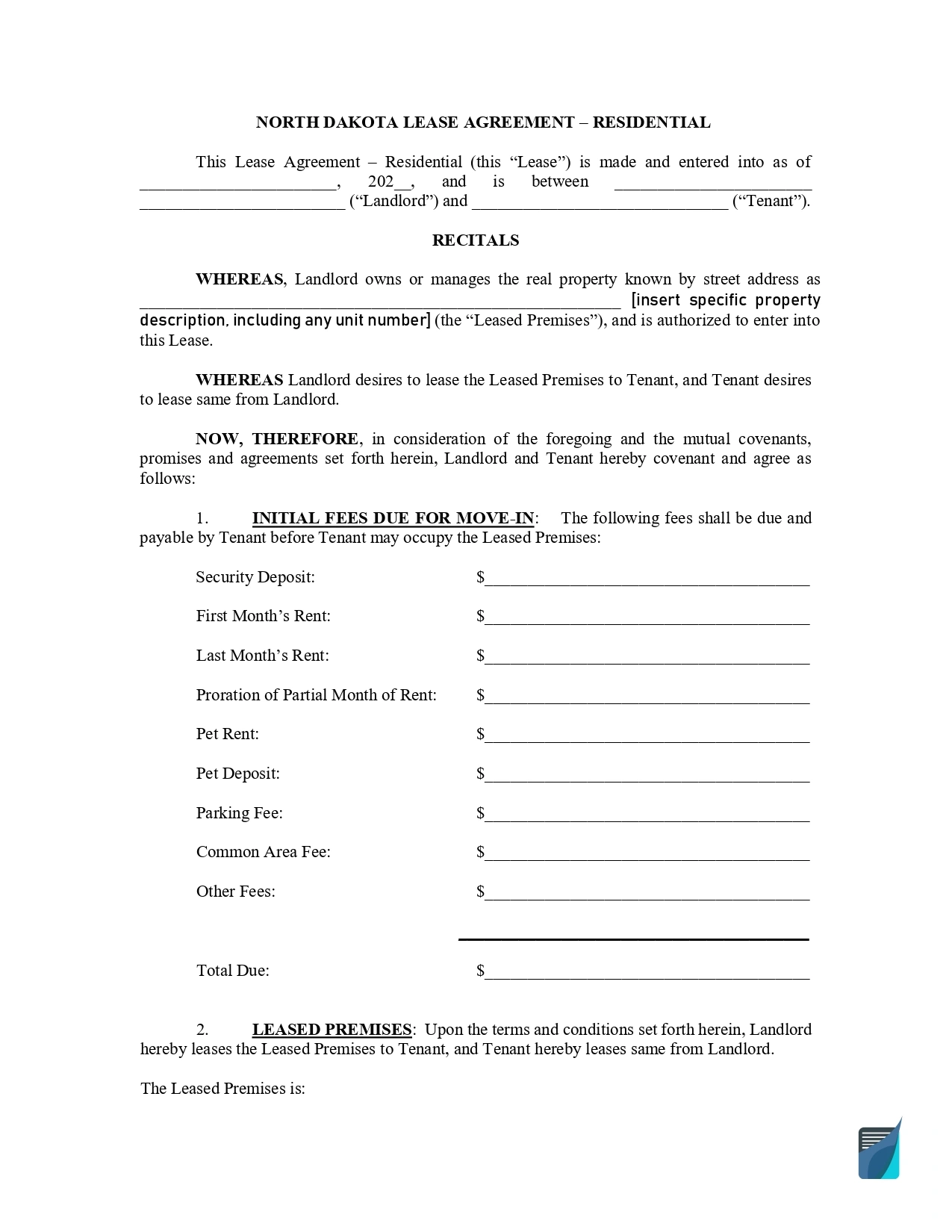
Once you download the North Dakota rental lease agreement, you can fill it in on your computer with FormsPal's online PDF editor before printing or signing it.

This FAQ covers common North Dakota rental questions, including when a landlord can enter the unit, whether landlords owe deposit interest, and whether a city can set its own rent control rules.
No. Unless it is impractical, the landlord must first notify tenants and get their consent, which cannot be unreasonably withheld and must name a specific time [1.7].
Usually, yes. A North Dakota landlord must hold the deposit in a federally insured interest-bearing account, but the landlord does not owe interest if the tenant's occupancy lasted less than nine months [1.5].
No. State law bars any North Dakota city or other political subdivision from passing an ordinance that controls how much rent a landlord can charge for residential or commercial property [1.2].
General information, not legal or tax advice.
