
A Montana quitclaim deed is a written document, signed by the grantor (the transferring owner), that passes the grantor's interest in real property to the grantee (the recipient).[1] This deed template is common between family members and others who trust each other. The quitclaim deed form passes the property without any warranty, so the grantee gets less protection than with a warranty deed.
Last Updated: October 2026. This guide is reviewed and updated regularly to reflect current Montana law. If you notice an error or outdated information, please contact us.
Build Your Document
Answer a few simple questions to make your document in minutes
Save and Print
Save progress and finish on any device, download and print anytime
Sign and Use
Your valid, lawyer-approved document is ready
Four Montana rules shape a quitclaim deed. They cover the written and signed transfer, the effect of the word "grant", acknowledgment before recording, and the protection that recording gives against later buyers and lenders.
Montana quitclaim deeds are governed by the Montana Code Annotated, chiefly Title 70, which covers the transfer of real property in chapter 20 and recording in chapter 21, with the recording standards and fees in Title 7, chapter 4, part 26 (Mont. Code Ann. § 70-21-208).[5]
An estate or interest in real property may not be created, granted, assigned, surrendered, or declared except by operation of law or by a conveyance or other instrument in writing. The writing must be subscribed (signed) by that party or by the party's lawful agent authorized by writing. Estates at will and terms of 1 year or less are outside the rule.[1]
In a conveyance of an estate of inheritance, fee simple or possessory title, the word "grant" implies two limited promises by the grantor. The deed's express terms can restrain them. First, the grantor has not already conveyed the same estate, or any interest in it, to anyone else. Second, the estate is free from encumbrances made by the grantor or anyone claiming under the grantor.[2]
The form on this page quit claims the property without any warranty and subject to existing easements, liens and other encumbrances. Check the property record before you sign or accept it.
Unless an instrument belongs to a class provided for in either 70-21-205 or 70-21-207, before the instrument can be recorded, its execution must be acknowledged as provided in subsection (1) or proved as provided in subsection (2).
In plain words, a deed is normally acknowledged or proved before it can be recorded.[3] The form on this page ends with an acknowledgment page for a notary public to complete.
A witness signs only if the deed is proved by a subscribing witness instead of being acknowledged by the grantor (Mont. Code Ann. § 70-21-203).[3]
Montana treats a conveyance of real property as void against a later purchaser or encumbrancer (such as a lender) when that person:
A lease for a term of 1 year or less is the exception.[4] Recording the deed promptly is how a grantee protects the transfer.
Record the deed with the county clerk and recorder of the county where the property lies (Mont. Code Ann. § 70-21-208).[5]
Montana's recording standards (Mont. Code Ann. § 7-4-2636) set the page margins and require the name and mailing address of the person the recorded deed is returned to in the upper left corner of page one.[6]
The county clerk and recorder charges a per-page recording fee set by Mont. Code Ann. § 7-4-2637, and a deed that does not meet the 7-4-2636 standards is recorded for that fee plus an additional charge.[7]
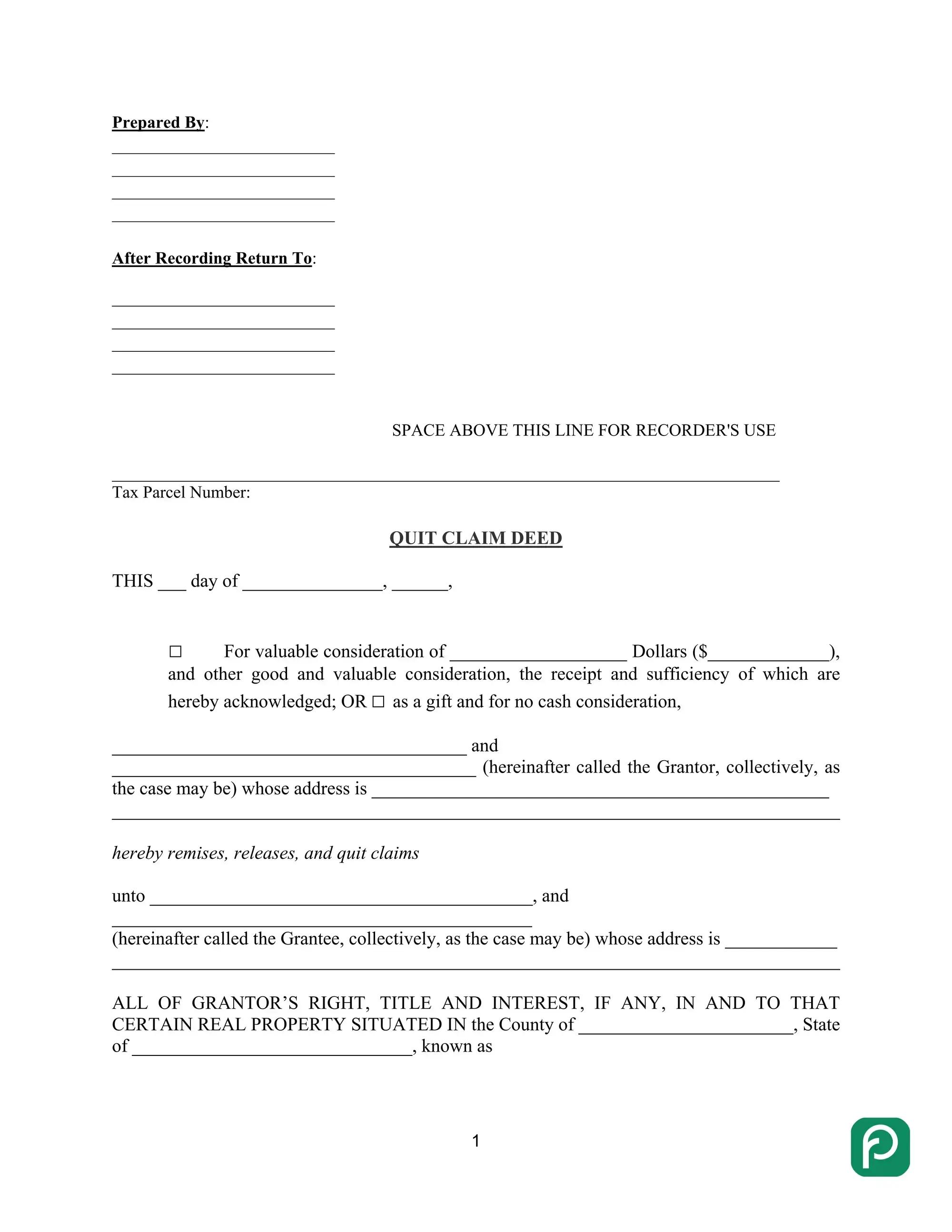
The Montana quit claim deed form is titled "Quit Claim Deed" and runs five pages. Pages 1 and 2 hold the parties and the property, page 3 is blank, page 4 holds the signature lines, and page 5 is the notary's acknowledgment. Fill it in the order below.
Once the notary has completed page 5, record the signed deed. Recording is what protects it against later buyers.[4]
File a realty transfer certificate with the deed. The clerk and recorder will not record the deed without it, though a missing certificate does not affect the deed's validity between the parties (Mont. Code Ann. § 15-7-305).[8]
A quitclaim transfer is only as good as the rights the grantor holds, so a few checks help before anyone signs. These are practical habits, not legal requirements. Walk through the list with the other party before the form goes to a notary.
Buyers who want the grantor to make promises about the title often look at a general warranty deed or a special warranty deed instead. A sale of real property is often paired with a Montana real estate purchase agreement.
Complete the quitclaim deed form and sign it.[1] Before the deed can be recorded, its signing must be acknowledged or proved.[3] Then record it, because a conveyance of real property is void against a later purchaser or encumbrancer who acts in good faith, for valuable consideration, and records first.[4]
Your mother, as the grantor, can sign a written deed, such as a quitclaim deed, that names you as the grantee.[1] Record the deed afterward so that it is protected against a later purchaser or encumbrancer who acts in good faith.[4]

General information, not legal or tax advice.
