
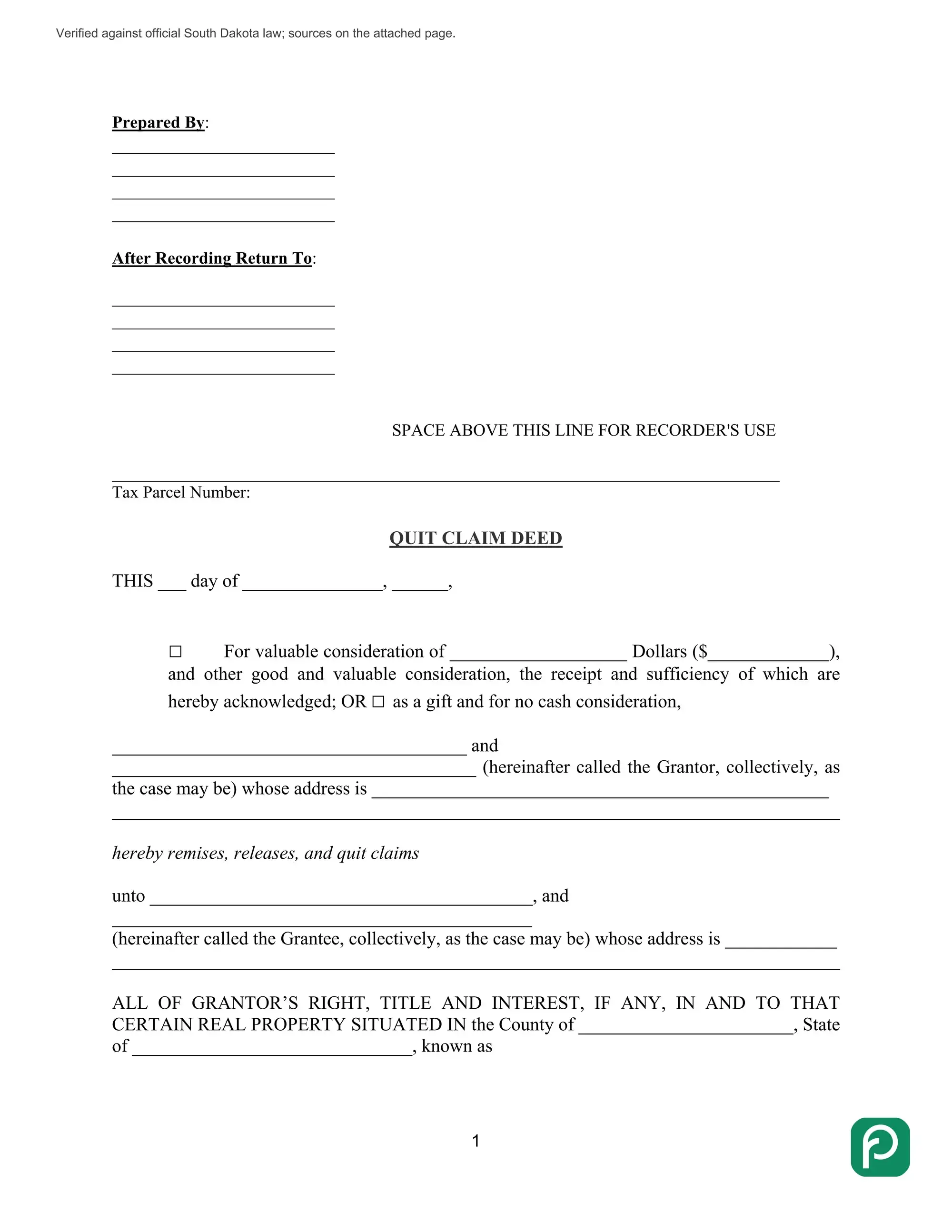
A South Dakota quitclaim deed is a written document that conveys and quitclaims all of the grantor's interest in described real estate to the grantee.[3] The grantor is the person giving up the interest, and the grantee is the person receiving it. The FormsPal form quit claims the property without warranty of any kind, so the grantee gets no promise that the title is clear.
Last Updated: October 2026. This guide is reviewed and updated regularly to reflect current South Dakota law. If you notice an error or outdated information, please contact us.
Build Your Document
Answer a few simple questions to make your document in minutes
Save and Print
Save progress and finish on any device, download and print anytime
Sign and Use
Your valid, lawyer-approved document is ready
In South Dakota, quitclaim deeds are often used when property is given to someone without a sale, such as between family members. They also come up when a title issue needs clearing up, or when one spouse gives up an interest in jointly owned property during a divorce. If the grantee wants promises about the title, look at the other deed forms instead.
South Dakota sets its quitclaim deed rules in Title 43 of the South Dakota Codified Laws. The sections below cover the statutory form, the acknowledgment a deed needs before it can be recorded, and how the deed is recorded with the register of deeds.
Section 43-25-7 of the South Dakota Codified Laws gives a short form for a quitclaim deed. In it, the grantor conveys and quitclaims to the grantee all interest in the following described real estate. The form names the grantee's post office address and the county in the state of South Dakota where the real estate sits.
A deed that follows this form is enough to convey the grantor's interest in the property described. An equivalent instrument that makes the parties' transaction plain is not invalid for want of the statutory wording.[3]
Under Section 43-28-8 of the South Dakota Codified Laws, a deed's execution, meaning its signing, must be acknowledged by the person executing it before the deed can be recorded.[2] An acknowledgment is the signer's formal statement that the signature is their own.
Two exceptions apply: the classes of instruments the statute lists, and an instrument whose record a court has authorized by judgment or order.[2] The FormsPal form has an acknowledgment block on page 5 for this step.
Under Section 43-25-26 of the South Dakota Codified Laws, a deed that is not duly acknowledged can still be recorded if its execution is proved by a subscribing witness.[5]
Two rules from the South Dakota Codified Laws apply when a quitclaim deed is recorded:
For example, a property in Pennington County, where Rapid City sits, is recorded with the Pennington County register of deeds. A property in Brown County, where Aberdeen sits, is recorded with the Brown County register of deeds.[1]
File a certificate of value with the deed. Under Section 7-9-7 of the South Dakota Codified Laws, the register of deeds may not accept a deed used to transfer an interest in real property unless a certificate of value comes with it.[6]
The FormsPal South Dakota quitclaim deed form has six form pages. Page 3 is blank, and the legal description goes on Exhibit A on page 6. Work through the parts below in the order they appear on the form. After you download the PDF, you can fill it in on screen with our PDF editor, or print it and write by hand.
The form asks for the details below. Gather them first, so you can complete the deed in one sitting and avoid blanks you have to fix later.
Once the acknowledgment is complete, the transfer of the property is not finished until the deed reaches the county. Use this short checklist to wrap up the paperwork.
The register of deeds charges a recording fee set by Section 7-9-15 of the South Dakota Codified Laws. The amount can change and filing practice can differ by county, so ask the register of deeds for the current requirements before you go.[7]
These answers come from the South Dakota Codified Laws on quitclaim deeds and recording. Each answer covers one point about the deed or the property transfer it makes. The statute behind each one is listed in the numbered notes at the end of this page.
A deed that follows the statutory form is sufficient to convey the grantor's interest in the property described. The form has the grantor convey and quitclaim to the grantee all interest in the following described real estate. An equivalent instrument that makes the parties' transaction plain is not invalid for want of the statutory wording.[3]
Yes, before it can be recorded. The person executing the deed must acknowledge its execution. Two exceptions apply: the classes of instruments the statute lists, and an instrument whose record a court has authorized by judgment or order.[2]

General information, not legal or tax advice.
Unless noted otherwise, the sources below are from the South Dakota Codified Laws, published by the South Dakota Legislature.
