
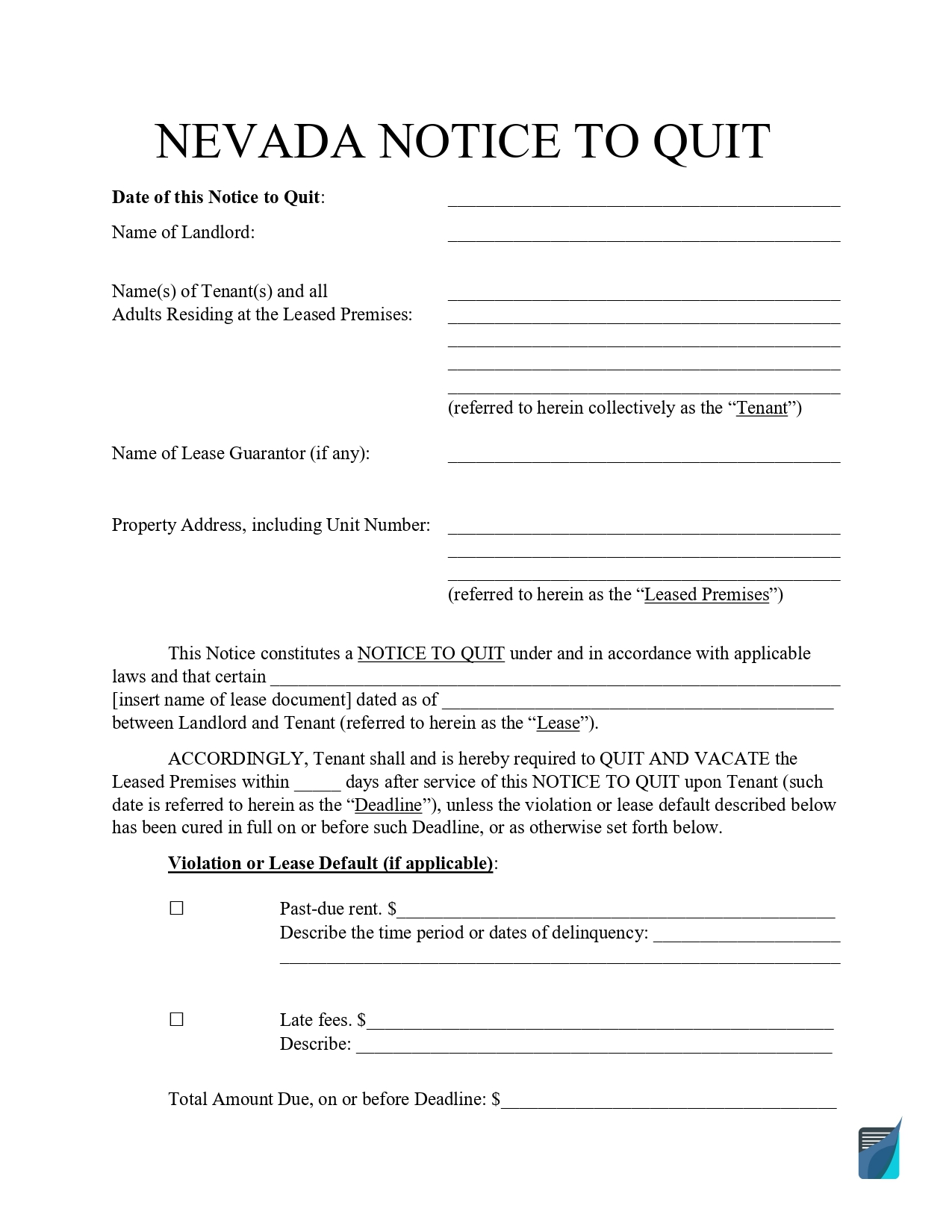
A Nevada eviction notice is a written notice a landlord serves on a tenant to end the tenancy for nonpayment of rent, a lease violation, or without cause. The landlord must serve it before filing an eviction case in court. Nevada law sets how many days the tenant gets to respond, and the notice period depends on the reason for the eviction.
Last Updated: September 2026. This guide is reviewed and updated regularly to reflect current Nevada law. If you notice an error or outdated information, please contact us.
Build Your Document
Answer a few simple questions to make your document in minutes
Save and Print
Save progress and finish on any device, download and print anytime
Sign and Use
Your valid, lawyer-approved document is ready
Landlords use this notice most often when a tenant is behind on rent or has broken a lease term. It does not remove the tenant by itself. If the tenant does not pay, fix the issue, or leave by the deadline, the landlord’s next step is to file an eviction lawsuit in Nevada court.
Nevada law sets a written notice period before a landlord can file an eviction case in Nevada’s justice court, and how long the tenant gets depends on the reason for the eviction. The three most common notice periods are seven judicial days for nonpayment of rent, five days for a lease violation, and at least 30 days to end most periodic tenancies without cause.
A tenant who does not pay, fix the problem, or leave within that period is in unlawful detainer, the statute’s term for staying on the property without the legal right to do so.[2.10]
Several of these notice periods are counted in judicial days rather than calendar days. A judicial day is generally a day the court is open for business, so weekends and court holidays do not count toward the notice period.
Nevada’s eviction laws sit mainly in Chapter 40 of the Nevada Revised Statutes, which sets the notice period for each reason a landlord ends a tenancy and how a court case for possession proceeds. The rent demand notice may be served at any time after the rent becomes due, and it has no separate grace period built into the statute.[2.10]
Nevada’s eviction notice is also called a notice to pay rent or quit, a notice to cure or quit, or a notice to vacate, depending on the reason for the eviction. All of these refer to the written notice a landlord serves before filing a case in court.
Beyond the general notice periods above, several narrower rules apply depending on the type of tenancy or the timing of the rent.
When a landlord serves a notice for a lease violation, the notice must also go to any subtenant who is actually living on the property.[2.11] You can count any of these notice periods with our deadline calculator.
Nevada law also protects these notice periods from being shortened by agreement.
“It is unlawful for a landlord to attempt by contract or other agreement to shorten the specified periods of notice and any such contract or agreement is void.”
A few situations outside the usual landlord-tenant notice rules also carry their own timing requirements under Nevada law.
| Rent Grace Period | Not specified. Notice may be served any time after rent becomes due. |
| Notice of Non-Payment | 7 judicial days (residential); 5 days (commercial) |
| Notice of Non-Compliance (Lease Violation) | 5 days |
| State Laws | Nev. Rev. Stat. §§ 40.230 to 40.2542[2] |
Nevada landlords use a different eviction notice for each reason they end a tenancy. The type controls how many days the tenant gets to act. The tenant can pay overdue rent, fix a lease violation, or move out by the deadline, depending on which notice applies.
A no-cause notice to end a periodic tenancy must also tell the tenant about two statutory extensions.[2.2]
A separate three-day notice applies to unlawful activity. A tenant who carries on an unlawful business on the premises, or who violates the controlled substances provisions of NRS 453.011 to 453.552 (except NRS 453.336) there, is guilty of unlawful detainer if the tenant remains in possession after service of three days' notice to surrender (NRS 40.2514).[2.13]
Nevada’s eviction process starts with the written notice and moves to court only if the tenant does not act in time. A landlord may never remove a tenant or shut off services without a court order, even after the notice period runs out.[1]
Self-help evictions are illegal. Nevada law does not let a landlord recover or take possession of the dwelling unit by self-help, such as locking out the tenant, cutting off a utility the rental agreement requires, or removing the tenant’s belongings. A landlord may recover possession of the unit only through a court action, when the tenant has surrendered the unit, or when the tenant has abandoned it under the conditions the law sets.[1]

Other Eviction Notice Forms by State
General information, not legal or tax advice.
