
A Rhode Island eviction notice is a written notice a landlord sends a tenant to start ending a tenancy for nonpayment of rent or a violation of the lease, before the landlord can file an eviction case in court. Rhode Island law sets the notice period and the tenant's chance to fix the problem, and both vary by the reason for eviction.
Last Updated: September 2026. This guide is reviewed and updated regularly to reflect current Rhode Island law. If you notice an error or outdated information, please contact us.
Build Your Document
Answer a few simple questions to make your document in minutes
Save and Print
Save progress and finish on any device, download and print anytime
Sign and Use
Your valid, lawyer-approved document is ready
The notice itself is not a court order and does not remove the tenant. A landlord who wants the tenant out must still file a complaint in court and get a court order once the notice period ends.
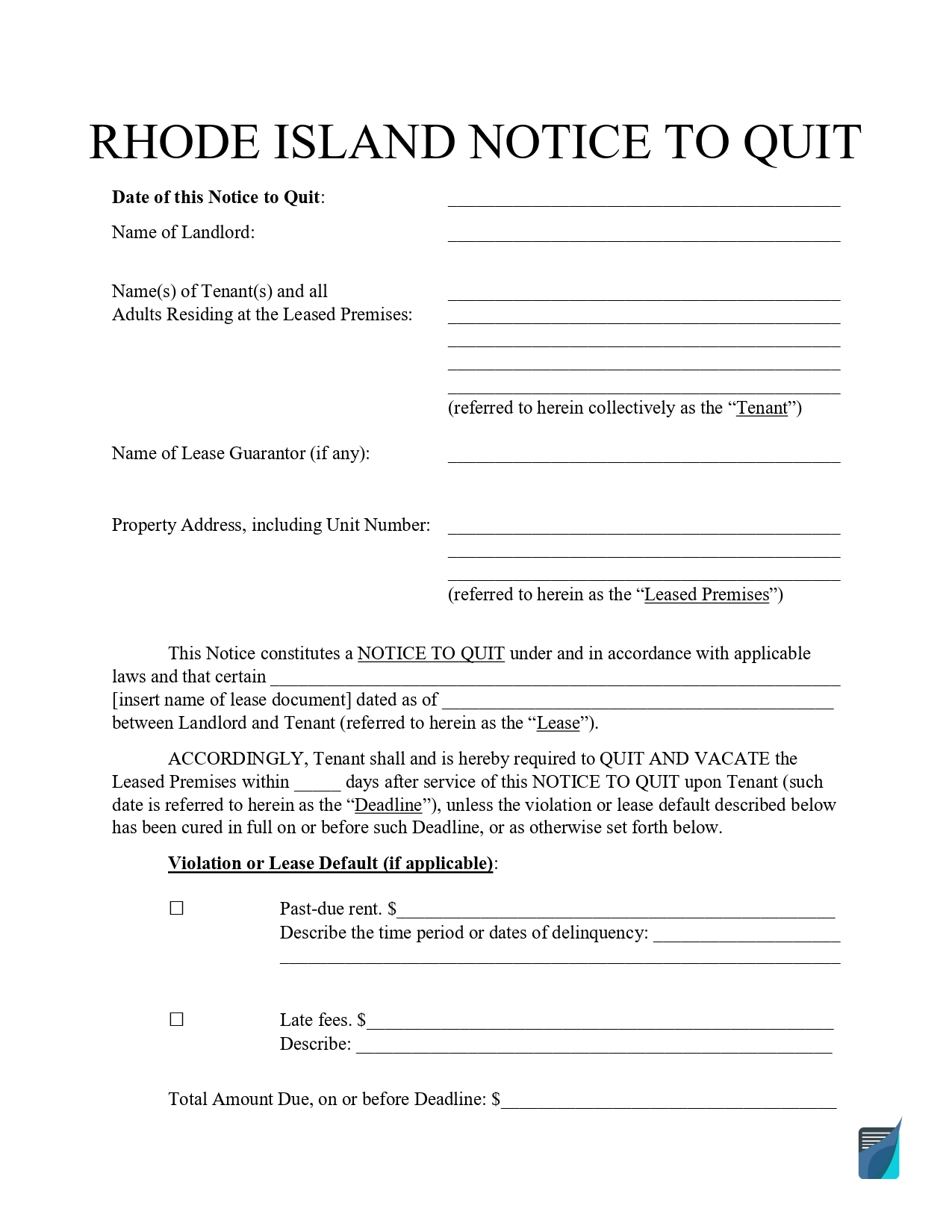
A Rhode Island eviction notice is a written notice a landlord serves on a tenant. It starts the process of ending a tenancy, most often for nonpayment of rent or a violation of the lease. The notice tells the tenant the reason, how much time they have to pay or fix the problem, and what happens if they do not.
A Rhode Island eviction notice is also called a notice to quit or a notice to vacate. All three names refer to the same document.
This notice is different from the eviction complaint a Rhode Island landlord may later file in court. The notice comes first and gives the tenant a chance to pay or fix the problem. The complaint follows only if the tenant does not.
Rhode Island's notice requirements come from the same law, the Residential Landlord and Tenant Act, that governs the rest of the eviction process described on this page.[2]
Rhode Island's statutory demand notice for nonpayment goes to a tenant who is more than fifteen days in arrears, and state law requires that the tenant be sent it before an eviction for nonpayment (R.I. Gen. Laws § 34-18-56(a)). Under R.I. Gen. Laws § 34-18-56, a notice for nonpayment of rent must state the amount of overdue rent and demand payment. It must also tell the tenant that the rental agreement will end if the rent is not paid in full within five days of the date the notice was mailed.[2]
If the tenant does not pay within that period, the landlord may then file an eviction action in court. The eviction notice for nonpayment must include:
For a lease violation other than nonpayment, R.I. Gen. Laws § 34-18-56 requires the landlord to give the tenant a written notice with at least twenty days to fix the problem. The notice must also set a termination date no less than twenty-one days after the notice is mailed.[2]
The Rhode Island eviction notice for a lease violation must include:
Under R.I. Gen. Laws § 34-18-56, both the twenty-day cure period and the twenty-one-day termination date run from the date the landlord mails the notice, not from the date the tenant actually receives it.[2]
The tenant keeps the right to fix the problem and remain in the rental, but not if this is the second notice on the same issue within the past six months. In that case, the right to cure is lost and the landlord may proceed with the eviction.[2]
| Rent Grace Period | Not Mentioned |
| Notice of Non-Payment | 5 days |
| Notice of Non-Compliance | 20 days |
| State Laws | Rhode Island General Laws, Chapter 34-18 (Sections 34-18-1 to 34-18-57) |
Rhode Island law does not set a separate rent grace period apart from the notice periods above. The five-day notice for nonpayment and the twenty-day notice for a lease violation are the waiting periods Rhode Island's Residential Landlord and Tenant Act sets before a landlord can file an eviction case.[2]
Rhode Island law sets clear timelines for an eviction notice. For nonpayment of rent, the tenant has five days from the date the notice was mailed to pay before the landlord can file in court. For a lease violation, the tenant has twenty days to fix the problem, and the notice must give at least twenty-one days before the tenancy ends. A tenant loses the right to fix a repeated problem if it is the second notice on the same issue within six months.
For example, say a landlord sends Ben Carter a twenty-day notice in March for a lease violation. Ben Carter fixes it, and then commits the same violation again in July. Because it is the second notice on the same issue within six months, Ben Carter no longer has the right to fix it. The landlord can move ahead with the eviction.[2]
Rhode Island regulates eviction notices by the reason for eviction, and each type carries its own timeline and required content. The two notice types set out in Rhode Island's residential landlord-tenant law are the notice for nonpayment of rent and the notice for a lease violation other than nonpayment, each explained below.[2]
The main difference between the two is what triggers the notice and how long the tenant has to respond. A nonpayment notice responds to unpaid rent and gives five days to pay. A noncompliance notice responds to any other lease violation and gives twenty days to fix it, with the tenancy ending no sooner than twenty-one days after the notice is mailed.[2]
Nonpayment of Rent
This notice goes to a tenant who is more than fifteen days in arrears, and state law requires that the tenant be sent it before an eviction for nonpayment (R.I. Gen. Laws § 34-18-56(a)). Under R.I. Gen. Laws § 34-18-56, the notice must state the amount of overdue rent and demand payment. It must also explain that the rental agreement will end if the tenant does not pay in full within five days of the date the notice was mailed.[2]
The Rhode Island notice may be served by placing a copy in regular first-class mail, postage prepaid, with the sender certifying the date of mailing.[2] Use our deadline calculator to confirm the exact last day of the notice period. If the tenant does not remedy the nonpayment, the Rhode Island landlord may then begin formal eviction proceedings.
Lease Violation (Noncompliance with the Rental Agreement)
When a tenant violates a term of the rental agreement other than paying rent, R.I. Gen. Laws § 34-18-56 requires the landlord to give a written notice with at least twenty days to fix the breach. The notice must also set a termination date no less than twenty-one days after the notice is mailed.[2]
The tenant keeps the right to fix the problem, but loses it if this is the second notice on the same issue within the past six months.[2]
Beyond those two notices, Rhode Island also lets either the landlord or the tenant end a month-to-month tenancy, or any periodic tenancy of more than a month but less than a year, by written notice delivered at least thirty days before the date in the notice. A week-to-week tenancy needs ten days' notice and a year-to-year tenancy three months (R.I. Gen. Laws § 34-18-37(b)).[3]
Rhode Island's eviction process moves through several stages. The landlord serves the required notice, and the tenant gets a chance to pay or fix the problem. If the problem is not resolved, the landlord files a complaint in court, and the court holds a hearing before ordering the tenant to leave.[2]
Every stage above follows Rhode Island's Residential Landlord and Tenant Act, from the first notice through the final court order. Skipping a required step, such as filing without attaching the notice, can force a Rhode Island landlord to start the process over.[2]
Self-help is not allowed. A Rhode Island landlord cannot force a tenant out without a court order. Under R.I. Gen. Laws § 34-18-34, a landlord who unlawfully removes or excludes a tenant, or who cuts off heat, water, electricity, gas, or another essential service to push the tenant out, can be made to let the tenant back in or pay damages.[1]
If a landlord unlawfully removes or excludes the tenant from the premises or willfully diminishes services to the tenant by interrupting or causing the interruption of heat, running water, hot water, electric, gas, or other essential service, the tenant may recover possession or terminate the rental agreement and, in either case, recover an amount not more than three (3) months periodic rent or threefold the actual damages sustained by him or her, whichever is greater.
In a nonpayment eviction the landlord may also recover a reasonable attorney's fee if the tenant's nonpayment was willful and the tenant had received a demand notice for unpaid rent within the six months before the case was filed (R.I. Gen. Laws § 34-18-35(d)).[4]
A landlord in Rhode Island can lose time and money by cutting corners on the notice process. Small errors in the notice or the filing can force a case to start over. Common mistakes include:
Getting these details right the first time keeps a Rhode Island eviction case on schedule.

Other Eviction Notice Forms by State
General information, not legal or tax advice.
Unless noted otherwise, the sources below are from the R.I. Gen. Laws.
