
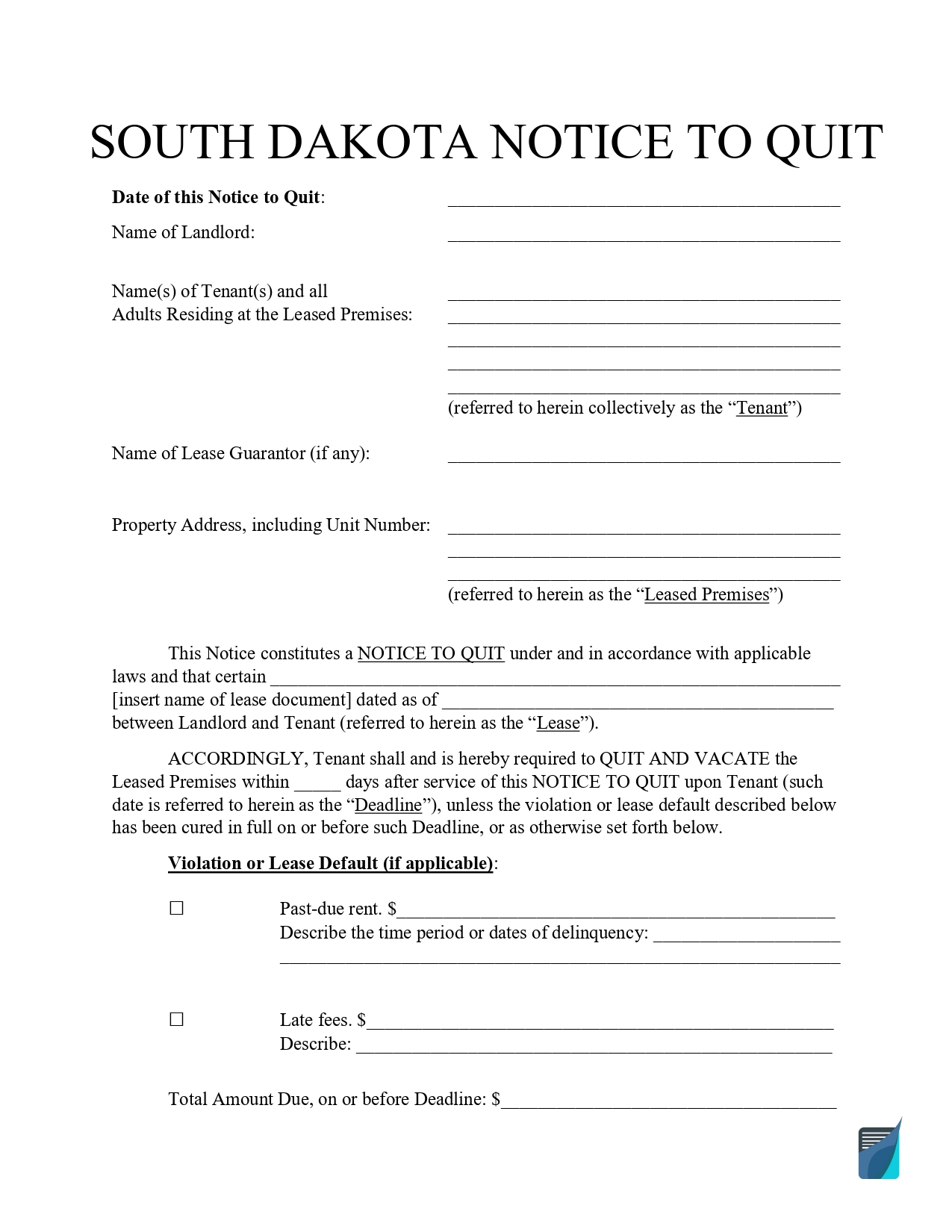
A South Dakota eviction notice is a written notice a landlord serves on a tenant to end the tenancy for nonpayment of rent, a lease violation, or without cause, before filing an eviction case in court.
Last Updated: September 2026. This guide is reviewed and updated regularly to reflect current South Dakota law. If you notice an error or outdated information, please contact us.
Build Your Document
Answer a few simple questions to make your document in minutes
Save and Print
Save progress and finish on any device, download and print anytime
Sign and Use
Your valid, lawyer-approved document is ready
Landlords use this notice when a tenant holds over after the lease ends, fails to pay rent within three days after it is due, or commits waste on the property. It is not a court order and does not remove the tenant by itself. If the tenant does not comply, the landlord's next step is filing a case in court.
This document also goes by other names, including notice to quit and notice to vacate.
South Dakota law lets a landlord evict a tenant for holding over after the lease term ends, for failing to pay rent within three days after it becomes due, or for committing waste on the property. It also allows eviction when the tenant does or fails to do something that, under the lease's own terms, ends the tenancy.[1.1]
In practice, a landlord may also end a lease early when the tenant misuses the property or ignores a repair request. In practice, a false claim of disability or fraudulent service animal papers can also be grounds for action.
| Rent Grace Period | 3 days (after the same shall be due) |
| Notice of Non-Payment | 3 days |
| Minimum Service Attempts | At least 2, one week apart, both within 30 days |
| Continuance Limit | 14 days, unless the tenant gives an approved undertaking |
| State Laws | South Dakota Codified Laws, Sections 21-16-1 to 21-16-12 |
South Dakota landlords use a different notice depending on why the tenancy is ending, such as nonpayment of rent, a lease violation, or ending a lease that has no fixed term. Each notice type follows its own rule for when a landlord may serve it.
If a tenant does not comply with an eviction notice, South Dakota law sets the court process a landlord must follow, from filing the complaint through serving the summons, appearing in court, and getting a judgment for possession.
In practice, tenants keep secure, uninterrupted access to the property and its essential services. A tenant who is wrongfully denied access may seek damages or end the lease.
South Dakota does not allow self-help evictions. The complaint that starts an eviction case must be in writing, verified by the landlord or the landlord's agent, or signed by the landlord's attorney, and served with a summons.[1.3] In practice, the complaint is filed in the county where the property is located.
Once a landlord files the case, South Dakota law requires the summons to be served on the tenant before the case can proceed.[1.3]
The time for the tenant's appearance and pleading is five days from the date of service, or thirty days after service by publication, whichever occurs sooner. The court may grant an adjournment or continuance, but not for more than fourteen days. An exception applies if the tenant gives the landlord a court-approved undertaking with good and sufficient surety that guarantees payment of rent and costs if the landlord wins the case.[1.5]
An eviction action cannot be brought in connection with any other legal action, except for rents, profits, or damages, though the landlord may bring separate actions for those.[1.2] An eviction action may be brought on for trial upon two days notice after issue is joined.[1.6]
Court Judgment and Eviction
If the court rules for the landlord, the court issues a judgment for possession of the property, along with any rents, profits, or damages awarded. No execution for possession can be served except in the daytime. If the tenant does not leave voluntarily, an execution for possession is served to carry out the judgment.[1.7]

Other Eviction Notice Forms by State
General information, not legal or tax advice.
Unless noted otherwise, the sources below are from the South Dakota Codified Laws, published by the South Dakota Legislature.
