Free Minnesota Living Will Form

A Minnesota living will, called a health care directive under state law, is a written document that states your medical treatment wishes if you become unable to communicate them yourself. Under Minn. Stat. § 145C.03, it must be signed and dated, then verified either by a notary public or by two witnesses.[1]

Last Updated: September 2026. This guide is reviewed and updated regularly to reflect current Minnesota law. If you notice an error or outdated information, please contact us.

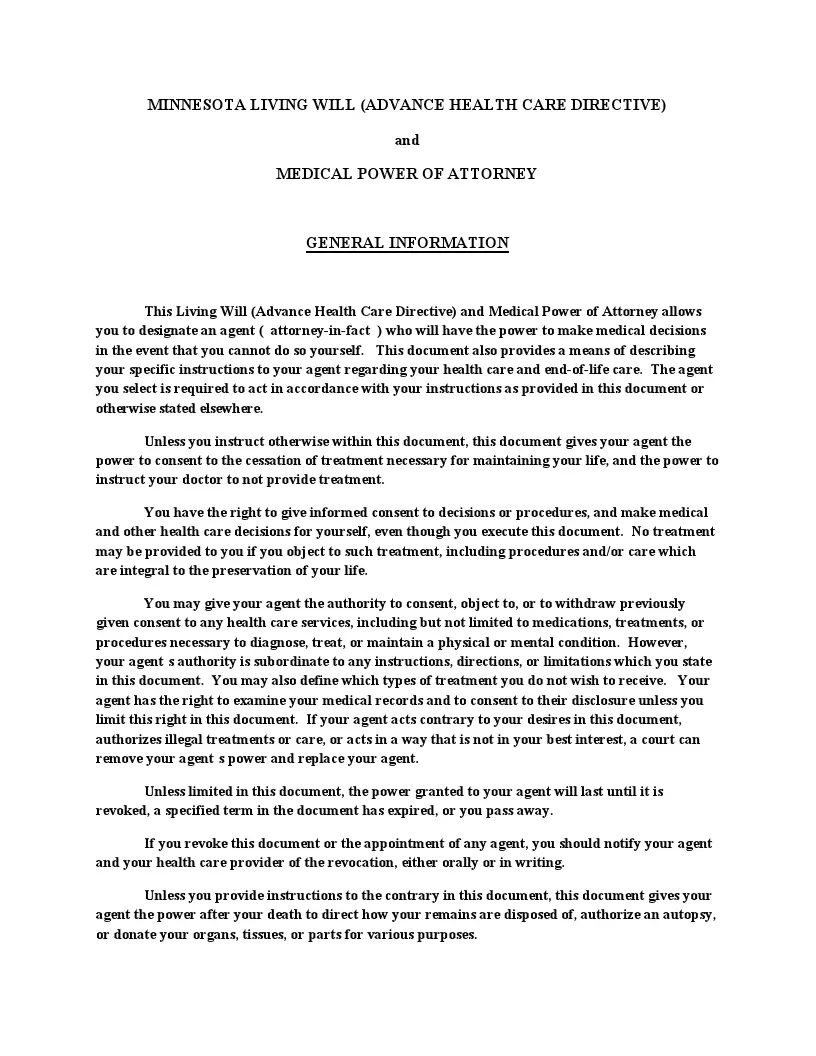
Minnesota living will form preview

Create a high-quality Minnesota Living Will Form online now!

Build Your Document

Answer a few simple questions to make your document in minutes

Save and Print

Save progress and finish on any device, download and print anytime

Sign and Use

Your valid, lawyer-approved document is ready

... or download your Minnesota Living Will Form as a  PDF file or   Word file

A living will template lets you appoint a health care agent to make medical decisions for you. It also lets you record instructions for specific treatments, such as CPR or artificial nutrition, or give your agent broader authority instead.

Keep your Minnesota living will where your health care agent and primary physician can find it, and talk through your wishes with them. Review and update it whenever your health situation or preferences change.

Signing Requirements and Laws

A Minnesota health care directive is valid once you sign and date it, and your signature is verified either by a notary public or by two witnesses, under Minn. Stat. § 145C.03.[1] The rules below explain who can serve in each role.

You sign and date the directive yourself, or you authorize someone else to sign it on your behalf.[1]

  • Witnesses. If you use witnesses instead of a notary, at least one of the two witnesses must not be a health care provider giving you direct care, or an employee of that provider, on the day you sign. Neither your health care agent nor your alternate agent may serve as a witness.[1]
  • Notarization. A notary public may verify your signature instead of using witnesses. The notary may be an employee of a health care provider giving you direct care, which is not allowed for a witness. A health care agent or alternate agent named in the directive may not act as the notary either.[1]

Minnesota law calls this document a health care directive. You may also see it called a living will, an advance directive, or, when it names an agent, a health care power of attorney.

Common mistake: Do not ask your named health care agent or alternate agent to serve as a witness or notary. Minnesota law disqualifies them from that role.[1]

Minnesota Living Will Form Details

Document Name Minnesota Living Will Form
State Form Name Minnesota Health Care Directive
Signing Requirements Notary Public or Two Witnesses[1]
Validity Requirements Minn. Stat. § 145C.03[1]
Suggested Statutory Form Minn. Stat. § 145C.16[2]

Template Preview
Create a high-quality Minnesota Living Will Form online now!

Steps to Fill Out the Form

Filling out the Minnesota Living Will (Advance Health Care Directive) and Medical Power of Attorney covers your health care wishes, your agent's authority, and the signing requirements. The list below walks through each part in order.

FormsPal's printable form completes the witness-acknowledgment path on page 8. If you prefer notarization instead, which Minnesota law also allows, have a notary public verify your signature in place of the two witnesses.

  1. Enter Your Name and Address. On page 2, fill in the date, your full name, and the address where you live. This identifies you as the person making the declaration.
  2. Initial the Treatments You Do Not Want. On page 2, initial each treatment you want withheld if you become incapacitated. Options include CPR, nutrition or hydration by tube, a ventilation machine, dialysis, blood transfusions, organ transplants, or any life-sustaining treatment.
  3. Initial the End-of-Life Conditions. On pages 2 and 3, initial the conditions under which you do not want your life artificially extended. Options include being unable to communicate, a deteriorated mental condition, an end-stage or terminal condition, or a vegetative state confirmed by your physician and one other physician.
  4. Add Additional Instructions (Optional). On page 3, use the blank lines to add any health care wishes not already covered above.
  5. Appoint Your Health Care Agent. On page 3, name the person you want to make health care decisions for you, with their address and phone number. This person is your attorney-in-fact for health care.
  6. Name a Substitute Agent. On page 4, name a substitute agent, with their address and phone number, to act if your first agent is unable or unwilling to serve.
  7. Review Your Agent's Authority. Pages 4 through 7 list the powers your agent holds once you are incapacitated, including access to your medical records and the authority to consent to or refuse care. These powers apply automatically. No entries are required unless you want to limit them.
  8. Sign and Date the Document. On page 8, sign, print your name, and date the document under "IN WITNESS WHEREOF, I have hereunto set my hand on."
  9. Complete the Witness Acknowledgment. On page 8, have two witnesses print their names, addresses, and city and state, then sign and date the acknowledgment. Neither witness can be your named agent or alternate agent, and neither can be your health care provider or an employee of that provider.

Frequently Asked Questions

Where Can I Get a Minnesota Living Will Form?

Minnesota law provides a suggested combined form for a health care directive under Minn. Stat. § 145C.16, covering both the appointment of a health care agent and health care instructions.[2] The FormsPal Minnesota Living Will Form above follows that structure and is ready to fill in, print, and sign.

How Do You Create a Minnesota Living Will?

To create a Minnesota living will, complete the health care agent and health care instruction sections. Then sign and date the document yourself, or have someone you authorize sign for you. Have your signature verified either by a notary public or by two independent witnesses to make it valid.[1] The steps below walk through the FormsPal form section by section.


General information, not legal or tax advice.

Sources

Unless noted otherwise, the sources below are from the Minn. Stat..

  1. Minn. Stat. § 145C.03.
  2. Minn. Stat. § 145C.16.
Published: Jun 20, 2024
Mara Erlach
Mara Erlach
Writer & Attorney
Mara has been practicing estate planning and trust law in California since 2003, taking pride in helping clients of all backgrounds and asset profiles form a complete and customized estate plan. Her specialties are: estate planning, wills and trusts, trust and probate administration.