
In Mississippi, a living will, also known as an advance health care directive, is a legal document allowing individuals to state their wishes regarding medical treatment and end-of-life care in advance. This document becomes effective if the person becomes unable to make decisions due to a medical condition.
Last Updated: September 2026. This guide is reviewed and updated regularly to reflect current Mississippi law. If you notice an error or outdated information, please contact us.
The Mississippi living will clearly outlines the types of medical treatments and life-sustaining measures the person consents to or refuses. This includes decisions about resuscitation, mechanical ventilation, artificial nutrition and hydration, and other treatments. The living will also establishes a medical power of attorney (a separate but related document), allowing a designated person to make healthcare decisions on the individual’s behalf.
A Mississippi living will is completed by writing out your health care wishes and naming a health care agent. You then sign the document in front of two qualified witnesses, or have it acknowledged before a notary public. At least one witness must not be related to you by blood, marriage, or adoption, and must not be entitled to any part of your estate.[1.1] Once signed, the directive lets your agent and health care providers follow the choices you wrote down.
A living will is different from a last will and testament:
Adults of any age can benefit from having one on file, especially before a major surgery or if you live with a chronic condition. Without a living will, your family and physician are left guessing at your wishes during a medical crisis, which adds stress at an already difficult time.
Mississippi’s living will law, found in Miss. Code Ann. 41-41-205, sets out how the document, called an advance health care directive, must be signed to be valid. The person making the directive, called the declarant or principal, puts it in writing and signs it, then has it witnessed or notarized.[1.1] The rest of this section explains who can witness the document and what limits apply to your agent.
Your agent can act either when a physician decides you can no longer make health care decisions, or immediately if you prefer. The statutory form lets an agent act for you even while you are still capable of deciding for yourself.[1.3] Choose someone who understands your wishes and is willing to carry them out, such as a spouse, adult child, or close friend.
If you name a health care agent, one limit applies. Unless the agent is related to you by blood, marriage, or adoption, the agent cannot be an owner, operator, or employee of a residential long-term care facility where you live.[1.1]
State law offers two ways to complete the signing: two witnesses, or acknowledgment before a notary public. A directive that is witnessed, rather than notarized, needs at least two witnesses who watched you sign it or heard you acknowledge your signature.[1.1] Each witness must be an adult.[1.2]
Every witness must also sign a declaration required by the statute:
Mississippi law sets out the exact words each witness declaration must include, in substance:[1.1]
I declare under penalty of perjury pursuant to Section 97-9-61, Mississippi Code of 1972, that the principal is personally known to me, that the principal signed or acknowledged this power of attorney in my presence, that the principal appears to be of sound mind and under no duress, fraud or undue influence, that I am not the person appointed as agent by this document, and that I am not a health-care provider, nor an employee of a health-care provider or facility.
At least one of the two witnesses must also be independent. This means the witness is not related to you by blood, marriage, or adoption. The same witness also cannot be entitled to any part of your estate, whether under an existing will or by operation of law.[1.1]
| Document Name | Mississippi Living Will Form |
| State Form Name | Mississippi Advance Health Care Directive |
| Signing Requirements | Two Witnesses or Notarization[1.1] |
| Validity Requirements | Miss. Code Ann. 41-41-205[1.1] |
| State Laws: Miss. Code Ann. §§ 41-41-205, 41-41-209 | |
Mississippi law also offers an optional combined statutory form. Under Miss. Code Ann. § 41-41-209, that model document lets you name a health care agent, give care instructions, name a primary physician, and authorize organ donation in one form.[1.3] FormsPal’s template below focuses on naming your agent and stating your care wishes.
Popular Local Living Will Forms
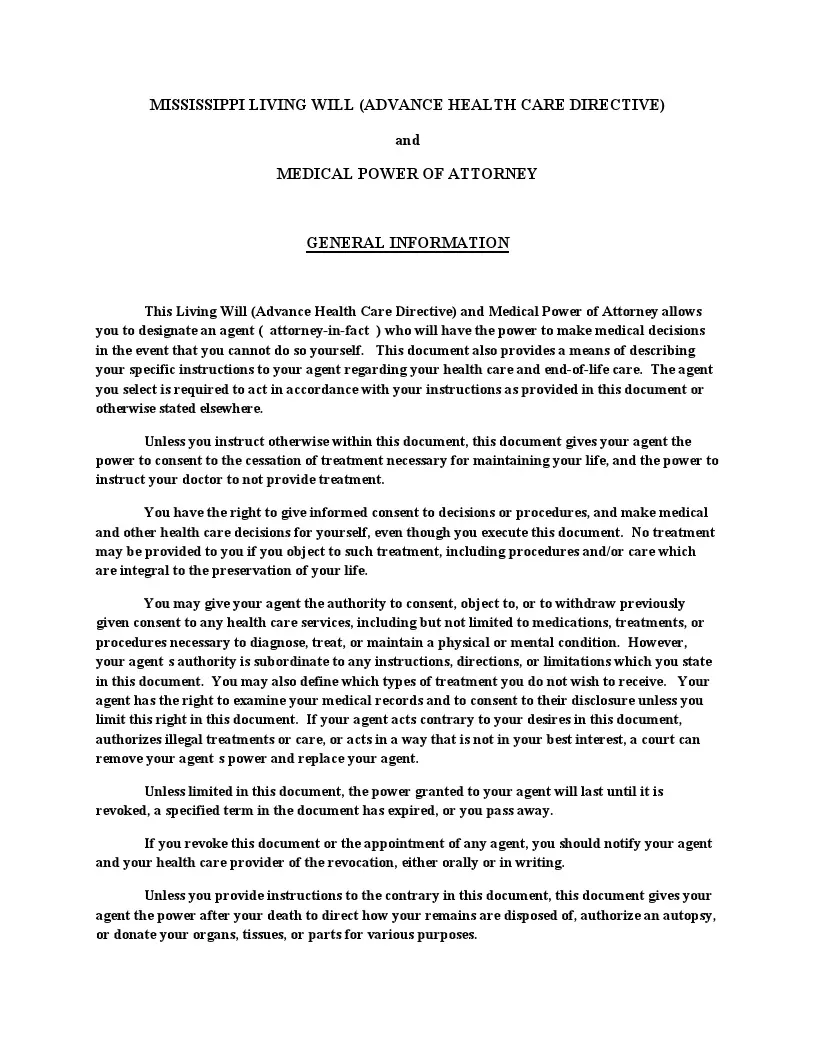
The Mississippi living will form has nine fillable pages, covering your health care agent, your treatment wishes, and your signature. Filling it out takes about 15 to 20 minutes once you have your agent’s contact information ready, and the steps below follow the form’s own page order.
Once every section is complete, you can fill in and sign the PDF directly using our online PDF editor. Then print or save a copy for your agent, your physician, and any health care facility where you receive care.

Other Living Will Forms by State
General information, not legal or tax advice.
