
A living will form in New Mexico is a legal document that lets you specify your wishes for medical care, especially end-of-life treatment. It applies if illness or incapacity leaves you unable to communicate those wishes yourself. A living will form is also commonly called an “advance directive.”
Last Updated: September 2026. This guide is reviewed and updated regularly to reflect current New Mexico law. If you notice an error or outdated information, please contact us.
A New Mexico living will states whether life-sustaining treatment should be given if you are terminally ill, in a persistent vegetative state, or permanently unconscious. In New Mexico, an advance directive can also include a durable power of attorney for health care, so you can appoint a healthcare agent to make your medical decisions.
New Mexico’s living will is part of an advance health-care directive under the state’s Uniform Health-Care Decisions Act, Chapter 24, Article 7A of the New Mexico Statutes. The part of the directive that names a health-care agent must be in writing and signed by the person making it, called the principal.[1.2] Two witnesses are recommended, but New Mexico law does not require them.[1.3]
If your directive also creates a durable power of attorney for health care, the same rule applies. New Mexico law requires the principal’s signature on that part of the document as well.[1.1]
| Document Name | New Mexico Living Will Form |
| State Form Name | New Mexico Advance Health Care Directive |
| Signing Requirements | Two witnesses recommended (not legally required) |
| Validity Requirements | Section 24-7A-2 |
| State Laws: New Mexico Statutes, Sections 24-7A-1 to 24-7A-18 | |
An individual is presumed to have capacity to make a health-care decision, and to give or revoke an advance health-care directive and to designate a surrogate. Unless your directive says otherwise, that determination must be made by two qualified health-care professionals. At least one of them must be your primary care practitioner.[1.5]
If the lack of capacity is because of mental illness or a developmental disability, one of the two professionals must have training and expertise in assessing that kind of impairment. You may challenge a capacity determination at any time, either in a signed writing or by telling a health-care practitioner directly that you disagree.[1.5]
New Mexico law penalizes anyone who misuses an advance directive. A health-care provider or institution that intentionally violates the Act is liable to the affected person for $5,000 or actual damages resulting from the violation, whichever is greater. The affected person may also recover reasonable attorney fees.[1.4]
A person who intentionally falsifies, forges, conceals, or destroys a directive or its revocation without consent is liable for $5,000 or actual damages resulting from the action, whichever is greater, plus reasonable attorney fees. The same penalty applies to anyone who coerces or defrauds someone into giving or revoking a directive.[1.4]
Moving from another state? An advance directive you signed in another state or jurisdiction, in compliance with that state’s law, is deemed valid and enforceable in New Mexico to the same extent as if you had made it here.[1.6] You do not need to redo the paperwork if you move.
No. New Mexico does not require notarization for a living will or health-care directive to be valid. After completing the form, sign and date it at the end. Two witnesses are recommended for added validation, but they are not required by law.[1.3]
Popular Local Living Will Forms
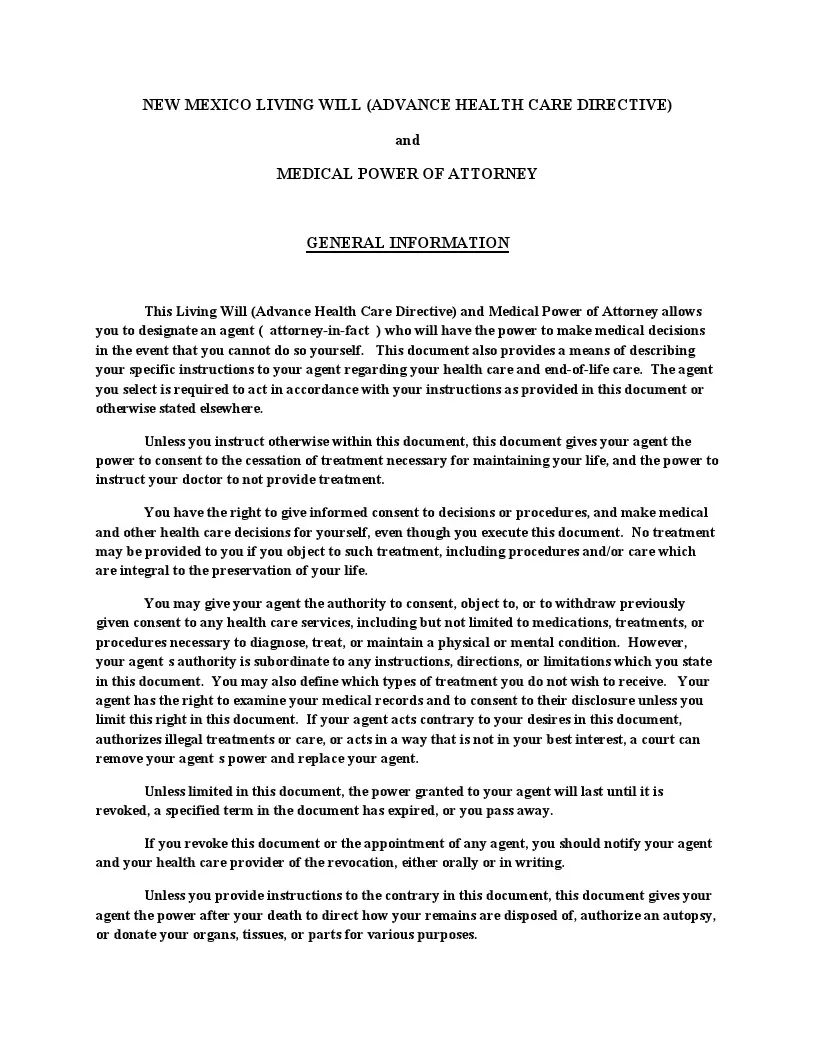
This document combines directives for health care and end-of-life decisions with the appointment of a healthcare agent who can make decisions on your behalf. Here is a step-by-step guide to help you complete the form in the order the form itself follows.

General information, not legal or tax advice.
