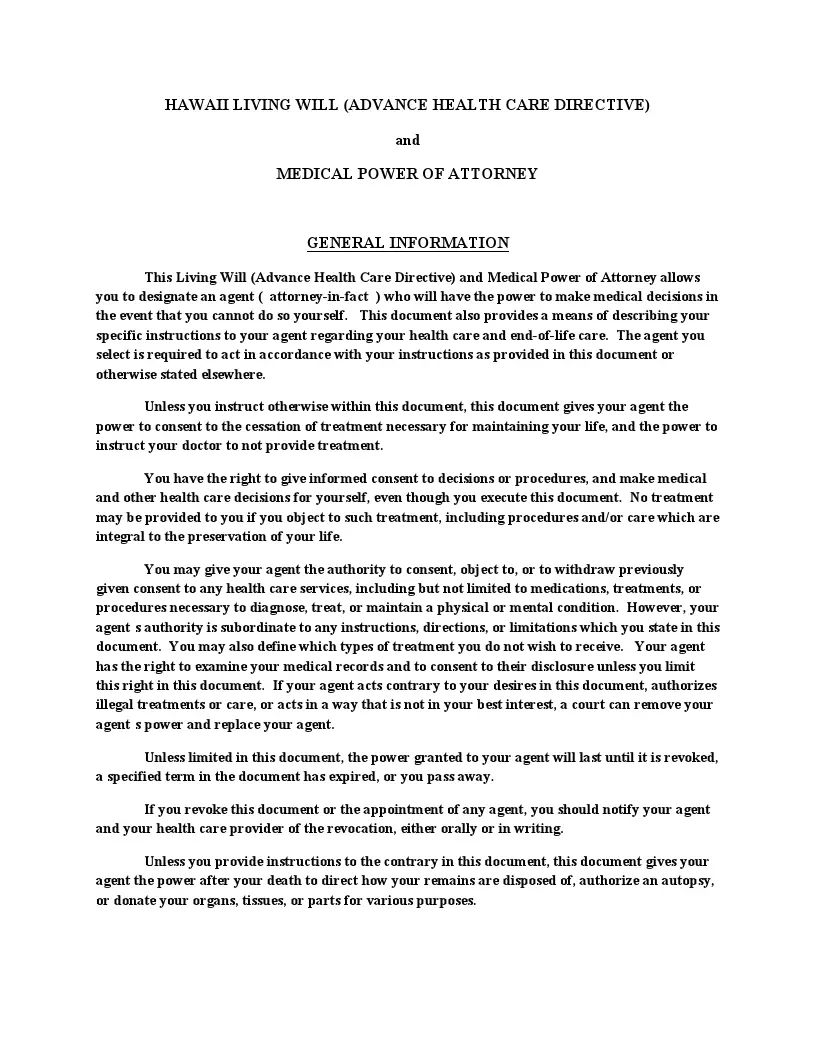
A Hawaii living will is a written document that lets you state which medical treatments you want, or want withheld, if illness or injury leaves you unable to communicate your wishes.
Last Updated: September 2026. This guide is reviewed and updated regularly to reflect current Hawaii law. If you notice an error or outdated information, please contact us.
It is governed by the state’s Uniform Health-Care Decisions Act, Haw. Rev. Stat. Chapter 327E, and it typically guides your family and health care providers on treatments such as artificial nutrition, hydration, and other life-sustaining care.
State law also provides an optional combined form that pairs a power of attorney for health care with your treatment instructions in a single document, so you can name a health care agent and record your wishes together.[2] FormsPal’s builder lets you create your living will, name a health care agent, and download a completed PDF or Word document to sign.
Hawaii’s living will, part of the Advance Health Care Directive under Haw. Rev. Stat. Chapter 327E, must be in writing and signed by you or, if you cannot sign, by someone else in your presence and at your direction. Two witnesses must then confirm that they watched you sign it or that you already told them you had signed it, or you can have the directive acknowledged before a notary public instead.[1]
At least one of your two witnesses cannot be related to you by blood, marriage, or adoption, and cannot be entitled to any part of your estate when you die.[1]
In short, a valid directive needs:
Agent eligibility. Unless your agent is related to you by blood, marriage, or adoption, your agent cannot be an owner, operator, or employee of the health care institution where you are receiving care.[1]
Following these requirements helps make sure health care providers honor your directive when the time comes.
A witness may not be the agent named in the directive, and may not be a health care provider or an employee of a health care provider or facility (Haw. Rev. Stat. § 327E-3(c)).[1]
Your witnesses must be adults who know you personally, or you may sign before a notary instead (Haw. Rev. Stat. § 327E-16).[2]
You can revoke or replace your advance health care directive at any time (Haw. Rev. Stat. § 327E-16).[2]
| Document Name | Hawaii Living Will Form |
| State Form Name | Hawaii Advance Health Care Directive |
| Signing Requirements | Two Witnesses or Notary Public |
| Validity Requirements | Section 327E-3 of the Hawaii Revised Statutes |
| State Laws: Hawaii Revised Statutes, Chapter 327E | |

Filling out this form covers two parts. You give instructions about your care, and you can name a health care agent to decide for you if you cannot. You can fill in the downloaded PDF using FormsPal’s PDF editor before you print and sign it. Follow the form’s sections in order so your directive is complete and ready to sign.

To make a living will in Hawaii, you sign the directive yourself, or have someone sign it for you in your presence and at your direction. The signing must be witnessed by at least two individuals, or acknowledged before a notary public instead. Unless the agent is related to you by blood, marriage, or adoption, your health care agent cannot be an owner, operator, or employee of the health care institution where you are receiving care.[1]
Hawaii’s optional statutory form is organized in four parts.[2]
Keep your signed directive where family members and providers can find it, and give copies to your health care agent and your physician.
General information, not legal or tax advice.
Unless noted otherwise, the sources below are from the Haw. Rev. Stat..