
A Massachusetts living will is a written document that records your wishes for medical treatment if you become unable to communicate them yourself. Massachusetts’s advance directive statute centers on the health care proxy. Under it, you name someone to make health care decisions on your behalf if you cannot make them yourself. A living will is commonly prepared alongside a health care proxy to spell out your specific treatment preferences.
Last Updated: September 2026. This guide is reviewed and updated regularly to reflect current Massachusetts law. If you notice an error or outdated information, please contact us.
Build Your Document
Answer a few simple questions to make your document in minutes
Save and Print
Save progress and finish on any device, download and print anytime
Sign and Use
Your valid, lawyer-approved document is ready
In practice, a Massachusetts living will guides your doctors and health care agent by outlining your preferences for medical treatment. It works together with a health care proxy to provide instructions about decisions such as life support, resuscitation, and pain management.
In Massachusetts, a living will form serves as a directive to your appointed health care agent and your medical team. It records your preferences in medical treatment, particularly in end-of-life situations. A health care proxy names someone to make decisions for you, while a living will describes the decisions themselves. Most people prepare both documents together rather than relying on just one. This document should be:
Line up your two witnesses before your signing appointment, and double-check neither one is the person you are naming as your health care agent.
Pairing your living will with a legally executed health care proxy helps your medical team follow your values. This matters most if you become unable to communicate your wishes yourself. Give a copy of both documents to your agent and your medical team.
Massachusetts’s health care proxy law, Mass. Gen. Laws ch. 201D, § 2, sets the signing and witnessing rules described below.
You must sign the health care proxy yourself, or have someone sign it at your direction if you cannot sign. Two other adults must witness your signature.[1]
State law bars anyone named as your health care agent from acting as one of your two witnesses. By signing, your witnesses affirm in writing that you appeared to be at least 18 years old, of sound mind, and under no constraint or undue influence.[1]
Every competent adult may appoint a health care agent by executing a health care proxy, and every adult is presumed competent unless a court decides otherwise (Mass. Gen. Laws ch. 201D, § 2).[3]
Massachusetts has no living will statute. The binding instrument under state law is the health care proxy created by Mass. Gen. Laws ch. 201D, under which your agent may make any health care decision you could make yourself (ch. 201D, § 5). A living will has no statutory effect of its own, but it guides your agent and your providers.[2]
Massachusetts law requires two adult witnesses for your signature, and bars the person you name as your health care agent from serving as one of them. Your witnesses must sign the document. By signing, they affirm in writing that you appeared to be at least 18 years old, of sound mind, and under no constraint or undue influence.[1]
| Document Name | Massachusetts Living Will Form |
| State Form Name | – |
| Signing Requirements | Two Witnesses |
| Avg. Time to Fill Out | 13 minutes |
| # of Fillable Fields | 54 |
| Available Formats | Adobe PDF; Microsoft Word |
| Governing Law | Mass. Gen. Laws ch. 201D, § 2 |
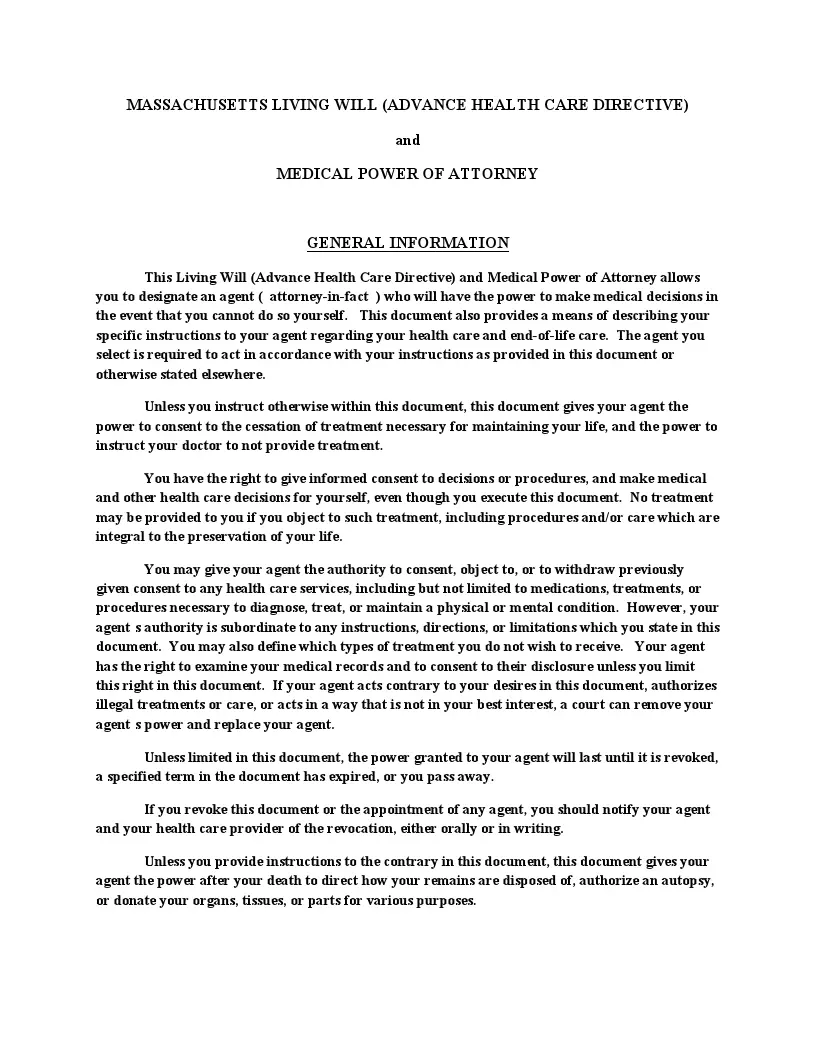
The form combines your health care proxy appointment with an initialed list of treatment preferences, a space for additional instructions, a substitute agent section, and a signature and witness block. Watch the walkthrough below, then follow the steps in the next section to fill it out.
Filling out FormsPal’s Massachusetts living will and health care proxy form involves 10 steps, in the order the form presents them. It starts with your declaration details on page 2 and ends with your two witnesses’ signatures and affirmation on pages 8 and 9. The form has 54 fillable fields across its 11 pages.
Once every page is signed and witnessed, give copies to your health care agent, substitute agent, and primary doctor. Keep the original somewhere safe but easy to find.

Yes. Massachusetts’s health care proxy statute requires the document to be signed by the declarant, or signed at the declarant’s direction if they are unable to sign themselves. The signature must happen in the presence of two other adults who sign as witnesses.[1] This is the same signing step your Massachusetts living will form walks you through when you appoint your health care agent.
General information, not legal or tax advice.
