
A North Dakota living will, also called a health care directive, is a written document that lets you state your wishes for medical treatment if illness or injury leaves you unable to communicate. It is governed by Chapter 23-06.5 of the North Dakota Century Code. The North Dakota living will guides your doctors and family, and lets you appoint a health care agent to decide on your behalf when you cannot.
Last Updated: September 2026. This guide is reviewed and updated regularly to reflect current North Dakota law. If you notice an error or outdated information, please contact us.
A signed living will template takes effect only when a physician determines you can no longer make or communicate health care decisions. Paired with it, a medical power of attorney lets you name a “health care agent,” also called a health care proxy, to make those decisions for you. You decide how broad or limited your agent’s authority is.
North Dakota law sets the requirements for a living will to be valid. The declarant, the person making the document, must have the capacity to sign it, either in person or through someone they authorize to sign on their behalf. State law lets the signing be verified by a notary public or by at least two witnesses who are at least eighteen years old. The version of the form on this page uses the two-witness method.[1.1]
The witnesses must meet the following criteria:
Each witness must be present when you sign or acknowledge your signature, and must certify that the information in the acknowledgment is true and correct. Without this, or without notarization, North Dakota will not treat the document as valid.[1.2]
North Dakota law lets you use either a notary public or two qualifying witnesses, and the notary may be an employee of the health care or long-term care provider treating you.[1.1] The North Dakota form on this page only includes signature lines for the two-witness method, so plan to have two qualifying witnesses present when you sign.
The legal framework for living wills in North Dakota is outlined in the North Dakota Century Code, Chapter 23-06.5. This chapter provides detailed regulations concerning the creation and execution of advance directives.
Because circumstances and preferences can change, many people review their living will every few years and after a major life event.
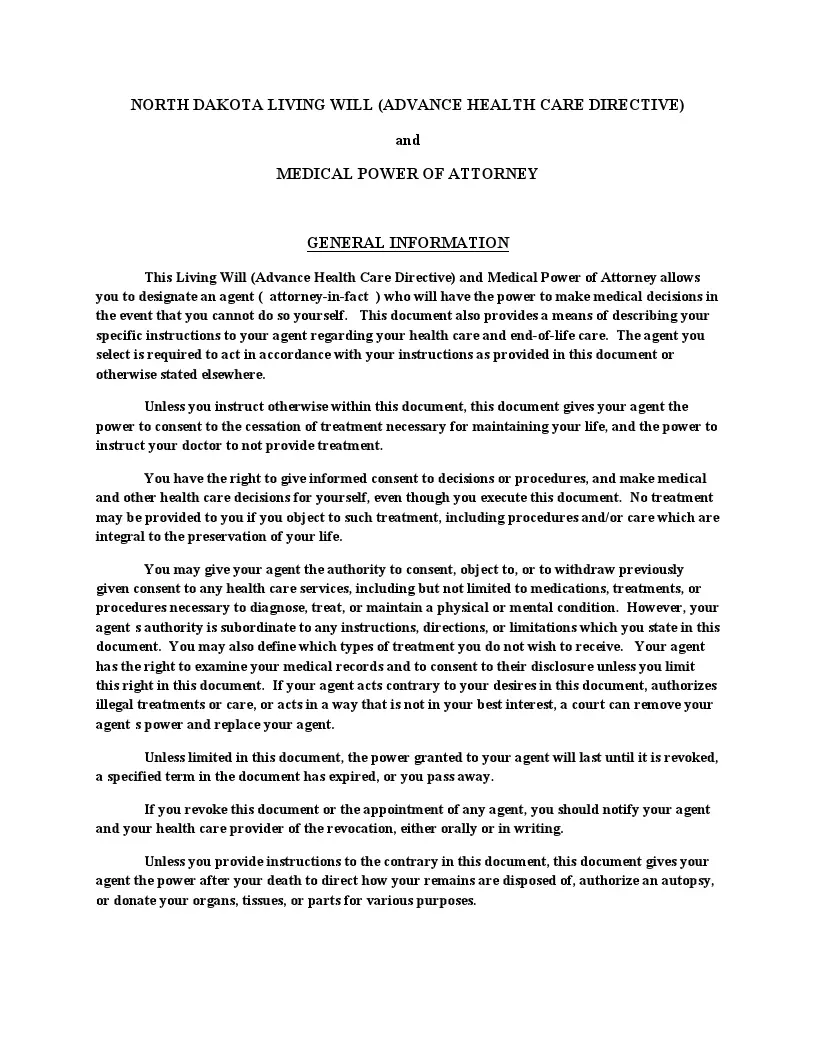
This document combines two parts in one form: a living will (your health care instructions) and a medical power of attorney (naming who can decide for you). You can fill out one part, the other, or both.
| Document Name | North Dakota Living Will Form |
| State Form Name | North Dakota Health Care Directive |
| Signing Requirements | Two Witnesses or a Notary Public |
| Validity Requirements | 23-06.5-05 |
| State Laws: North Dakota Century Code, Sections 23-06.5-01 to 23-06.5-19 | |
Most problems with a North Dakota living will come from the signing step, not the health care choices themselves. A document that is otherwise complete can still fail if the wrong person acts as a witness, or if the signing requirements above are not followed exactly. Watch for these before you sign:
Filling out the North Dakota Health Care Directive means working through it in the order the form itself uses: your health care and end-of-life wishes first, then your health care agent, then your signature before two witnesses. Below is that order, with the page of the form where each part appears.

A North Dakota living will is your written instructions for end-of-life and other health care decisions, used only if you become unable to communicate them yourself. It differs from a last will and testament, which distributes property after death, and from a living trust, which manages assets during your lifetime. Paired with a medical power of attorney, it also lets you name someone to decide on questions the document itself does not address.
Many adults create one alongside a will or a trust as part of routine estate planning, not only after a serious diagnosis. Because the document only takes effect if you cannot communicate, you keep full control over your own care for as long as you are able to make decisions yourself.
A North Dakota living will is valid when the declarant has the capacity to sign it. The signature must then be verified by a notary public, or by at least two witnesses who are eighteen or older and meet the state’s eligibility rules.[1.1] Without one of these two methods, North Dakota will not recognize the document.
General information, not legal or tax advice.
