
A Virginia living will, also called an advance directive, is a written document where an adult sets out the medical care choices to follow if they later cannot decide for themselves. It can also name an agent to make those decisions on their behalf. Under Va. Code Ann. § 54.1-2983, any adult capable of making an informed decision may make one at any time.[1]
Last Updated: September 2026. This guide is reviewed and updated regularly to reflect current Virginia law. If you notice an error or outdated information, please contact us.
The document usually covers two parts: your health care wishes, and, if you choose, a medical power of attorney naming an agent. A Virginia living will is not a substitute for a last will, and it does not need to name an agent. These documents let you plan for future medical decisions without involving a court.
Any adult capable of making an informed decision may make a written Virginia advance directive at any time, addressing health care choices for a time when the declarant can no longer decide. If any part of the document later turns out to be invalid or illegal, that does not affect the rest of the advance directive.[1]
In practice, physicians and appointed agents generally act only within the choices you set out in the document.
Virginia’s advance directive law defines several terms used on the form.[3]
Two subscribing witnesses must be present when the declarant signs.[1] These may be relatives or medical staff acting in good faith, as long as they are at least 18 years old.[3]
A patient already diagnosed with a terminal condition may instead make an oral advance directive. Two witnesses and the attending physician must be present when the patient states it.[1]
It is the declarant’s own responsibility to notify the attending physician that an advance directive has been made. If the patient is comatose or otherwise unable to communicate, any other person may notify the physician instead, including notice that the advance directive has been submitted to the Advance Health Care Planning Registry.[1]
| Document Name | Virginia Living Will Form |
| State Form Name | Virginia Advance Directive for Health Care |
| Signing Requirements | Two Witnesses |
| Validity Requirements | Section 54.1-2983 |
| Avg. Time to Fill Out | 13 minutes |
| # of Fillable Fields | 48 |
| Available Formats | Adobe PDF; Microsoft Word |
| State Laws: Virginia Code, Sections 54.1-2981 to 54.1-2993.1 | |
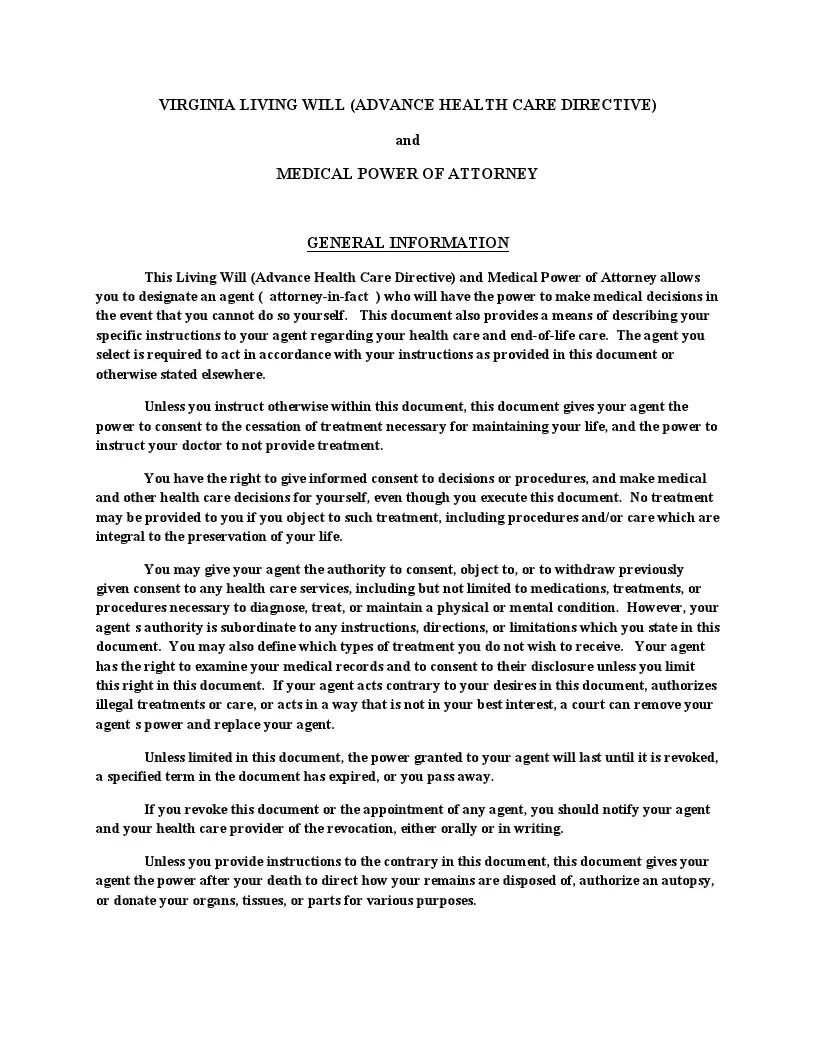
You can fill out the Virginia living will and medical power of attorney in seven steps. They cover your information, health care wishes, agent appointments, signature, and witness acknowledgment, in the form’s own order. FormsPal’s builder above walks you through each field.


Virginia law provides a suggested combined form for a written advance directive. Va. Code § 54.1-2984 sets out language you may use to appoint a health care agent and record your treatment wishes in one document.[2] FormsPal’s template above already follows this structure, so you can fill it out directly instead of drafting the statutory language yourself.
To be valid, a written Virginia living will must be signed by the declarant in the presence of two subscribing witnesses. Any adult capable of making an informed decision may make one at any time, before a crisis occurs. Virginia also allows an oral advance directive when a patient already diagnosed with a terminal condition speaks it in front of the attending physician and two witnesses.[1]
Planning a Virginia living will with a durable power of attorney helps your loved ones and medical team understand your wishes. This planning also keeps major life decisions, including end of life decisions, out of court.
General information, not legal or tax advice.
Unless noted otherwise, the sources below are from the Va. Code Ann..
