
An Illinois quitclaim deed is a written instrument that passes all of the grantor's existing rights in real estate to the grantee, and nothing more.[1.1] The person giving up the interest transfers it to the person receiving it. The deed makes no promise that the seller owns the property, so it is most often used to transfer real estate between family members or into a family trust or business. Download the free form below or build one online in minutes.
Last Updated: October 2026. This guide is reviewed and updated regularly to reflect current Illinois law. If you notice an error or outdated information, please contact us.
Build Your Document
Answer a few simple questions to make your document in minutes
Save and Print
Save progress and finish on any device, download and print anytime
Sign and Use
Your valid, lawyer-approved document is ready
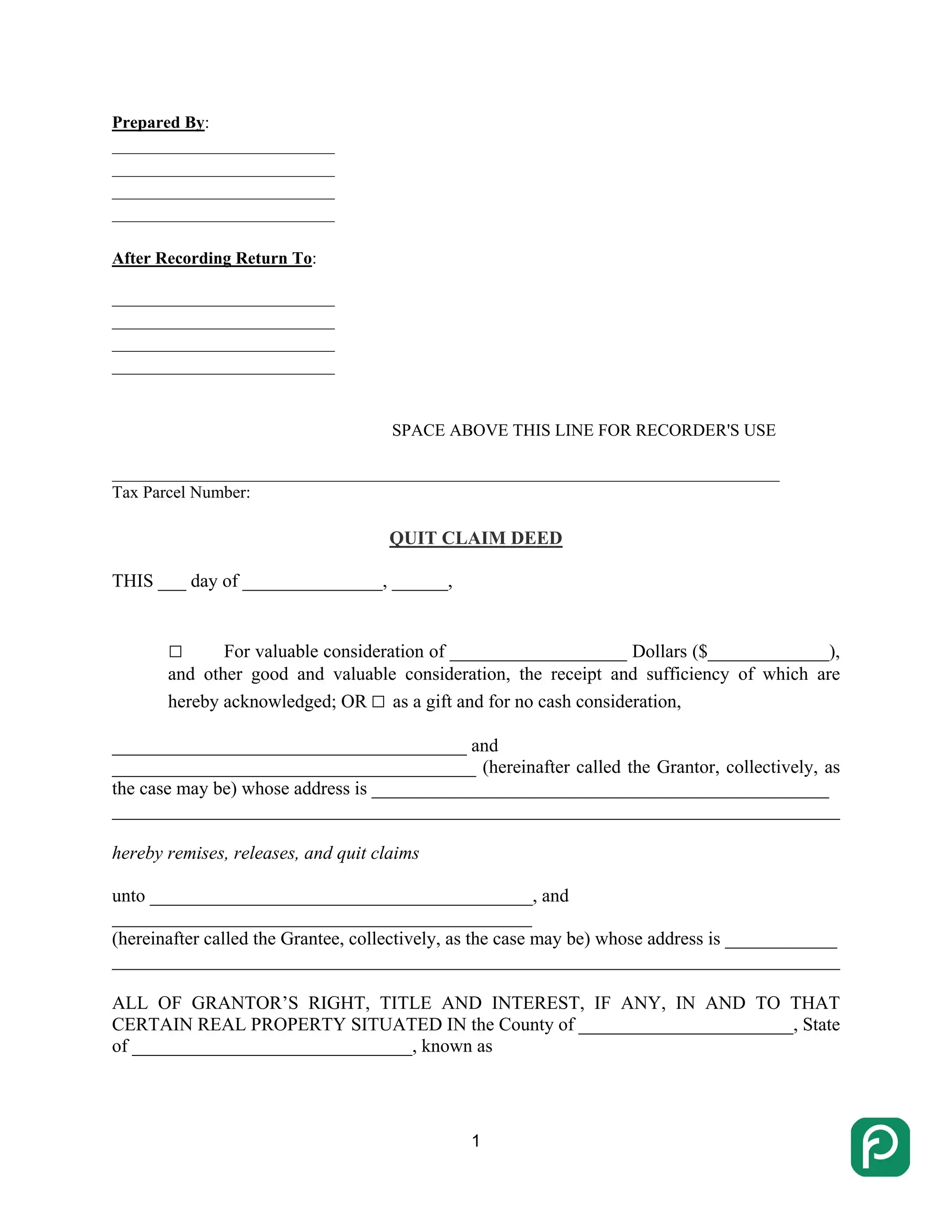
Use this free printable deed form when real property moves between people who trust each other. Deeds of this kind are common between spouses, relatives and a family trust. The Illinois quitclaim deed form carries no warranty of any kind. The form says so itself on page 2, so read every printed page before you sign.
Illinois sets the rules for a quitclaim deed in the Conveyances Act, 765 ILCS 5. A deed that follows the statutory form passes the existing rights of the person who signs it.[1.1] To be made a matter of record, the signatures must be acknowledged by a notary.[1.3] Filing the deed protects it against later buyers and creditors.[1.2]
Section 10 of the Act describes the short form of deed that Illinois law recognizes.[1.1] Its words are:
Every deed in substance in the form described in this section, when otherwise duly executed, shall be deemed and held a good and sufficient conveyance, release and quit claim to the grantee, his heirs and assigns, in fee of all the then existing legal or equitable rights of the grantor, in the premises therein described, but shall not extend to after acquired title unless words are added expressing such intention.
In plain words, the deed does two things and stops there:
A deed that is to be made a matter of record must carry an acknowledgment. Under 765 ILCS 5/35C, the signatures of the parties making the conveyance must be acknowledged by a notary public appointed and commissioned by the secretary of state. The statute also allows acknowledgment by one of the courts or officers designated in section 20 of the Act.[1.3]
In practice, the signer appears in front of the notary, so the notary can complete the acknowledgment printed on the form.
The statutory form comes with two formatting rules:
Failing to meet either rule does not affect the validity or effect of the deed.[1.1]
Filing is what protects a deed against third parties. Under 765 ILCS 5/30, an unrecorded deed is adjudged void as to creditors and subsequent purchasers without notice until it is filed for record.[1.2] So file the signed deed soon after the notary completes the acknowledgment.
In practice, people file the deed with the county recorder's office in the county where the real estate is located.
This FormsPal form runs five pages, and page 3 is blank on purpose. Complete the parts below in order, review each page, and then sign before a notary. You can complete the PDF in our PDF editor or print it and write by hand.
Keep a copy of the signed and notarized deed for your records before you file the original.
Before you transfer the real estate, review the finished deed against the form one more time. Check that the Parcel Id is correct, that the address matches the property, and that every page you plan to file is present.
These answers cover what Illinois law says about a quitclaim deed used to transfer real estate. Each one comes from the Conveyances Act, 765 ILCS 5, so you can review the statute text before you rely on it.
It gives the grantee whatever rights the grantor has in the property, and nothing more. Under 765 ILCS 5/10, the deed passes all the then existing legal or equitable rights of the grantor in the property described. If the seller holds no interest, nothing passes. The deed also does not extend to after acquired title unless words are added expressing such intention.[1.1]
The statutory form has two formatting rules, and a recorded deed needs two more things:
Failing to meet the two formatting rules does not affect the validity or effect of the deed.[1.1]
Only in one case. Recording is exempt from all recording fees if the deed is executed for the sole purpose of reflecting a legal name change, and the grantor and grantee are the same individual or individuals.[1.1]

Other Quitclaim Deed Forms by State
General information, not legal or tax advice.
