
A Hawaii eviction notice is a written notice a landlord serves on a tenant to end a tenancy for unpaid rent, a lease violation, or without cause, before filing an eviction case in court. Hawaii law sets the notice period and content requirements a landlord must follow before going to court.
Last Updated: September 2026. This guide is reviewed and updated regularly to reflect current Hawaii law. If you notice an error or outdated information, please contact us.
Build Your Document
Answer a few simple questions to make your document in minutes
Save and Print
Save progress and finish on any device, download and print anytime
Sign and Use
Your valid, lawyer-approved document is ready
In practice, skipping a step in this process can delay the case or give the tenant grounds to challenge it in court.
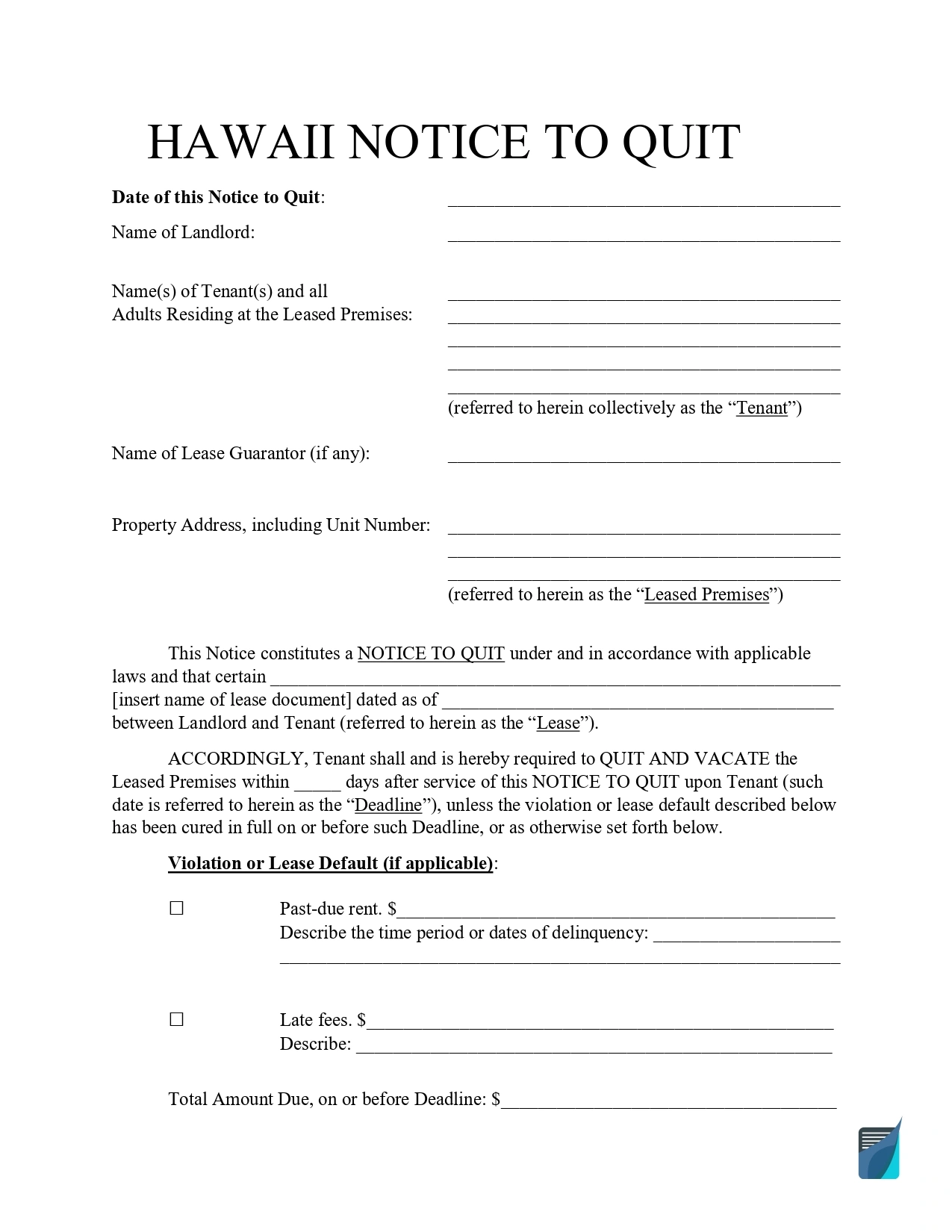
The notice needed depends on the reason for eviction. Nonpayment of rent calls for a five-day notice to pay or vacate, and most other lease violations call for a ten-day notice to cure. Not every Hawaii eviction notice form states a reason and a cure deadline: a notice for a lease violation must name the violation and give at least ten days to fix it, a notice ending a month-to-month tenancy (45 days) needs no reason, and no cure time is required when the violation threatens irremediable damage (HRS §§ 521-69 and 521-71).[1.5] If the tenant does not comply, the landlord can then file for eviction in the local court.
A Hawaii eviction notice is also called a notice to quit, a notice to vacate, or a pay or quit notice.
State law gives both landlords and tenants specific timeframes and protections before an eviction case can move forward. The rules below summarize the notice required for nonpayment of rent, lease violations, and ending a periodic tenancy, along with what a landlord may not do to remove a tenant.
Before acting, landlords and tenants in Hawaii should know the rules below:
In practice, a notice typically names the tenant, describes the reason for it, states the deadline, and is signed and dated by the landlord or the landlord's agent. These are the protections currently in effect under the state's Revised Statutes Chapter 521, Part VI.[1]
A landlord or tenant who is unsure which notice period applies should check the type of tenancy and the reason for eviction against the list above before acting. Keeping a copy of the lease, the notice, and any related messages helps both sides if the matter later goes to court.
Hawaii's eviction rules for residential rentals come from Hawaii Revised Statutes Chapter 521, Part VI. A landlord who wants a tenant out must give written notice for the period the statute sets for that reason, then go to court if the tenant does not comply. A landlord cannot remove a tenant or retake the unit without a court order.[1]
For unpaid rent, the landlord must demand payment in writing and state that the rental agreement will end if the tenant does not pay within the time given. Hawaii law requires at least five business days from the tenant's receipt of the notice.[1.1]
A valid notice under Hawaii law must:
| Rent Grace Period | Agreed to by the parties |
| Notice of Non-Payment | 5 days[1.1] |
| Notice of Non-Compliance | 10 days[1.2] |
| State Laws | Hawaii Revised Statutes, §§ 521-68 to 521-74.5[1] |
Hawaii uses different eviction notices depending on why the landlord wants the tenant out. A five-day notice covers unpaid rent, and a ten-day notice covers most other lease violations. Longer notices of 28 to 120 days apply when either side ends a periodic tenancy without cause, or when the landlord plans to demolish or convert the property.
Landlords who are unsure which type applies can use a document builder that asks about the reason for eviction and fills in the matching timeframe. Tenants who receive one can use the waiting period to review their options, gather any unpaid rent, or speak with a housing counselor.
Five-Day Notice to Pay Rent
This notice applies when rent is overdue. The tenant has five business days after receiving the notice to pay the rent or face eviction proceedings.[1.1] Many landlords deliver this notice in person or by mail and keep a copy along with proof of delivery in case the matter goes to court.
Ten-Day Notice to Cure a Lease Violation
Under Section 521-69 of the Haw. Rev. Stat., a tenant has ten days after receiving written notice to fix a lease violation other than nonpayment.[1.2] Examples include an unauthorized pet or an unpaid utility bill the lease makes the tenant's responsibility.
Hawaii law does not require this ten-day window when the tenant's conduct causes or threatens irremediable damage to a person or property, such as violence or serious property destruction.[1.2] Keeping written records of the notice and any repairs the tenant makes can help both sides if a dispute reaches court.
Notices to End a Month-to-Month or Shorter Tenancy
Hawaii sets a different notice period depending on who is ending the tenancy and how it is structured:
Landlords and tenants who are unsure which notice period applies can check the type of tenancy in their written lease agreement.
Choosing the Right Notice
Which notice to use depends on why the landlord wants the tenant out and how the tenancy is set up. Unpaid rent calls for the five-day notice, and most other lease violations call for the ten-day notice, unless the violation causes irremediable damage. Ending an ongoing month-to-month tenancy without a violation uses the 45-day or 28-day timeframe, a tenancy shorter than month-to-month uses 10 days, and a planned demolition, condo conversion, or change to short-term rental use needs 120 days.
Landlords and tenants can count a notice period exactly with FormsPal's deadline calculator, entering the date the notice was received and the number of days the statute requires.
Popular Local Eviction Notice Forms
Hawaii requires landlords to follow a set legal process before removing a tenant, and self-help is never allowed at any stage. The process moves from written notice, to a waiting period for the tenant to respond, to a court case if the tenant does not comply, and finally to court-ordered enforcement.
No Self-Help by the Landlord
Hawaii law bars a landlord from forcing a tenant out without going through this court process. A landlord may not cut off water, hot water, electricity, gas, or another essential service to push a tenant out, or otherwise take back the unit outside the court process.[1.4]
A tenant who believes a landlord used self-help outside the court process can raise the issue with the court handling the eviction case.
If the Tenant Stays After the Notice Period
If the landlord waits more than 60 days to start a court case after the tenancy ends, a month-to-month tenancy begins at the earlier rent. This applies when the parties have not signed a new agreement. A tenant who stays without the landlord's consent after the termination date can also owe up to twice the monthly rent under the previous rental agreement, prorated for each day the tenant remains.[1.3]
Tenants who are unsure whether a new tenancy has started this way can review their communication with the landlord or ask the court for guidance.

General information, not legal or tax advice.
