
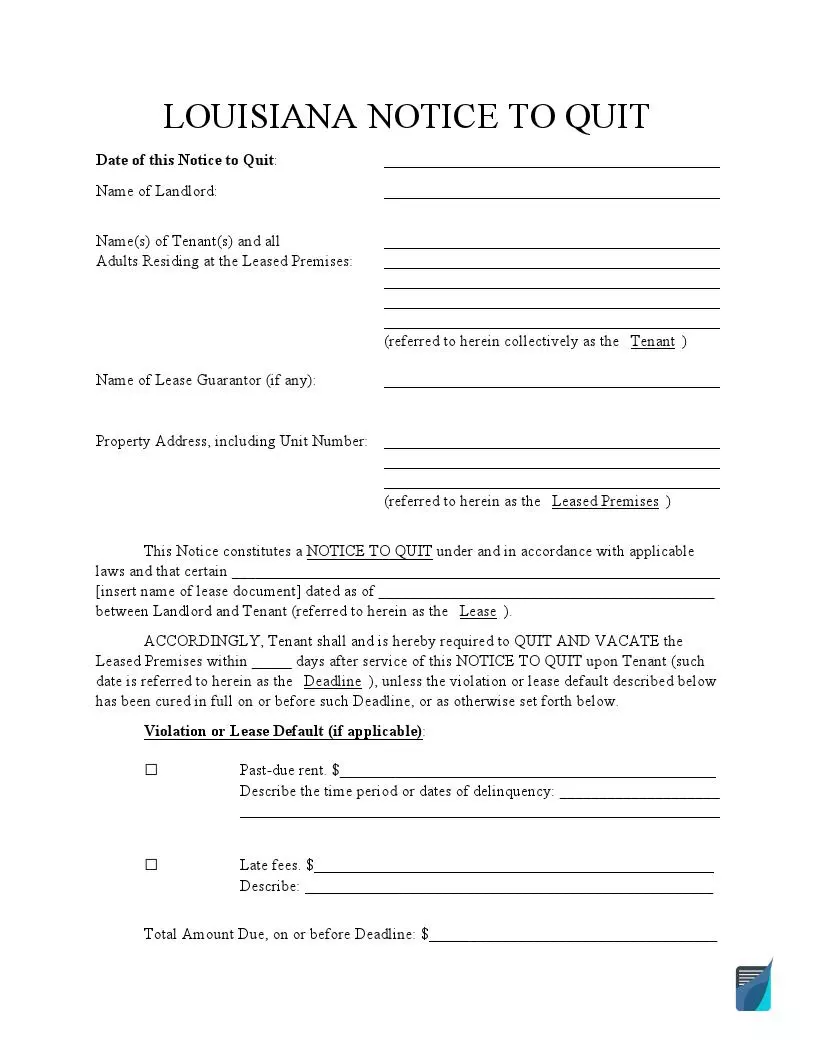
A Louisiana eviction notice is a written notice a landlord serves on a tenant to end a tenancy for nonpayment of rent, a lease violation, or without cause, before the landlord can file an eviction case in court.
State law requires the notice to be in writing and delivered to the tenant, and it sets the number of days the tenant has before the landlord can go to court. The most common reasons a landlord sends this notice are unpaid rent, a lease violation such as an unauthorized pet, and ending a month-to-month tenancy without cause. Louisiana law does not allow a landlord to remove a tenant without a court order, so the notice is only the first step.
Build Your Document
Answer a few simple questions to make your document in minutes
Save and Print
Save progress and finish on any device, download and print anytime
Sign and Use
Your valid, lawyer-approved document is ready
Last Updated: September 2026. This guide is reviewed and updated regularly to reflect current Louisiana law. If you notice an error or outdated information, please contact us.
Louisiana law requires a landlord to give the tenant written notice before starting an eviction case, no matter the reason for ending the tenancy. Under La. Code Civ. Proc. art. 4701, the lessor or the lessor’s agent must cause a written notice to vacate the premises to be delivered to the tenant.[1] The notice must give the tenant not less than five days from delivery to leave the property. FormsPal’s free eviction notice template can be adapted for Louisiana or any other state.
Louisiana landlords send this notice for a few common reasons:
An eviction notice is also called a notice to vacate or a notice to quit. Louisiana statutes and courts use the term notice to vacate.
A lease can take away the standard notice period only through a written waiver contained in the lease itself. Where that waiver exists, the landlord or the landlord’s agent may begin eviction proceedings as soon as the tenant’s right to occupy the property ends, for any reason, without waiting out the usual notice period.[1] Always check the lease for this clause before relying on it.
After the eviction case ends, a landlord who wants to collect unpaid rent or recover personal property left behind may want to talk to an attorney, so any next steps do not expose the landlord to a claim for damages.
| Rent Grace Period | Not specified |
| Notice of Non-Payment | 5 days |
| Notice of Non-Compliance | 5 days |
| Notice to End a Month-to-Month Tenancy | 5 days |
| State Laws | La. Code Civ. Proc. arts. 4701 to 4705 |
In Louisiana, a tenant has not less than five days from the date the landlord delivers the written notice to vacate, unless the lease contains a written waiver of that notice period.[1] This applies whether the notice is for unpaid rent, a lease violation, or ending a month-to-month tenancy without cause. Count the days with FormsPal’s deadline calculator to confirm the exact date the notice period ends.
Not automatically. Louisiana law caps how early a notice can be sent when the lease has a definite end date. If the lease has a definite term, notice to vacate may be given not more than thirty days before the term expires.[1] That thirty-day window controls when the landlord can send the notice ahead of the lease’s natural end date. It is not a promise of thirty days to leave after any notice. The actual time to vacate for nonpayment or a no-cause termination is the five-day period described above.
A Louisiana eviction always goes through the courts, never through a landlord’s own hands. The landlord or the landlord’s agent must first deliver a written notice to vacate that gives the tenant at least five days, unless the lease waives that notice in writing.[1] If the tenant does not leave, the landlord files a case in court, and the court sets the hearing not earlier than the third day after the tenant is served.[2]
At the hearing, the court tries the case and hears any defense the tenant raises. If the tenant fails to answer or appear, or if the court finds for the landlord, the court orders the tenant to deliver possession of the property to the landlord, and the judgment stays effective for at least ninety days.[2] Louisiana law does not let a landlord remove a tenant without going through this court process.[2]
Louisiana landlords use a few standard notices to vacate, and the notice period is the same five days in each case under La. Code Civ. Proc. art. 4701.[1] The type of notice depends on why the tenancy is ending: unpaid rent, a lease violation, or a month-to-month tenancy the landlord wants to end without cause.
Evicting a tenant in Louisiana always goes through the courts. The landlord identifies the reason for eviction, delivers a written notice to vacate, and if the tenant does not leave, files a petition in court. The court then holds a hearing and, if it rules for the landlord, issues a judgment of eviction that a law enforcement officer carries out.[2]
Louisiana eviction cases can involve more than one court form, and which ones apply depends on the stage of the case and whether the tenant contests it. Below are the forms most often used in a Louisiana eviction, from the notice the tenant receives about the court date to the document that authorizes a law enforcement officer to remove the tenant.

General information, not legal or tax advice.