
A Washington state eviction notice is a written notice a landlord serves on a tenant to end the tenancy before filing a case in court, for nonpayment of rent, a lease violation, or without cause. Depending on the reason, the notice gives the tenant a set number of days to pay the rent, fix the problem, or move out.
The eviction process generally follows three stages: notice, court action, and eviction itself. Most evictions do not require a lawyer, though a landlord dealing with a tenant accused of illegal activity on the property may want one.
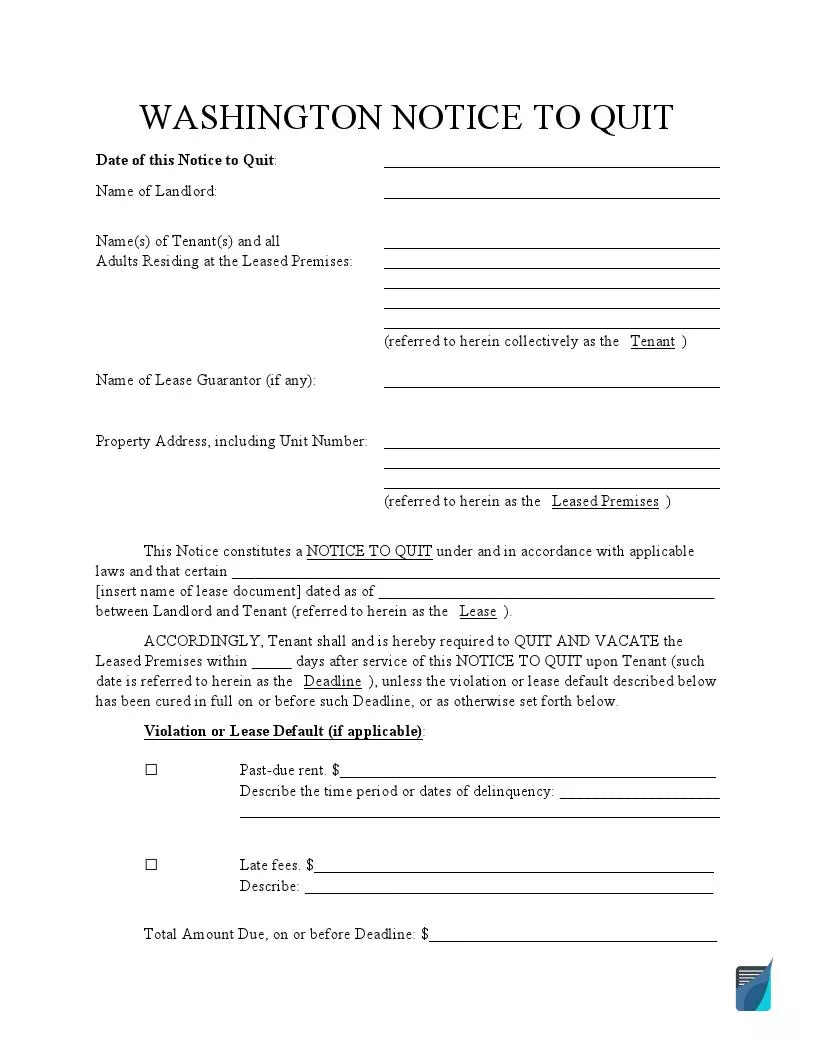
A Washington eviction notice is also called a notice to vacate or a notice to quit. All three names refer to the same written notice a landlord serves before going to court.
Build Your Document
Answer a few simple questions to make your document in minutes
Save and Print
Save progress and finish on any device, download and print anytime
Sign and Use
Your valid, lawyer-approved document is ready
Last Updated: September 2026. This guide is reviewed and updated regularly to reflect current Washington law. If you notice an error or outdated information, please contact us.
Washington’s eviction rules mainly come from the Residential Landlord-Tenant Act, chapter 59.18 RCW, along with the older unlawful detainer statute in chapter 59.12 RCW. Together they require a landlord to give written notice before filing in court, set out how the notice must be served, and give the tenant a set number of days to pay rent, fix a violation, or move out.[2]
In practice, the landlord tries to deliver the notice in person to the tenant or to another adult who lives there. When personal delivery is not possible, posting a copy on the front door and mailing a copy is a common way to complete service. If a subtenant is also in actual possession of the property, Washington law requires the landlord to serve that subtenant too.[2]
Washington law allows a landlord to end a tenancy for a few main reasons:
Nonpayment is the most common reason for eviction in Washington. The state sets no grace period: the landlord may serve the notice as soon as rent is due, and the notice gives the tenant 14 days to pay in full or move out.[2]
A lease violation covers many situations, including:
Sometimes a tenant simply does not move out when the rental agreement ends. When that happens, the landlord can ask a court to order the eviction. If the tenant fixes the problem or agrees to the landlord’s terms during the notice period, the case does not have to go to court.
| Rent Grace Period | None. The notice may be served as soon as rent is due.[2] |
| Notice of Non-Payment | 14 days |
| Notice of Non-Compliance | 10 days[2] |
| State Laws | Wash. Rev. Code ch. 59.12 |
Washington landlords use different notices depending on why the tenancy is ending. The reason determines how many days the tenant gets before the landlord can file in court, and whether the tenant can fix the problem to stay. The four notices below cover nonpayment, a lease violation, ending a month-to-month tenancy, and serious misconduct such as nuisance, waste, or unlawful conduct. Tenants who are unsure which notice they received should compare the wording against the four notices below.
After choosing the right notice, fill it in with our PDF editor before printing or signing it.
Popular Local Eviction Notice Forms
Yes. Washington law lets a landlord serve a 3-day notice to quit when a tenant causes a nuisance, commits waste, or uses the property for an illegal purpose. If the tenant is still there after the three days, the landlord may file an eviction case in court.[2]
Because it is a notice to quit rather than a notice that lets the tenant fix the problem, a tenant facing this kind of notice should get legal help right away, before the landlord can evict them.
Washington’s eviction process runs through five stages once informal efforts fail: delivering the notice, filing in court, waiting for the tenant’s written response, the court hearing, and the sheriff serving the writ of restitution. Each stage has its own timeline, and only a court order lets the landlord retake the property.[1]
Self-help evictions are illegal in Washington. A landlord cannot remove a tenant, change the locks, shut off utilities, or take a tenant’s belongings without a court order. Only the sheriff carrying out a signed writ of restitution may retake the property.[1]
Three court documents carry an eviction case forward for landlords and tenants after the notice period ends: the summons and complaint that start the lawsuit, and the writ of restitution that ends it. If the tenant already fell behind on a court-ordered payment plan, a fourth document, the notice of default, can also come into play.

General information, not legal or tax advice.
Unless noted otherwise, the sources below are from the Revised Code of Washington.