
A Louisiana durable power of attorney is a legal document in which one person, the principal, names a trusted person, the agent, to handle financial matters on the principal's behalf. Louisiana law calls this arrangement a mandate. Unless the parties agree otherwise, a mandate does not end when the principal becomes incapacitated.[4] The principal can end it at any time.[3]
Last Updated: October 2026. This guide is reviewed and updated regularly to reflect current Louisiana law. If you notice an error or outdated information, please contact us.

Build Your Document
Answer a few simple questions to make your document in minutes
Save and Print
Save progress and finish on any device, download and print anytime
Sign and Use
Your valid, lawyer-approved document is ready
The FormsPal template is a durable power of attorney for financial matters. The form itself states that it does not authorize anyone to make medical or other health-care decisions. Many families pair it with a separate document for medical decisions as part of estate planning. For that, see our other Louisiana POA forms.
Louisiana law calls a power of attorney a mandate. The person who gives the authority is the principal, and the person who receives it is the mandatary, also called the agent. The legal rules sit in the Louisiana Civil Code. Learn what the law says about form, incapacity, ending a mandate and notice to third parties.
Unless the parties agree otherwise, a mandate does not end when the principal becomes incapacitated or disabled, or is otherwise unable to revoke it.[4] This is what makes a Louisiana power of attorney durable. The statute says it this way:
In the absence of contrary agreement, neither the contract nor the authority of the mandatary is terminated by the principal's incapacity, disability, or other condition that makes an express revocation of the mandate impossible or impractical.
Tell the people your agent dealt with. After a revocation, the principal must notify the third persons with whom the agent was authorized to contract. If the principal does not give that notice, the principal stays bound by the obligations the agent has undertaken.[5]
Louisiana has no statute that sets a general notarization requirement for a power of attorney, because a mandate is not required to be in any particular form (La. Civ. Code art. 2993).[1]
The FormsPal template still includes an acknowledgment page for a notary. You can complete it by signing in front of a notary.
| Document Name | Louisiana Durable Power of Attorney Form |
| Other Names | Louisiana Financial Durable Power of Attorney, LA DPOA |
| Relevant Laws | La. Civ. Code art. 2993, art. 3024, art. 3025, art. 3026, art. 3028 |
| Notarization | Notary acknowledgment page included in the template |
| Avg. Time to Fill Out | 10 minutes |
| # of Fillable Fields | 37 |
| Available Formats | Adobe PDF |
Popular Local Durable POA Forms
DPOA docs are among the most commonly used ones within the USA. Here are some of the most requested durable power of attorney papers.
Filling out a Louisiana durable power of attorney takes eight short steps on the FormsPal template. The form runs five pages, from the names of the principal and agent to the notary acknowledgment. Have the details below ready, then work through the steps in order.
The screenshots under each step show the FormsPal Louisiana durable power of attorney template filled with sample entries in blue, so you can see where each answer goes. The names, addresses, dates and amounts are examples only.
Before you start, gather this information:
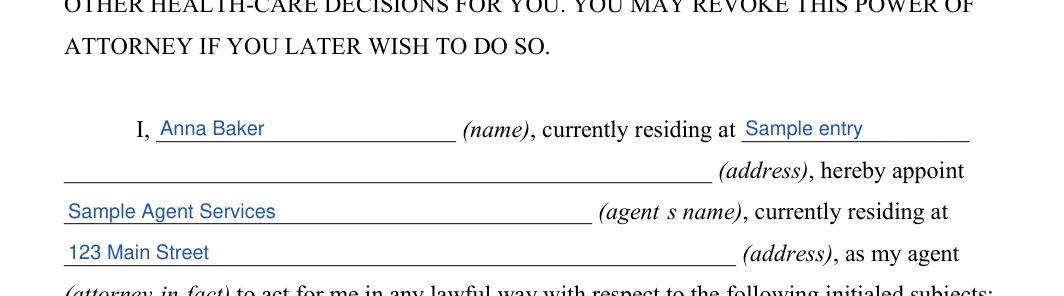
On page 1, enter your name and current address in the opening paragraph. Then enter the name and address of your agent, also called your attorney-in-fact.
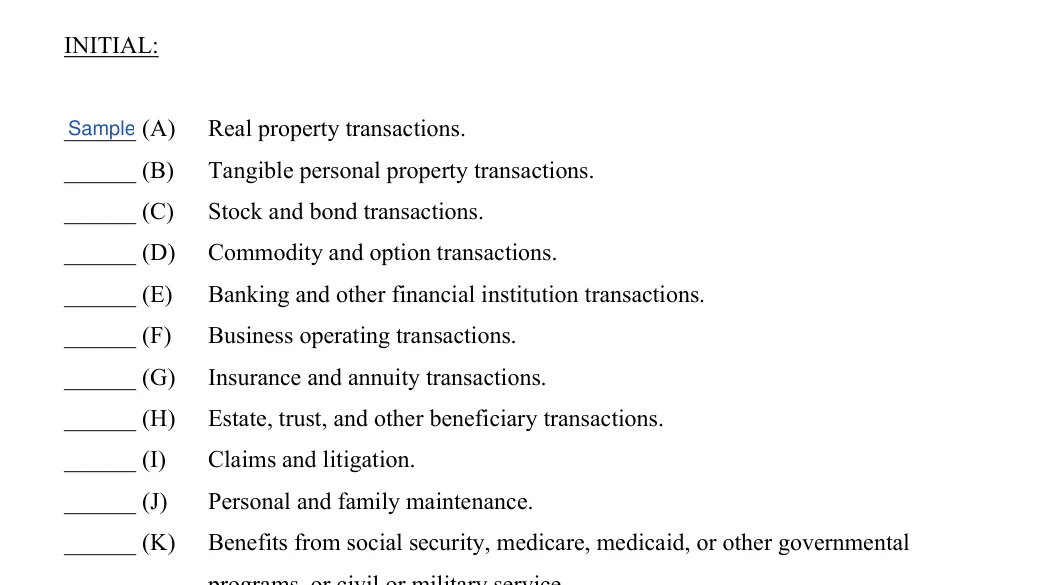
On page 2, initial the line in front of each power you want to grant, from (A) Real property transactions through (K) Government benefits. Leave a line blank to withhold that power.
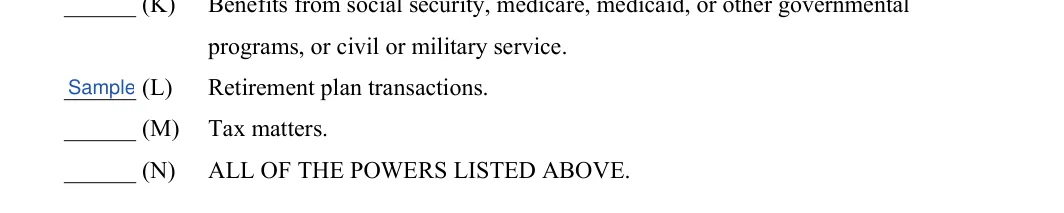
Initial (L) Retirement plan transactions and (M) Tax matters if you want to grant them. To grant every power, initial only line (N), All of the powers listed above. The form says you need not initial any other line then.
The form also carries four preprinted special instructions on pages 2 and 3. They cover health information, medical claims, retirement accounts and digital assets. The form has no blank lines for you to write in.
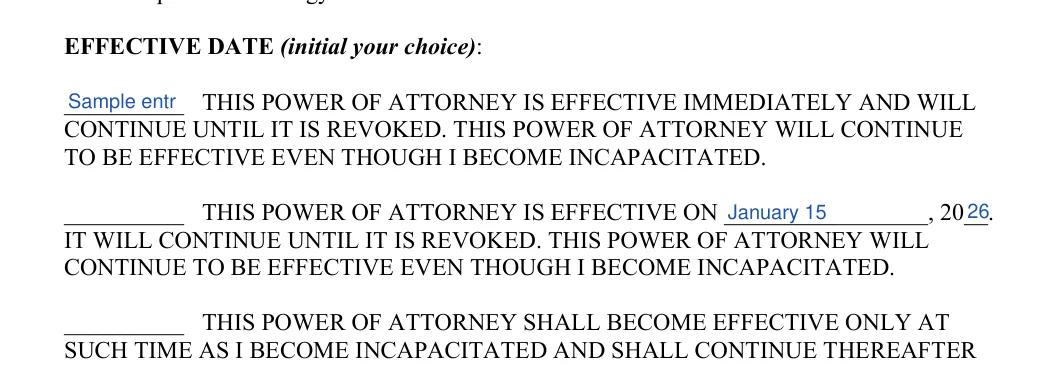
On page 3, initial one of the three options. The first option starts the document right away. The second starts it on a date you write in. The third starts it only when you become incapacitated.
Below the options, the form explains what it means by incapacitated. It says a court order or two physicians' certifications are attached to the original.
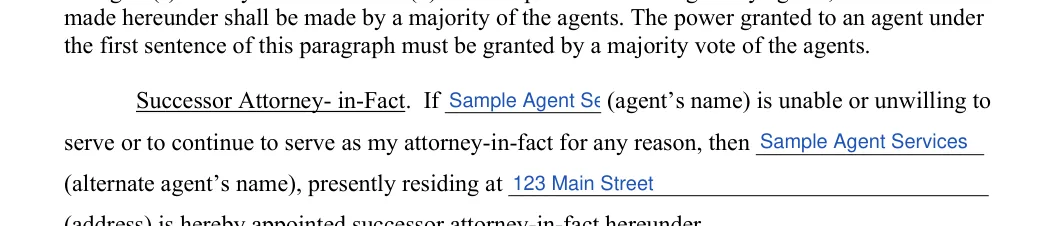
On page 4, repeat your agent's name, then enter the name and address of an alternate agent. The alternate steps in if your agent is unable or unwilling to serve. Leave the alternate lines blank if you do not name one.
The form also includes a paragraph for the case of more than one agent.
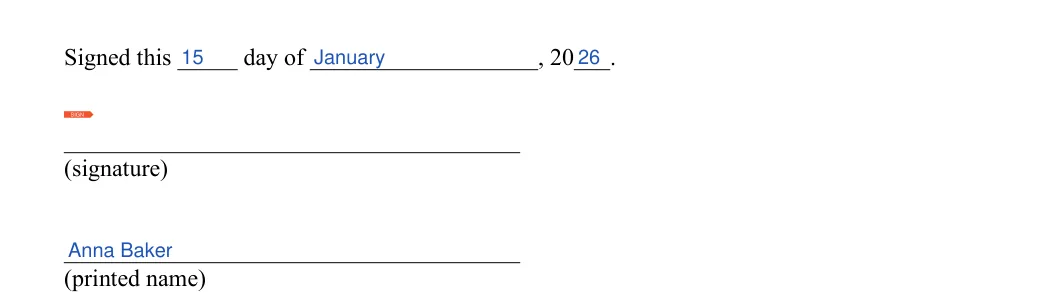
Still on page 4, fill in the day, month and year in the line that begins 'Signed this'. Then sign and print your name.
The form states that any third party who receives a copy may act under it. It also states that all prior general powers of attorney you have executed are revoked.
Page 5 is the acknowledgment, which you complete in front of a notary or another officer. Enter the county, the date, the name and title of the officer, and your name as principal.
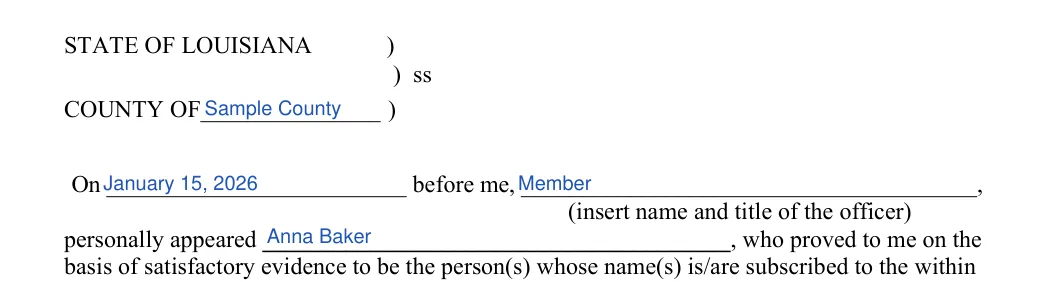
The notary or other officer signs the signature line and adds the seal. According to the acknowledgment text, the officer verifies only your identity, not that the document is true, accurate or valid.

Make several copies of the signed legal document. Give one to the person you named and to any alternate, and keep one for your records.
Create your form online with the FormsPal builder, or download the PDF and print it. The template has 37 fillable fields across five pages, so you can learn the process as you fill it in. To complete the PDF on screen, use the FormsPal PDF editor.

These answers cover the questions people ask most often about this document. Each one draws directly on the Louisiana Civil Code and points to its source in the list at the end of the page.
A person with parental authority over a child may delegate provisional custody of the child by written mandate to any natural person.[4]
Yes, unless the parties agree otherwise. The mandate and the agent's authority are not terminated by the principal's incapacity, disability or other condition that makes an express revocation impossible or impractical.[4]
No. A mandate is not required to be in any particular form. If the law prescribes a certain form for an act, a mandate authorizing that act must be in that form.[1]
The mandate and the agent's authority end when the principal dies. They also end when the agent dies.[2]

General information, not legal or tax advice.
