
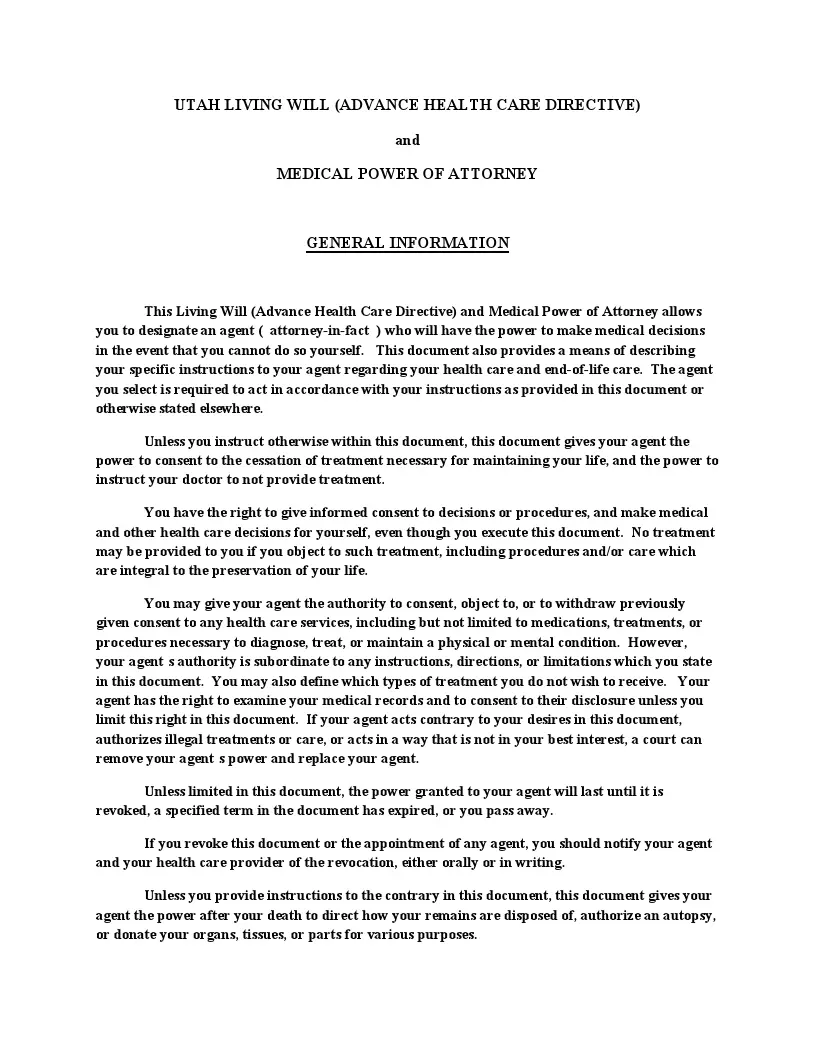
A Utah living will is a written document that states your wishes for medical treatment if illness or injury leaves you unable to communicate. This page also serves as a power of attorney form Utah residents use to name a health care agent, and it covers decisions about life-sustaining treatment, resuscitation, and other end-of-life care.
Last Updated: September 2026. This guide is reviewed and updated regularly to reflect current Utah law. If you notice an error or outdated information, please contact us.
The same document lets you name a health care agent to carry out your wishes and make decisions it does not cover. Filling it out gives your family and health care providers clear, written instructions to follow during a medical crisis.
Utah law sets rules for the part of this document that names a health care agent. That part must be in a record, signed by the person creating it, and signed by one adult witness.[1.4] The rule applies to the medical power of attorney portion, not to your general health care wishes.
Utah disqualifies certain people from acting as your agent once you lack the capacity to make health care decisions. A court can find that a potential agent poses a danger to your well-being, and that alone disqualifies them, even without a protective order.[1.2]
An owner, operator, employee, or contractor of a nursing home or assisted living facility where you live or receive care is also disqualified. The exception is a person who is your family member, your cohabitant, or a descendant of your cohabitant.[1.2]
This form provides two witness signature blocks in the acknowledgment section. Utah law itself requires only one adult witness for the part of the directive that names a health care agent.[1.3] Many people still have a second person sign the extra line as further evidence the document was properly witnessed.
If you make changes later, most people repeat the same signing and witnessing steps used the first time, to avoid any question about whether the changes are valid. Reviewing this document after any major health or family change also helps keep it up to date. If you revoke the document or your agent’s appointment, tell your agent and your health care provider, either in writing or out loud.
You may make a directive if you are an adult or an emancipated minor (Utah Code § 75A-9-101) with capacity, meaning you can communicate a decision and understand its nature and consequences (Utah Code § 75A-9-102).[2.1]
| Document Name | Utah Living Will Form |
| State Form Name | Utah Living Will (Advance Health Care Directive) and Medical Power of Attorney |
| Signing Requirements | One adult witness, required only when naming a health care agent |
| State Laws: Utah Code, Title 75A, Chapter 9 | |
Popular Local Living Will Forms
Filling out this power of attorney form Utah residents use together with a living will takes you through nine parts on an eight-page document, in the order the form itself uses. Complete each part in sequence, since the health care wishes and end-of-life sections come before the agent appointment page. You can fill in the downloaded PDF on your screen with FormsPal’s PDF editor instead of printing a blank copy.

Yes, but only for that part of the form. This power of attorney form Utah residents use needs a witness only for the section that names a health care agent.[1.3] That part of the document must also be in a record and signed by you.[1.4]
Yes. Under Utah law, a witness counts as present if they are physically in the same location as you. They also count as present if they join you by real-time audio and video technology.[1.2] This lets you complete the witnessing step by video call instead of meeting in person.
"Is considered present if the witness and the individual are: physically present in the same location; using electronic means that allow for real time audio and visual transmission and communication in real time to the same extent as if the witness and the individual were physically present in the same location."
Utah disqualifies a potential agent from acting for you once you lack the capacity to make health care decisions. This applies if a court finds that the person poses a danger to your well-being, even when the court does not issue a protective order against them.[1.2] The same disqualification rule also covers certain nursing home and assisted living facility staff, covered in more detail below.
Generally, no. Utah disqualifies an owner, operator, employee, or contractor of a nursing home or assisted living facility where you live or receive care from acting as your agent. This applies once you lack the capacity to make health care decisions. The exception is when that person is also your family member, your cohabitant, or a descendant of your cohabitant.[1.2]
No. On this power of attorney form Utah law states that a health care decision made by your agent is effective without judicial approval.[1.2] Your agent can act on the authority you grant in this document without first going to court.
General information, not legal or tax advice.
