
Updated:
A Florida power of attorney is a document that appoints your agent. For a financial power, Fla. Stat. § 709.2105 requires the principal's signature, two subscribing witnesses and a notary. This page lists Florida forms for durable, medical, tax (DR-835), vehicle and child powers.
Key facts
Build Your Document
Answer a few simple questions to make your document in minutes
Save and Print
Save progress and finish on any device, download and print anytime
Sign and Use
Your valid, lawyer-approved document is ready
The Florida power of attorney forms below cover nine jobs: durable, medical, general, limited, child, real estate, tax, vehicle and revocation. Two of them are state agency forms: Form DR-835 from the Florida Department of Revenue and Form HSMV 82053 from the Florida Department of Highway Safety and Motor Vehicles. Each card names the people who sign that form.
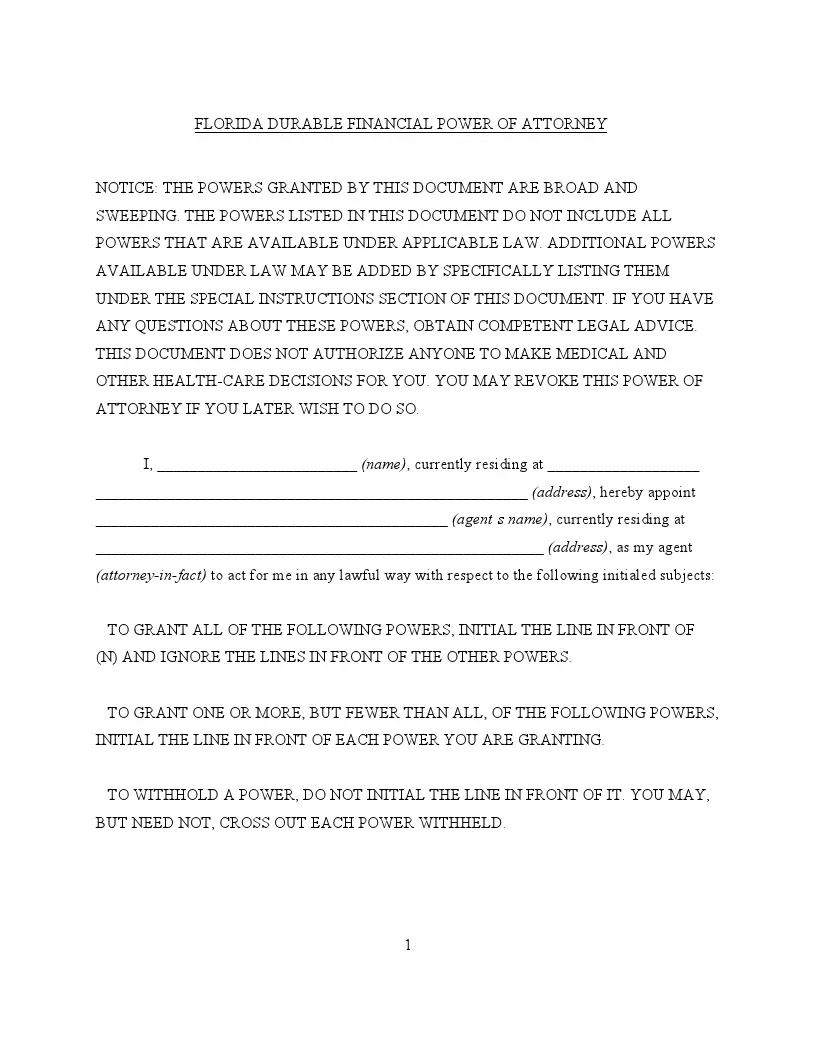
Durable power of attorney in Florida keeps the agent's authority over the principal's finances in place after the principal becomes incapacitated. The document is durable only if it contains the words "This durable power of attorney is not terminated by subsequent incapacity of the principal except as provided in chapter 709, Florida Statutes," or similar words showing that intent (Fla. Stat. § 709.2104).
| Also Known As | Florida DPOA |
| Signing Requirements | Notary Public and Two (2) Witnesses |
| Download | PDF Template |

Medical power of attorney in Florida is a designation of a health care surrogate: the person named makes health care decisions for the principal, receives health information for the principal, or both. Fla. Stat. § 765.202 requires the designation to be signed by the principal in the presence of two subscribing adult witnesses.
| Also Known As | Health Care POA or MPOA |
| Signing Requirements | Two (2) Witnesses |
| Download | PDF Template |

General power of attorney gives an agent broad authority over the principal's property and finances. A general power of attorney without the durability words ends when the principal becomes incapacitated (Fla. Stat. § 709.2109).
| Also Known As | General (Financial) POA |
| Signing Requirements | Notary Public and Two (2) Witnesses |
| Download | PDF Template |

Limited power of attorney covers one matter or a short list of them, such as the sale of a single valuable item the principal owns. A limited power of attorney terminates when its purpose is accomplished (Fla. Stat. § 709.2109).
| Also Known As | Special POA |
| Signing Requirements | Notary Public and Two (2) Witnesses |
| Download | PDF Template |

Child power of attorney lets a parent or guardian name someone to take care of a child while the parent is away. The Florida minor child power of attorney page covers this form in detail.
| Also Known As | Minor POA |
| Download | PDF Template |

Real estate power of attorney hands an agent rights over a property, such as buying, selling or renting it. Like any power of attorney under chapter 709, it is signed by the principal and two subscribing witnesses and acknowledged by the principal before a notary public (Fla. Stat. § 709.2105).
| Also Known As | Limited Real Estate POA |
| Signing Requirements | Notary Public and Two (2) Witnesses |
| Download | PDF Template |

State tax power of attorney (Form DR-835 in Florida) is the form used if a principal does not want to deal with their taxes on their own. The principal asks an agent or an accountant to work for them and submit all tax info to the Florida Department of Revenue.
| Also Known As | Tax POA |
| Signing Requirements | Principal and Agent |
| Download | Form DR-835 |

Vehicle power of attorney lets an agent handle a motor vehicle matter, such as a registration, for the vehicle's owner. In Florida, the Florida Department of Highway Safety and Motor Vehicles issues it as Form HSMV 82053.
| Also Known As | HSMV POA |
| Signing Requirements | Vehicle Owner |
| Download | PDF Template | Form HSMV 82053 |

Revocation power of attorney ends a power of attorney the principal signed earlier. The original terminates when the principal revokes it (Fla. Stat. § 709.2109), and the former agent should get a copy of the revocation.
| Also Known As | POA Termination Form |
| Signing Requirements | Principal's signature (notary or witnesses recommended) |
| Download | PDF Template |
A Florida power of attorney is a document in which one person, the principal, gives another person, the agent, authority to act for the principal. The agent is also called an attorney-in-fact. The signing rules for a financial power of attorney sit in chapter 709 of the Florida Statutes (Fla. Stat. § 709.2105), and those for a health care surrogate in chapter 765 (Fla. Stat. § 765.202).
The table lists each Florida form on this page and the job it does.
| Form | Typical use |
|---|---|
| Durable power of attorney | Money and property matters that continue after incapacity |
| General power of attorney | Broad financial tasks |
| Limited power of attorney | One task, such as a single sale |
| Medical power of attorney | Health care decisions |
| Child power of attorney | Care of a child while the parent is away |
| Real estate power of attorney | Buying, selling, or renting property |
| Vehicle power of attorney (HSMV 82053) | Registration and other vehicle matters |
| Tax power of attorney (DR-835) | State tax matters |
| Revocation of power of attorney | Ending an earlier document |
A Florida durable power of attorney keeps the agent's authority in place after the principal becomes incapacitated, but only if the document contains the durability words of Fla. Stat. § 709.2104. Without them, the document is an ordinary power of attorney that stops when it is needed most.
The durability clause is the sentence that makes the document durable. Fla. Stat. § 709.2104 treats a power of attorney as durable if it contains these words, or similar words that show the principal's intent that the authority can be used notwithstanding the principal's later incapacity:
"This durable power of attorney is not terminated by subsequent incapacity of the principal except as provided in chapter 709, Florida Statutes."
A non-durable power of attorney terminates when the principal becomes incapacitated, because the rule in Fla. Stat. § 709.2109 ends any power of attorney that is not durable at that point. A general or limited form without the clause therefore leaves the agent with no authority during an illness or after an accident. A court finding that the principal is totally or partially incapacitated also terminates a power of attorney, unless the court determines that certain authority stays exercisable by the agent (Fla. Stat. § 709.2109).
Florida DPOA papers follow one statewide signing rule, whether the principal lives in Palm Beach, Broward, Miami-Dade, St. Lucie or Indian River County. The rule comes from Fla. Stat. § 709.2105, a state statute, so a durable power of attorney signed in West Palm Beach meets the same test as one signed in Vero Beach, Port St. Lucie or Fort Lauderdale.
A Florida power of attorney needs two witnesses and a notary: Fla. Stat. § 709.2105 requires it to be signed by the principal and by two subscribing witnesses and acknowledged by the principal before a notary public or as otherwise provided in s. 695.03. Subscribing witnesses are witnesses who sign the document themselves.
The medical power of attorney follows a different section. The table sets the two rules side by side.
| Document | Signing rule | Source |
|---|---|---|
| Durable, general, limited or real estate power of attorney | Signed by the principal and two subscribing witnesses, and acknowledged by the principal before a notary public or as otherwise provided in s. 695.03 | Fla. Stat. § 709.2105 |
| Designation of health care surrogate (medical power of attorney) | Signed by the principal in the presence of two subscribing adult witnesses | Fla. Stat. § 765.202 |
| Witnesses to a health care surrogate designation | The surrogate cannot witness; at least one witness is neither the principal's spouse nor a blood relative | Fla. Stat. § 765.202 |
A notary can sign the document for a principal who cannot hold a pen. If the principal is physically unable to sign, the notary public before whom the principal's oath or acknowledgment is made may sign the principal's name on the power of attorney pursuant to s. 117.05 (Fla. Stat. § 709.2105).
A Florida health care surrogate designation limits who may witness it. The person designated as surrogate shall not act as a witness to the document (Fla. Stat. § 765.202). At least one witness shall be neither the principal's spouse nor a blood relative (Fla. Stat. § 765.202). These two limits are written for health care surrogate designations.
A Florida agent must be 18 or older: Fla. Stat. § 709.2105 limits agents to a natural person who is 18 years of age or older, or a financial institution that has trust powers, has a place of business in Florida and is authorized to conduct trust business in Florida. A minor, or a company without those trust powers, cannot serve as agent under Fla. Stat. § 709.2105.
An agent's authority ends when the agent dies, becomes incapacitated, resigns, or is removed by a court (Fla. Stat. § 709.2109). When the agent is the principal's spouse, the authority also ends once an action is filed for the dissolution or annulment of their marriage or for their legal separation, unless the power of attorney provides otherwise (Fla. Stat. § 709.2109).
A successor agent clause keeps the document working after the first agent stops. When the agent's authority terminates and the power of attorney does not provide for another agent to act, the power of attorney itself terminates (Fla. Stat. § 709.2109).
A Florida power of attorney is completed in nine steps, from choosing the form to handing a copy to the agent, and the signing step follows Fla. Stat. § 709.2105.
Form DR-835 is the Florida power of attorney for state tax matters: on it, the principal names an agent or an accountant to work with the Florida Department of Revenue for them. The form is built for those tax matters; a durable or general power of attorney covers the principal's other money and property matters.
The tax card above lists two signers of Form DR-835: the principal and the agent.
Form DR-835 is filled out in five steps, in the order the form itself is laid out.
Form HSMV 82053 is the Florida vehicle power of attorney, issued by the Florida Department of Highway Safety and Motor Vehicles, that lets an agent handle a vehicle matter for the owner. A common use is a registration while the owner is away: the agent goes through the procedure in the owner's place. The vehicle card above lists one signer for Form HSMV 82053, the vehicle owner.
A Florida medical power of attorney is a written designation of a health care surrogate, who makes health care decisions for the principal, receives health information for the principal, or both (Fla. Stat. § 765.202). Fla. Stat. § 765.203 sets out a suggested form for the designation, which may, but need not, be used. Unless the document states a time of termination, the designation remains in effect until the principal revokes it (Fla. Stat. § 765.202(7)).
A health care advance directive controls over a conflicting power of attorney, with one exception. If the principal has executed a health care advance directive designating a health care surrogate, the terms of the directive control when the two conflict, unless the power of attorney is later executed and expressly states otherwise (Fla. Stat. § 709.2109). Unless the court orders otherwise, a proceeding to determine incapacity does not affect the agent's authority to make health care decisions for the principal (Fla. Stat. § 709.2109).
A power of attorney can give a relative or caregiver the power to consent to a child's medical care. When a person with the power to consent cannot be contacted after a reasonable attempt, and the provider has no actual notice to the contrary, a person who holds a power of attorney to provide medical consent for the minor may consent, in the order of priority the statute lists (Fla. Stat. § 743.0645(2)(a)). The rule covers a minor who is not committed to, or in the custody of, the Department of Children and Families or the Department of Juvenile Justice under the chapters the statute names. A power of attorney executed after July 1, 2001, to provide medical consent for a minor includes the power to consent to medically necessary surgical and general anesthesia services, unless the person who executes it excludes them (Fla. Stat. § 743.0645(2)(a)).
A Florida power of attorney terminates when any of the seven events listed in Fla. Stat. § 709.2109 happens:
A revocation does not bind an agent who, without knowledge of it, acts in good faith under the power of attorney (Fla. Stat. § 709.2109). Termination of a power of attorney is not effective as to an agent who, without knowledge of the termination, acts in good faith under the power of attorney (Fla. Stat. § 709.2109). An act performed that way, unless otherwise invalid or unenforceable, binds the principal and the principal's successors in interest (Fla. Stat. § 709.2109). A copy of the revocation should go to the former agent and to each bank or office that holds the old document.
A court case on the principal's capacity can pause the document. If any person initiates judicial proceedings to determine the principal's incapacity or for the appointment of a guardian advocate, the authority under the power of attorney is suspended until the petition is dismissed or withdrawn or the court authorizes the agent to exercise one or more powers (Fla. Stat. § 709.2109). If the agent is the principal's parent, spouse, child, or grandchild, the authority is not suspended unless a verified motion in accordance with s. 744.3203 is also filed (Fla. Stat. § 709.2109).
If an emergency arises after the proceedings begin and before the court rules on the principal's capacity, the agent may petition that court for authorization to exercise a power (Fla. Stat. § 709.2109). When the agent files that petition, it must set forth the nature of the emergency, the property or matter involved, and the power the agent would exercise (Fla. Stat. § 709.2109).
The power of attorney mistakes below each break a rule of the statutes cited on this page, and each one can leave the agent without the authority the principal meant to give.
Yes, a power of attorney under chapter 709 must be acknowledged by the principal before a notary public or as otherwise provided in s. 695.03 (Fla. Stat. § 709.2105). A health care surrogate designation is signed in the presence of two subscribing adult witnesses (Fla. Stat. § 765.202).
No, the document terminates when the principal dies (Fla. Stat. § 709.2109). The agent's authority under the document ends with it.
A spouse can be one of the two witnesses only if the other witness is neither the principal's spouse nor a blood relative, since at least one witness to a health care surrogate designation shall be neither (Fla. Stat. § 765.202).
The principal is the person who creates the power of attorney and grants the authority. The agent, also called an attorney-in-fact, is the person the principal names to act for them. Choose an agent you trust, because the agent acts for you within the powers the document gives.
Keep the signed original in a safe place and give your agent a copy. Tell the people and organizations that will deal with your agent, such as your bank, that the document exists.
Many people complete the form on their own. If your situation is complicated, such as a large estate or a family disagreement, talk to a Florida attorney before you sign.
Every state has its own power of attorney rules. These state pages are among the most visited on FormsPal.

These Florida documents often go with a power of attorney in an estate or property plan.
General information, not legal or tax advice.
