
An incident report form is a document used in various settings, including workplaces, public areas, emergency services, and educational institutions. It is an official record of unexpected events or accidents, detailing the circumstances and outcomes of specific incidents. The primary function of incident report forms is to capture critical data during an incident, ensuring no details are overlooked or forgotten.
Last Updated: October 2026. This guide is reviewed and updated regularly to reflect current law. If you notice an error or outdated information, please contact us.
Build Your Document
Answer a few simple questions to make your document in minutes
Save and Print
Save progress and finish on any device, download and print anytime
Sign and Use
Your valid, lawyer-approved document is ready
Incident reporting involves more than just following procedures. It’s a foundation for maintaining a safe and compliant business environment. By systematically documenting accidents or unforeseen events, organizations can significantly improve their security posture.
The primary reason for such detailed recording is the identification of potential hazards before they escalate into more severe problems. This approach and implementation of preventive measures effectively reduce the likelihood of similar incidents in the future. Other benefits of using these forms include:
Furthermore, reporting incidents is essential to uphold legal requirements. It offers organizations a foundation and body of evidence to show their compliance with safety regulations and due diligence. This information is crucial for internal documentation and in cases of inspections, audits, or legal matters where evidence of incident management may be needed to protect against accusations or legal actions.
Incident reports are also extremely important for gathering and analyzing data. Gathering information on accidents helps organizations identify trends and patterns, which can inform the improvement of policies and practices. This way, organizations can customize training programs, improve working conditions, and streamline operational processes.
These reports can be categorized based on the nature of the issue, the environment in which the incident occurs, and the potential impact on the organization or individuals involved. Pick the group closest to your situation.
Workplace incidents cover a range of situations, from workplace injuries to construction site problems to commercial mishaps. Each type underscores the need for stringent industry-specific safety measures and thorough documentation. Such measures are essential for physical safety and addressing workplace violence.
This category includes incidents involving personal or company-owned vehicles, specifically targeting accidents, safety violations, and other related issues within the transportation sector, including truck driving and general traffic disruptions.
Reports in this category cover everything from security breaches to emergencies like fires or critical incidents that require immediate attention due to their potential high impact on safety and operations.
These reports are critical in environments like hospitals and clinics. They document everything from patient falls to medication errors, highlighting the need for meticulous attention to patient care and medication management.
Incidents in schools, daycare centers, and summer camps often involve students or children. They can range from minor injuries to behavioral issues, necessitating vigilant supervision and proactive safety protocols.
Specialized incidents include those unique to specific fields, with examples such as cybersecurity breaches in IT, operational issues in police and military settings, or incidents within religious organizations like churches. Each requires tailored response strategies.
This broad category captures incidents like slips and falls, witness reports, and various forms of damage. It is applicable across multiple settings and emphasizes the importance of comprehensive incident documentation for investigation and response planning.
Forms are very effective for managing the incident reporting process for numerous reasons. Structured forms guarantee that every critical detail is methodically documented during the incident. It encompasses information such as the time, place, people, and event description. A standardized layout is important to avoid missing important information, which is essential for evaluating and reacting effectively.
Furthermore, forms make it easier and faster for employees or witnesses to document and report incidents, simplifying paperwork. In high-speed settings, this effectiveness is critical for promptly addressing potential risks. Incident report templates help maintain a uniform data entry process, which is critical for analyzing patterns and pinpointing company improvement areas.
Another benefit of using forms is adherence to legal requirements. Several sectors enforce strict rules mandating the need for documented proof of incident response and management. An effective incident report assists in meeting legal obligations by offering precise documentation for audits, inspections, or legal matters
Using one standard form for every report gives you:
An incident report template helps capture comprehensive details about unexpected events. The effectiveness of this document depends on several essential elements that ensure that all pertinent information is accurately recorded. Key details of an incident report form include:
A clear and detailed description in an incident report is essential for grasping the sequence and scope of what occurred. This section should present a factual, chronological account of the events leading up to, during, and following the accident, strictly avoiding objective language or assumptions about contributing factors. This fundamental information greatly assists in investigating the incident and devising strategies for corrective action to prevent similar occurrences.
Stick to what you saw, heard or measured, and leave out opinions about why it happened. Use times, places and exact words wherever you can, so a reader who was not there can picture the event.
| Instead of | Write |
|---|---|
| The area was unsafe. | The stairwell light was out and the handrail was loose. |
| The machine was broken. | The machine stopped at 3:10 PM and made a loud grinding sound. |
| She was angry. | She raised her voice and said, “I told you twice.” |
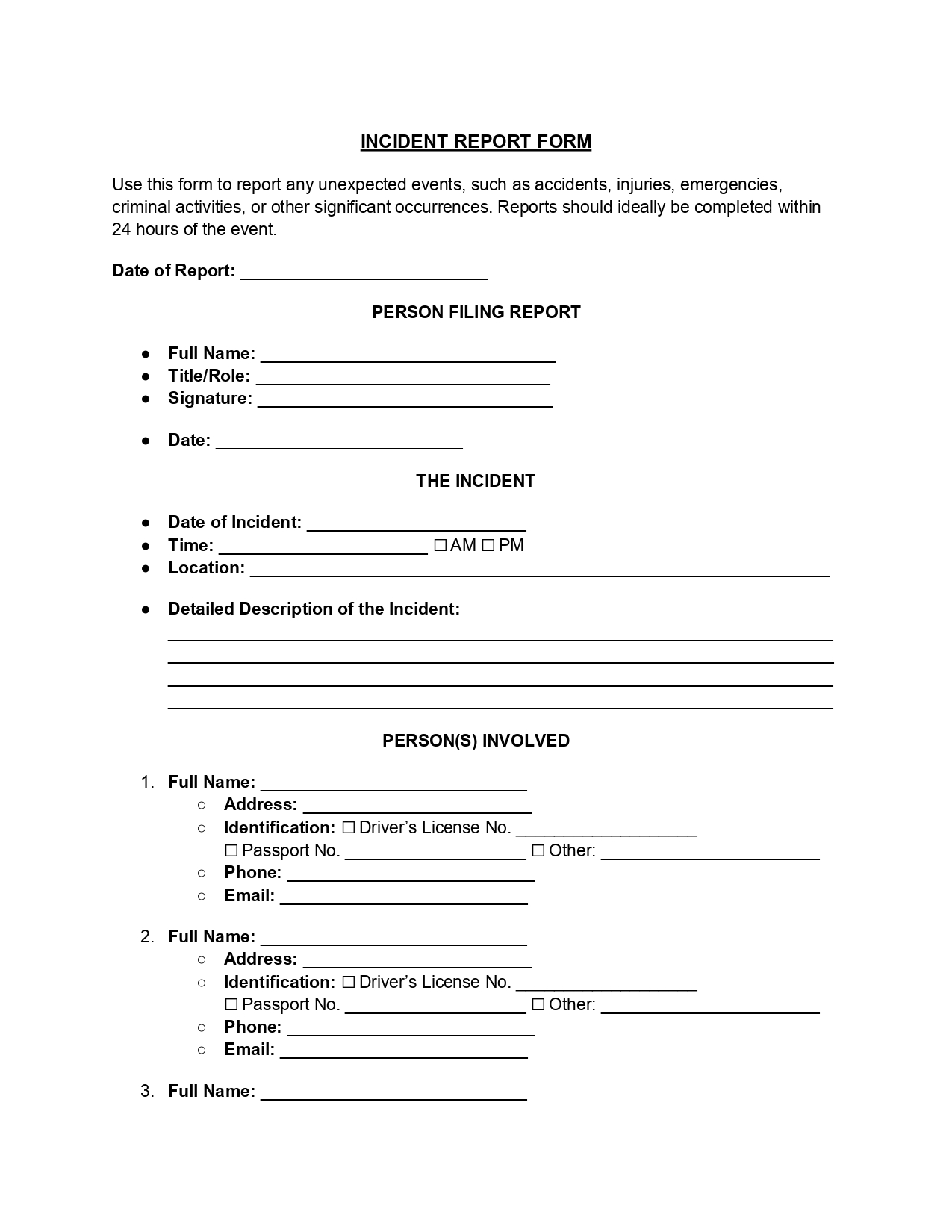
Complete an incident report immediately following the event to ensure witness testimonies are as accurate as possible. The form has seven parts, from the date of the report to the office use block at the end. Work through them in order and keep each answer short and factual.
Have these details at hand before you start:
Enter today’s date on the Date of Report line. Under Person Filing Report, write your full name and your title or role. Then sign and date the lines in that block.
Fill in the date of the incident, the time with AM or PM ticked, and the location. Then describe what happened before, during and after the event on the Detailed Description lines.
Example: “At 2:15 PM on March 3, Anna Baker slipped on a wet floor near the entrance at 123 Main Street. She fell on her left side and said her wrist hurt.”
For each person, write the full name, address, phone number and email address. Tick one identification box (Driver’s License No., Passport No. or Other) and enter the number. The form has room for three people, and the third continues on page 2.
Tick Yes or No under Was anyone injured. If Yes, describe the injuries on the lines provided. Name who was hurt and note what kind of injuries they have.
Tick Yes or No to show whether there were witnesses. If Yes, list each witness with a full name, phone number and email address.
Tick whether the police were notified and, if so, whether a report was filed. Then tick Yes, No or Refused for medical treatment. If treatment was given, mark On-site, Hospital or Other and name the place.
Leave this block blank. The person who receives the report fills in the Report received by line, the date and the follow-up action taken.
Write what you saw or heard, in the order it happened. Include the time, the place and the names of the people involved. Quote what people said when you can.
The FormsPal incident report form is general, so it suits most accidents, injuries and unexpected events. For a specific setting, such as a vehicle accident or a medication error, look through the incident report forms by type for a closer match.
Download the PDF from this page and open it in the FormsPal PDF editor to type in your answers. You can also use the Create My Document button to build the form online one step at a time, or print the PDF and write by hand.
Run through this short list before you hand in the report, then keep a copy for your own records.
General information, not legal or tax advice.
