
Motor vehicle power of attorney forms can be used to give another person a variety of powers over a vehicle that you (principal) own without transferring ownership of the vehicle to that person. That includes the right to register the vehicle, either in your name or theirs, as well as the right to buy or sell the vehicle on your behalf and sign the relevant paperwork. You can also ask this person to handle the maintenance of the vehicle, though the specifics are up to you and the individual you designate as your attorney-in-fact (also called representative or agent – as in other power of attorney forms). The most important thing is that a vehicle power of attorney gives your agent the right to complete DMV interactions for you. You don’t give up your rights over the vehicle when you grant some authority over the vehicle to your agent, but you do share those rights and responsibilities.
Last Updated: October 2026. This guide is reviewed and updated regularly to reflect current law. If you notice an error or outdated information, please contact us.
Build Your Document
Answer a few simple questions to make your document in minutes
Save and Print
Save progress and finish on any device, download and print anytime
Sign and Use
Your valid, lawyer-approved document is ready
One of the most common reasons to use a motor vehicle power of attorney is if the vehicle will need registration when you aren’t able to complete the registration yourself. There are lots of reasons you might not be available, including:
You may also want this type of limited power of attorney if you are relying on someone with more expertise to take care of the vehicle.
It’s also common to use a motor vehicle power of attorney if you want to sell a vehicle but aren’t able to sell it yourself. Say you’re moving and haven’t sold the vehicle yet. You might want to designate someone local to sell it for you instead of bringing the vehicle with you.
These POA also act as DMV power of attorney, so the person you authorize can also handle registration requirements. They will also be able to transfer the title on the vehicle if you are selling it.
There are a lot of ways to get a motor vehicle power of attorney. You can get the form from the DMV, an attorney, or from free forms available online here. Here are the steps to get your form and set everything up.
The table below lists each state, the signing details it shows for a vehicle power of attorney and the name of the state’s own DMV form. Several form names link to the matching FormsPal page, so you can open the form directly.
Forms and signing details change over time. Check with your state’s DMV for the current version before you use any form.
| STATE | Signing requirements | State DMV POA Form |
| Alabama | Owner of Vehicle | Form MVT 5-13 |
| Alaska | Notary Public | Form 847 |
| Arizona | Notary Public | Form 48-1001 |
| Arkansas | Owner of Vehicle | Power of Attorney for Vehicle Transactions |
| California | Owner of Vehicle | Form REG 260 |
| Colorado | Notary Public | Form DR 2175 |
| Connecticut | Two Witnesses and Notary Public | Form A-83 |
| Delaware | Notary Public | Form MV386 |
| Florida | Owner of Vehicle | Form 82053 |
| Georgia | Notary Public | Form T-8 |
| Hawaii | Notary Public | Form DMVL-596 |
| Idaho | Notary Public (if applying for duplicate title) | Form ITD 3368 |
| Illinois | Owner of Vehicle | Form RT-5 |
| Indiana | Notary Public | Form 1940 |
| Iowa | Notary Public | Form 411021 |
| Kansas | Owner of Vehicle | Form TR-41 |
| Kentucky | Notary Public | Form TC 96-336 |
| Louisiana | Notary Public | None |
| Maine | Certified Technician and Notary Public | None |
| Maryland | Owner of Vehicle | Form VR-470 |
| Massachusetts | Certified Technician and Notary Public | None |
| Michigan | Owner of Vehicle | Form TR-128 |
| Minnesota | Notary Public | None |
| Mississippi | Notary Public | Form 78-003-21-8-1-000 |
| Missouri | Notary Public (not required if signing electronically) | Form 4054 |
| Montana | Notary Public | Form MV65 |
| Nebraska | Notary Public | DMV Power of Attorney |
| Nevada | Notary Public | Form VP136 |
| New Hampshire | Owner of Vehicle | None |
| New Jersey | Certified Technician and Notary Public | MSC POA&DAA |
| New Mexico | Notary Public | Form MVD-11020 |
| New York | Notary Public | None |
| North Carolina | Notary Public | Form MVR-63 |
| North Dakota | Certified Technician and Notary Public | None |
| Ohio | Notary Public | Form BMV 3771 |
| Oklahoma | Certified Technician and Notary Public | None |
| Oregon | Owner of Vehicle | Form 735-500 |
| Pennsylvania | Notary Public | None |
| Rhode Island | Certified Technician and Notary Public | None |
| South Carolina | Notary Public | Form MC-25 |
| South Dakota | Notary Public | Form MV-008 |
| Tennessee | Notary Public | Form RV-F1311401 |
| Texas | Owner of Vehicle | Form VTR-271 |
| Utah | Certified Technician and Notary Public | None |
| Vermont | Certified Technician and Notary Public | None |
| Virginia | Owner of Vehicle | Form VSA 70 |
| Washington | Notary Public | Form TD-420-050 |
| Washington D.C. | Owner of Vehicle and Agent | Form DMV-VSPA-01 |
| West Virginia | Owner of Vehicle | Form DMV-9-TR |
| Wisconsin | Certified Technician and Notary Public | None |
| Wyoming | Notary Public | WYDOT Limited Power of Attorney |
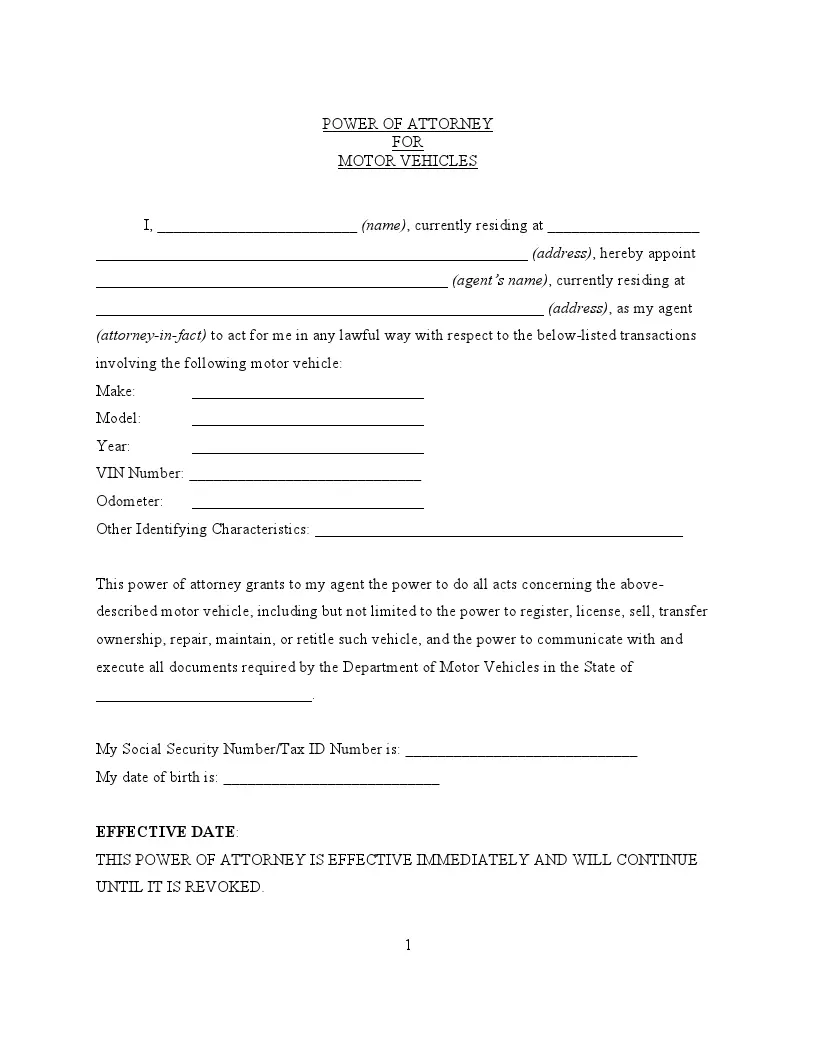
The steps below follow the FormsPal template that this page hands out. This guide is based on a template (PDF) we prepared with the help of a professional attorney. Work through it in order, from page 1 to page 3.
The screenshots under each step show the FormsPal Motor Vehicle Power of Attorney template filled with sample entries in blue, so you can see where each answer goes. The names, addresses, dates and amounts are examples only.
Step 1: Motor Vehicles (You and Your Agent)
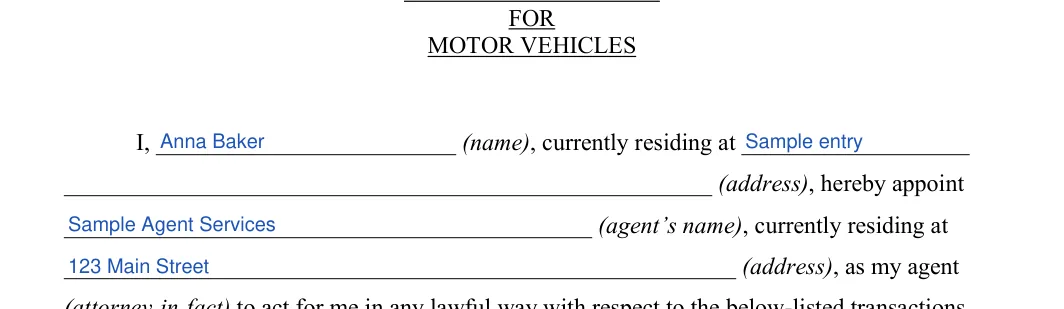
Start with the opening paragraph on page 1. Enter your name and address, then your agent’s name and address, in the blanks of the opening sentence. Your agent is also called your attorney-in-fact.

Step 2: Involving the Following Motor Vehicle
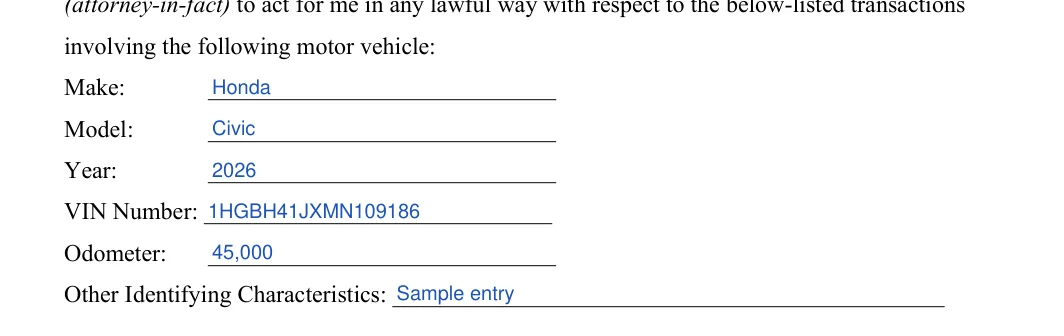
The form has room for one vehicle. Fill in these details for it:
On the “Other Identifying Characteristics” line, add the color and license plate number. Stickers, dents and scratches can also help tell your car apart from others of the same make and model.

Step 3: DMV State, Social Security Number or Tax ID, and Date of Birth
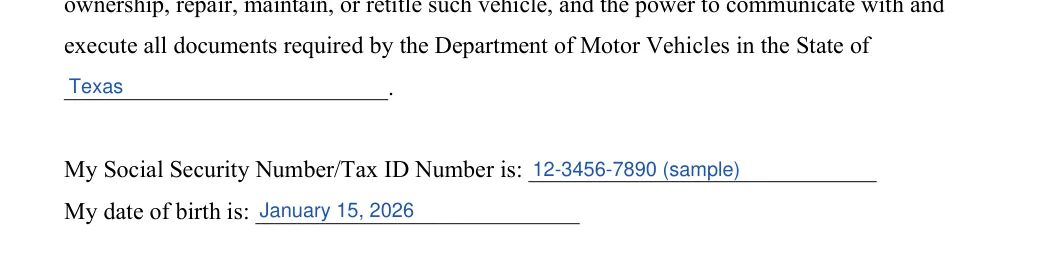
Write the state whose Department of Motor Vehicles your agent will deal with in the powers paragraph. Then fill in your Social Security Number or Tax ID Number and your date of birth. The Effective Date line below is preprinted, so you don’t need to enter anything there.
Unlike other kinds of power of attorney documents, your vehicle power of attorney form will typically also require your birthday and tax identification number. That’s partially to help identify the owner and to distinguish you from others who might share your name inside the state.
Your tax identification number is usually your social security number, though you may have a different tax identification number in some circumstances.

Step 4: Successor Attorney-in-Fact
On page 2, repeat your agent’s name, then enter the alternate agent’s name and address.
You can also choose to add other people to your POA as successor attorneys in fact. these people are authorized as your agent only if your primary agent is unavailable, if you revoke their responsibility, or if they choose not to act.
Having a successor attorney-in-fact can help make your POA more effective, but it isn’t a requirement. You can leave this section blank if you don’t want to designate an individual here.


Step 5: Signed This Day (Date, Signature and Printed Name)
Enter the day, month and year on the “Signed this” line. Then add your signature and your printed name. Do this once every other blank on pages 1 and 2 is filled in.

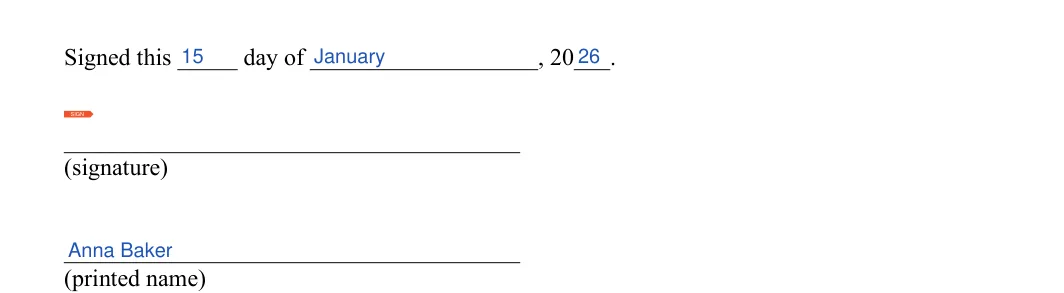
Step 6: Acknowledgment
The last page of the template is the acknowledgment. It has blanks for the state, county, date, the officer’s name and title, and your name as the person who appeared.
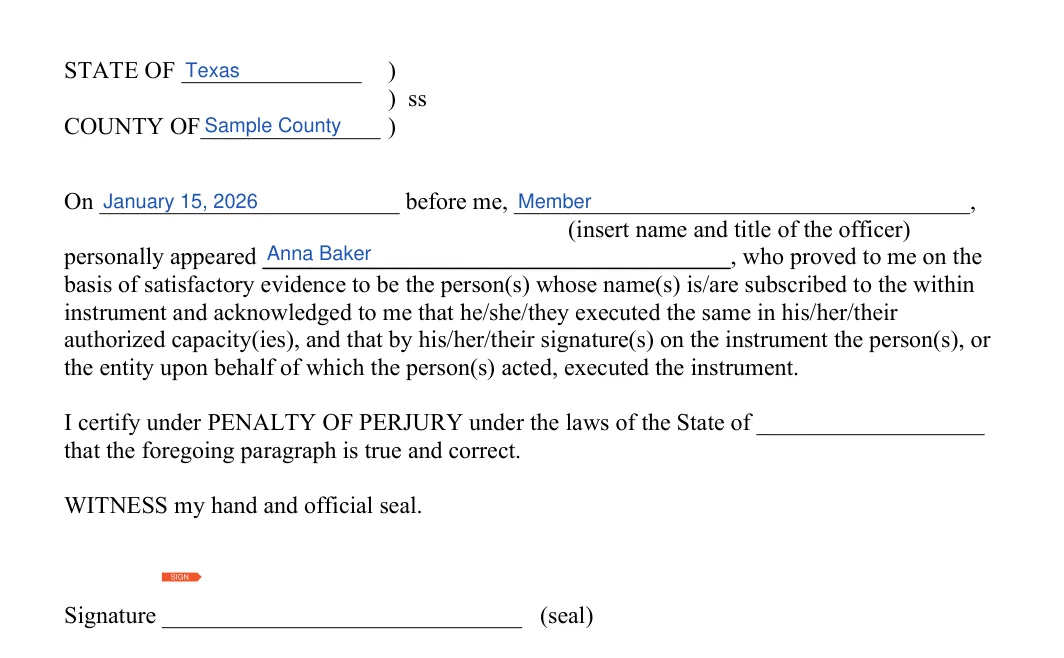
Once every blank on pages 1 and 2 is filled in, you are ready to sign and share the document. Read through the form one more time, then follow these steps to sign it, make the copies and hand it to your agent.
Make your own motor vehicle power of attorney online in a few minutes. Answer a few questions, then save, download and print the finished document. Prefer the blank template? Download the PDF from this page and fill it in with the FormsPal PDF editor.
These are the questions people ask most often about a motor vehicle power of attorney and the free template on this page. Each answer is short, so you can scan the list for the one you need and then go back to the form.
It is a document that lets you name an agent to act for you on a vehicle you own. The agent can handle tasks such as registration, a sale or DMV paperwork. You stay the owner of the vehicle.
Your agent can register the vehicle, buy or sell it for you, sign the related paperwork and deal with the DMV on your behalf. You can also ask your agent to handle maintenance. The details are up to you and your agent.
The FormsPal template asks for these details:
Use the state links near the top of this page to open a state-specific form. The signing table above also lists the name of each state’s own DMV form.
Select Create My Document on this page and answer a few questions. When you are done, download and print the document.
General information, not legal or tax advice.
