
A car bill of sale, or motor vehicle bill of sale, is a written record of a vehicle sale and its price. While this legal document acts as a receipt that confirms and records motor vehicle transactions, it does not provide legal proof of ownership after the transfer. As a result, new owners must obtain a title to demonstrate their ownership of the vehicle. Depending on your state’s DMV regulations, the seller may need to submit a completed bill of sale template before finalizing the title transfer paperwork.
Last Updated: October 2026. This guide is reviewed and updated regularly to reflect current law. If you notice an error or outdated information, please contact us.
Build Your Document
Answer a few simple questions to make your document in minutes
Save and Print
Save progress and finish on any device, download and print anytime
Sign and Use
Your valid, lawyer-approved document is ready
The requirements for a car bill of sale vary across states. Some ask for signatures from both parties involved in the transaction. Conversely, other states require only the seller’s signature to transfer ownership and establish proof of sale.
In 34 of the 49 states FormsPal's verified state data covers, state rules require an odometer disclosure, which is a written statement of the vehicle’s mileage. Regardless of the specific regulations, a bill of sale remains a crucial component in the process of buying or selling a car and its further registration by the buyer.
First, a motor vehicle bill of sale serves as a receipt that validates the transfer of a vehicle from the seller to the buyer. A signed form is worth completing in a private sale of a motor vehicle, as it provides protection in the event of potential disputes or complications. For a state-by-state overview, see this list of bill of sale rules for buying and selling cars.
Second, a bill of sale can absolve the seller from any liability if the vehicle is involved in a road accident. Additionally, for the buyer of a used vehicle, a properly executed form offers proof of title transfer, confirming their legal ownership and full rights to the car.
Should the vehicle violate any traffic laws, the seller can utilize the bill of sale in legal proceedings to demonstrate that they no longer own the vehicle, thereby avoiding criminal liability.
Third, when completed accurately, a bill of sale form can also function as a loan instrument, similar to a promissory note. For example, if a buyer is purchasing a vehicle in installments, the document can be structured as a bill of sale. However, the transfer of title and possession will only occur after all outstanding payments have been made, ensuring a comprehensive transaction process.
As a result, state regulations on car bill of sale requirements help to prevent abuse by either the seller or the buyer.
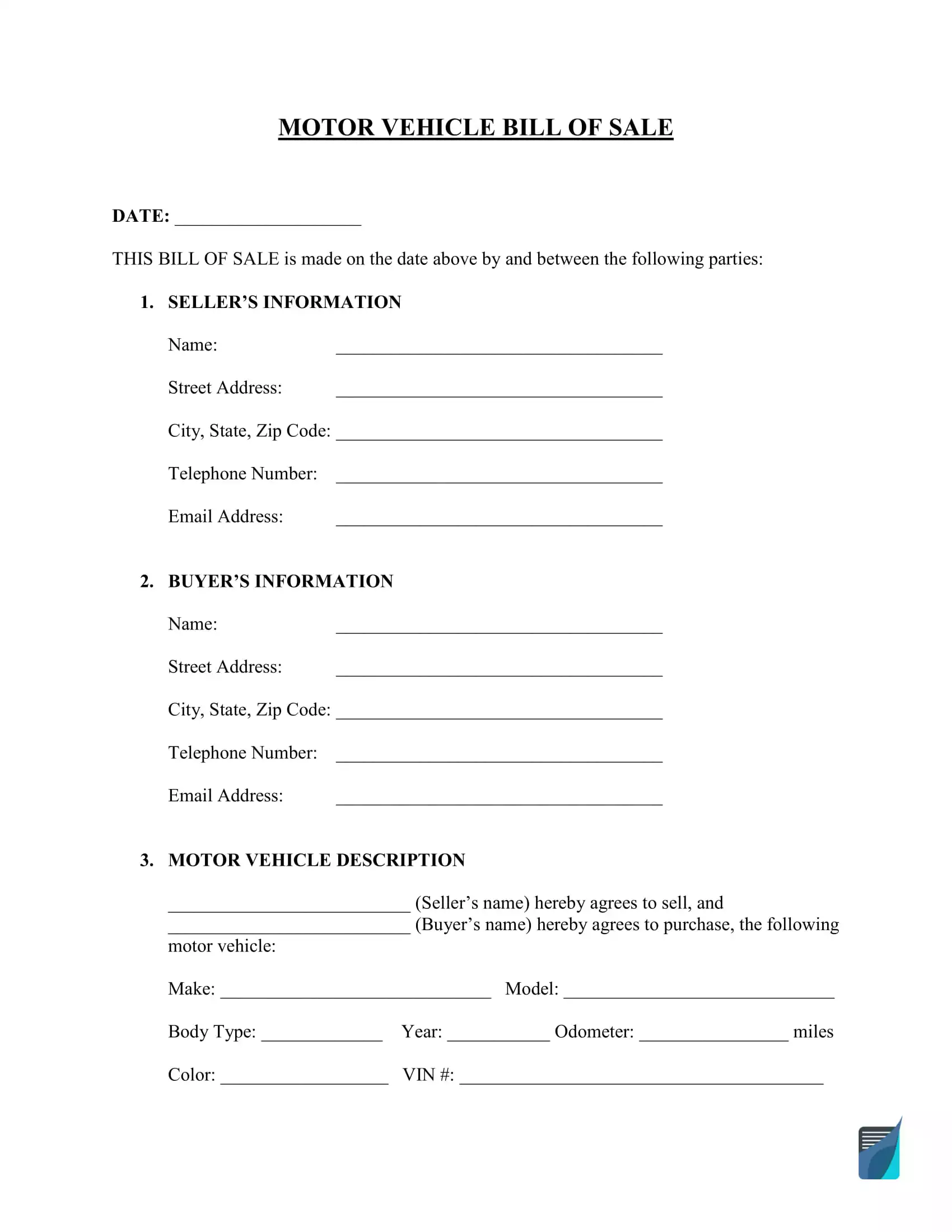
A complete motor vehicle bill of sale records these details:
The following guidelines are designed for the template available on our site, which allows you to create your own bill of sale. However, if a document is available from your local authorities, you can also use that for the transaction.
Write the full date of the sale (month, day and year) at the top of the motor vehicle bill of sale.


Use the full names of the buyer and the seller as they appear on a government ID. Add current contact details for both parties.

Copy the make, model, year and VIN from the vehicle title or the registration card. Then read the odometer reading from the dashboard on the day of the sale and write it in the form.
Include the exact purchase date and agreed-upon amount. Indicate the chosen payment method:
Next, state the payment method:
Finally, indicate whether all applicable sales taxes are included in the final cost. Write the sale price in numbers and in words so nobody can misread the amount.

Confirm that the payment has cleared before you sign over the vehicle. Keep the receipt together with your copy of the motor vehicle bill of sale.
The seller confirms their ownership of the vehicle, their right to sell it, and that there are no liens on it. They also verify that the vehicle information provided is true, accurate, and complete to the best of their knowledge.
In 22 of the 49 states FormsPal's verified state data covers, state rules call for the lienholder to release any lien on the vehicle, so pay off any loan on the car before the sale.
The “as-is” clause states that the seller offers no warranties and is not responsible for maintenance after the transfer.

Though not always required, obtaining the buyer’s signature can offer additional legal protection. Both parties may also choose a witness to attest to the transaction and sign the bill of sale.

While notarization is usually not mandatory, it can provide extra legal security. If you decide to notarize the document, locate a local notary public. Once notarized, the bill of sale offers stronger protection for both the previous and new owner, similar to purchase agreements.
In 11 of the 49 states FormsPal's verified state data covers, state rules call for a notarized bill of sale.

Signing the motor vehicle bill of sale is not the last step of a car sale. The title transfer and the vehicle registration come next, and the bill of sale supports both. Keep it together with the other vehicle paperwork, such as the title, the odometer statement and the payment receipt.
In 28 of the 49 states FormsPal's verified state data covers, state rules require a title transfer when a vehicle is sold.
In 27 of the 49 states FormsPal's verified state data covers, state rules call for a bill of sale in at least some vehicle sales, so the buyer should keep the original.
As a seller, you can either retain a copy or have all parties sign and complete two identical forms. Generally, the new owner should register the vehicle at their local DMV or county office.
It depends on your state. In 9 of the 49 states FormsPal's verified state data covers, state rules say a bill of sale is not required. Even then, a signed motor vehicle bill of sale gives both sides a record of the price, the date and the vehicle, which helps if a dispute comes up later.
In 13 of the 49 states FormsPal's verified state data covers, state rules accept a handwritten bill of sale or one you draft yourself. A ready-made form saves time because it already lists the buyer, the seller, the vehicle, the price and the date.
The deadline depends on the state. Where a state counts its title application deadline in days, the period runs from 15 to 60 days, depending on the state. That range comes from 5 of the 49 states FormsPal's verified state data covers.
Make at least two signed copies, one for the buyer and one for the seller. The buyer keeps the original for the title and registration process, and the seller keeps a copy as a record that the vehicle was sold. Each side should store these papers together:
General information, not legal or tax advice.
